Aug22
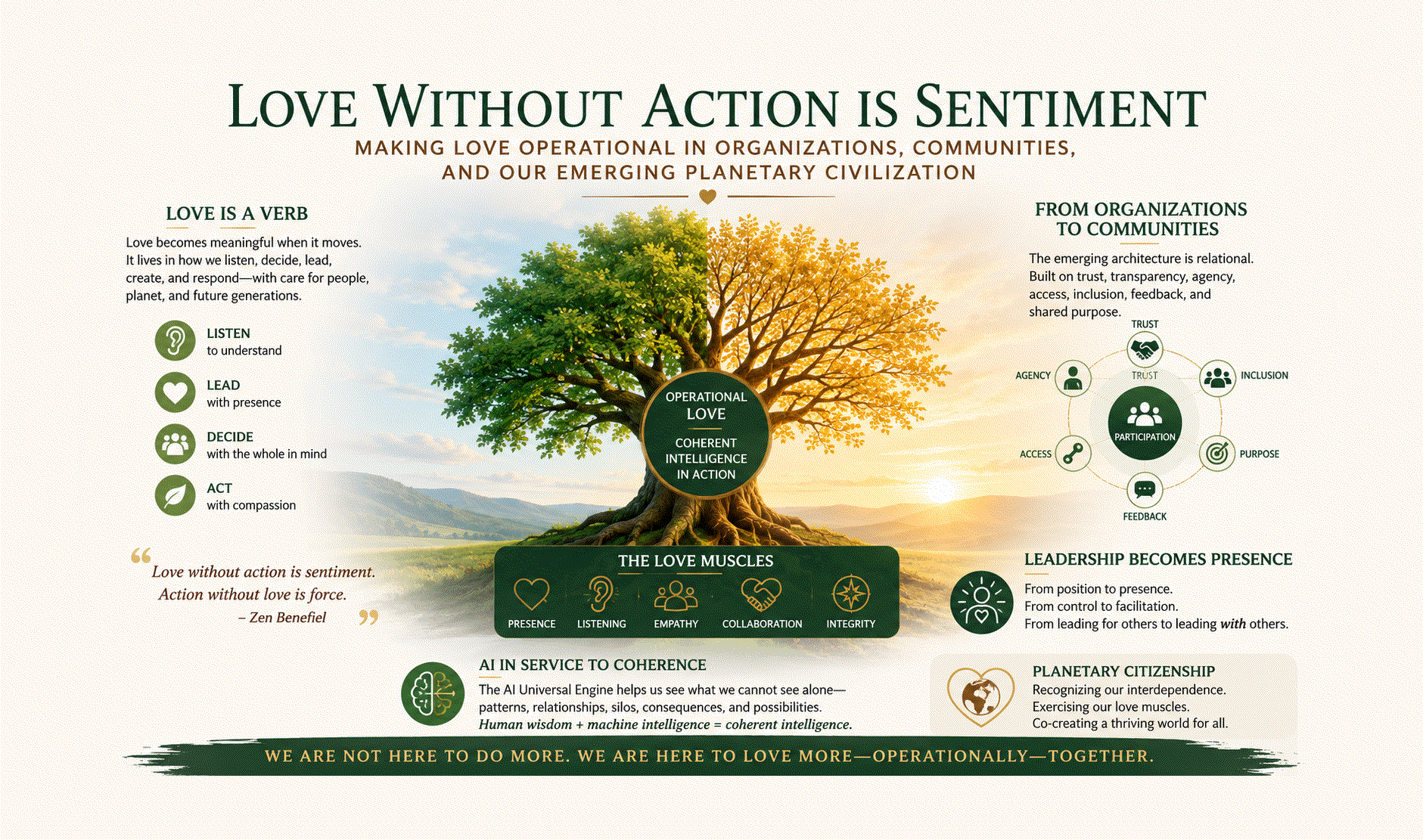
Making Love Operational in Organizations, Communities, and Our Emerging Planetary Civilization
We speak easily about love as an ideal. We sing about it, write about it, pray about it, and perhaps quietly hope there will be more of it in the world.
But what happens when love enters the boardroom?
What happens when it becomes part of how we make decisions, resolve conflict, design organizations, deploy technology, and respond to people whose perspectives challenge our own?
In Planetary Citizens: Awakening the Heart of Humanity, I offered a simple proposition:
“Love without action is sentiment. Action without love is force.”
Between those two extremes lies something we desperately need today: compassionate action.
Love Is a Verb
Love becomes meaningful when it moves.
It moves when we listen to understand rather than listening while preparing our rebuttal. It moves when a leader creates room for another person to contribute instead of needing to have the answer. It moves when an organization considers not only whether a decision is profitable or efficient, but how that decision affects employees, families, communities, ecosystems, and future generations.
None of this requires abandoning performance, accountability, or difficult decisions.
Quite the opposite.
Operational love asks us to expand our field of awareness so that better decisions become possible.
The principles of Planetary Citizenship point toward this expansion: unity in diversity, stewardship, conscious evolution, compassionate action, co-creation, integrity, transparency, and service to the whole. These aren't commandments. I think of them more as a compass for navigating increasing complexity.
Exercising Our Love Muscles
Like any capacity, love becomes stronger through practice.
One of the simplest practices I've found is also one of the hardest: be fully present with another human being.
Can I listen without constructing my response?
Can I encounter disagreement without immediately turning the other person into an opponent?
Can I speak honestly without diminishing another?
Can we seek synthesis rather than victory?
These questions became part of the Synergistic Conversation Model in Planetary Citizens: listen deeply, speak from personal truth rather than ideology, and seek synthesis rather than victory.
Imagine those three practices becoming normal in our workplaces.
Meetings would change.
Leadership would change.
Conflict would change.
Perhaps organizations themselves would begin to change.
From Organizations to Communities
Most organizations were designed primarily to organize work. Communities organize relationship and belonging around shared meaning.
Our next evolutionary opportunity may be learning to do both.
The architecture required isn't only technological or managerial. It is relational. It is built from trust, transparency, agency, accessibility, shared purpose, feedback, and participation. People need to feel seen, valued, and capable of contributing.
That changes the central organizational question.
Instead of asking only:
How do we get people to perform?
We might also ask:
How do we create conditions in which people come alive?
That is not abandoning organizational development. It is allowing organizational development to mature into community development.
The distinction matters because participation cannot simply be mandated. Technology can connect us, but platforms alone don't create participation. Culture does. Sustainable participation grows from belonging, relational trust, emotional intelligence, group coherence, shared purpose, deep listening, and genuine care.
In other words, love needs architecture.
Leadership Becomes Presence
This also changes our understanding of leadership.
The old model emphasizes position. The emerging model emphasizes presence.
Presence doesn't mean passivity. It means developing enough inner coherence to remain available when circumstances become uncomfortable. It means facilitating rather than automatically dictating, empowering people to take ownership, allowing vulnerability without surrendering accountability, and learning to lead with people rather than merely for them.
That may be one of our most important love muscles:
remaining present when it would be easier to retreat into authority, certainty, policy, or control.
Leadership then becomes less about having all the answers and more about creating conditions in which collective intelligence can emerge.
From Competition to Co-Creation
We've inherited a powerful story about competition. Yet complex planetary challenges aren't going to be solved by one person, organization, nation, technology, or worldview.
They require us to become better at weaving.
In Planetary Citizens, I describe co-creation as moving beyond the need to win toward discovering what we can create together. It asks us to listen more deeply, invite diverse voices, loosen our attachment to control, and allow something greater than our individual perspectives to emerge.
This doesn't erase individuality.
A symphony doesn't become beautiful because every instrument plays the same note.
Harmony requires difference.
The art is learning how difference becomes relationship rather than division.
And Then Along Comes AI
Artificial intelligence gives this conversation an intriguing new dimension.
We are building machines capable of processing quantities of information far beyond individual human capacity. Yet greater computational intelligence does not automatically produce greater wisdom.
So perhaps the more interesting question isn't:
How intelligent can AI become?
It is:
How might AI help humans become more coherent together?
This is part of the intention behind the emerging AI Universal Engine: exploring whether artificial intelligence can help us see relationships, patterns, silos, consequences, opportunities, and connections that are difficult for any one person—or even one organization—to perceive.
The goal isn't to outsource our humanity.
It is almost the opposite.
The technology becomes a mirror and a practice field for exercising our love muscles: listening more broadly, seeing systems more completely, discovering unexpected connections, and making decisions with greater awareness of the whole.
Human intelligence and artificial intelligence can then meet in service to coherent intelligence.
The Next Evolutionary Step
Planetary Citizenship begins with recognizing that we are not separate actors competing on an inert planet. We are participants in interconnected living systems.
That realization changes responsibility.
Conscious evolution asks a beautifully uncomfortable question:
How can I evolve in a way that serves the whole?
Maybe humanity's next evolutionary leap won't be measured primarily by smarter machines, larger organizations, faster economies, or more sophisticated technologies.
Perhaps it will be measured by our capacity to care across differences while still getting things done.
To listen without disappearing.
To disagree without dehumanizing.
To lead without dominating.
To create without needing to control.
To use intelligence in service to relationship.
To transform organizations into communities of participation.
And to recognize that our individual gifts become most meaningful when offered in service to something larger than ourselves.
That is love made operational.
And it begins with a wonderfully inconvenient realization:
Love is not something we're waiting for the world to give us.
It's something we're here to practice together.
By Zen Benefiel
Keywords: Culture, Future of Work, Leadership
 The Most Dangerous Leader in the Room May Be the One Everyone Depends On
 What is that Analytical AI?
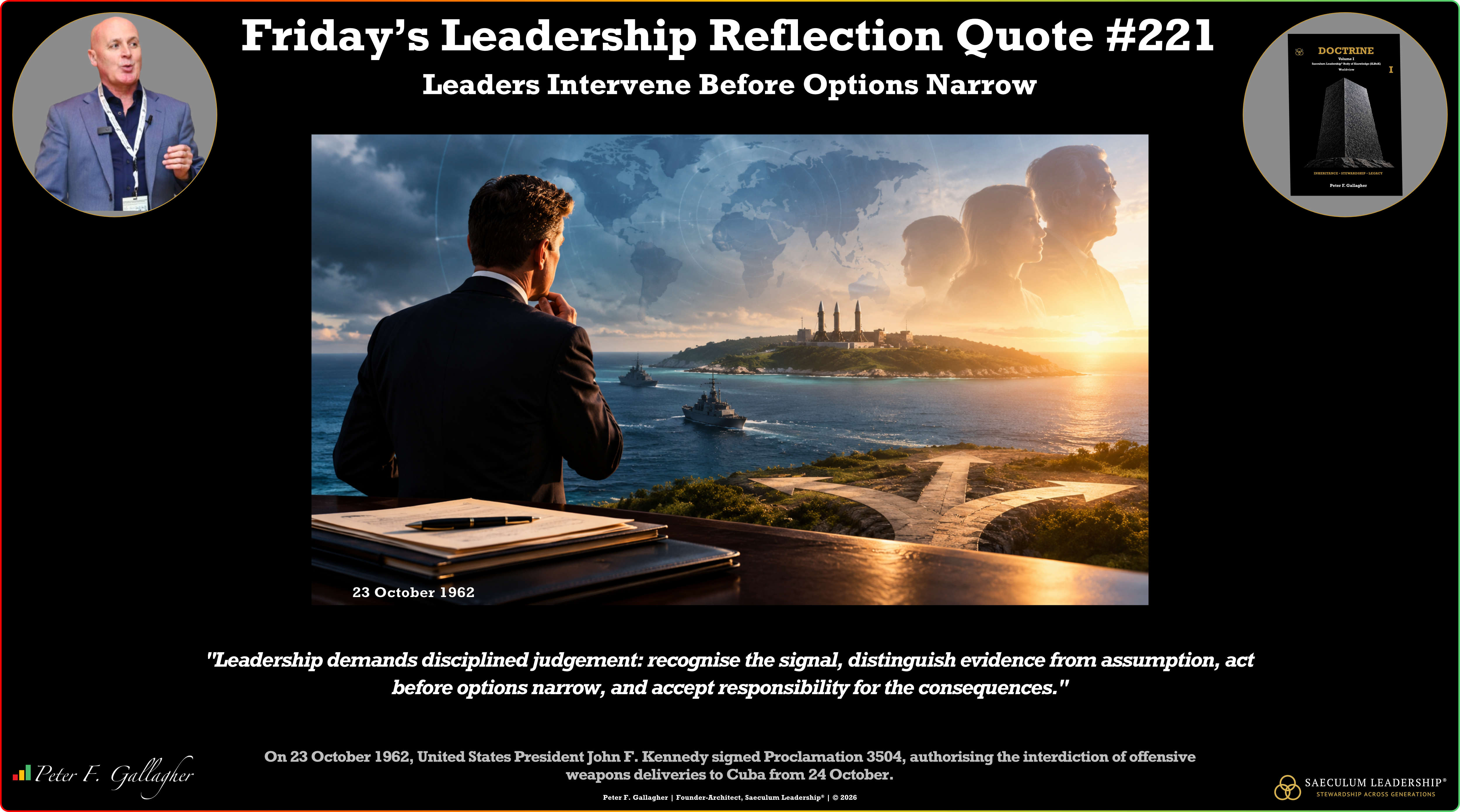 Friday’s Leadership Reflection Quote – Saeculum Leadership Leaders Intervene Before Options Narrow
 The Corix Partners Friday Reading List - October 23, 2026
 RIFLESSIONE SU AI, TECNOLOGIA E PERSONE