Jun29

Hiring internationally is a common practice, but many companies struggle to retain global talent. People often leave before their potential is reached. This is costly and leads to teams breaking up. To meet this challenge requires a look beyond simply finding the right skills. It's about getting ready to support international colleagues as they adjust, relate and thrive at work. It is important to understand culture and practical support.
For many European companies, local skilled workers are in short supply. They bring in people from abroad. This opens new perspectives, but also new challenges. There are costs in recruitment, relocation and onboarding. If a new hire leaves within the first year, these resources are wasted. Job “honeymoons” and the excitement of a new job typically only last three months to one year. The problem with early departures of an employee is often a mismatch of expectations, lack of proper integration or cultural challenges.
To keep new talent and avoid the expense of a revolving door, recruiters and managers need to build stronger bridges between new hires and the company.
Workplace culture issues are often found in everyday stories. Ted Lasso and Emily in Paris are two popular TV series.
Ted Lasso is an American football coach who has been asked to coach a top UK soccer team. He knows next to nothing about the sport or the rich traditions in British football. He’s getting pushback. The local team challenges his authority. The media and the public are sceptical. Ted’s language and approach at work do not resonate with his UK colleagues. Trust is built slowly.
The scenario highlights common workplace problems: misreading local business etiquette, missing subtle signals that shape relationships and not appreciating the differences in media coverage from country to country. If Ted had been given an onboarding guide on UK culture and the unwritten rules of football, he’d be in a better starting place.
Emily in Paris is about an American marketing executive who gets tossed into the Paris scene. She is instantly plunged into culture shock. French is used at work. Longer lunches or direct feedback are not part of the daily routine. Emily is left out of important informal discussions due to her lack of French language skills. She misses nuances, she feels left out. Her American style is judged as loud or brash by local colleagues. Still, her different way of thinking brings fresh ideas to the team.
Both scenario's show what can go wrong without preparation, what it is like to stand out and also the growth possible when different backgrounds meet.
Most employers provide basic onboarding on payroll, systems or legal documents. Few offer any sort of structured cultural onboarding. Often employees are allocated a small budget for relocation and then they have to figure out the rest themselves. There is no standard language training or guidance on common behavioural expectations;
This can create confusion for people, failure or exclusion. For example, small groups of coworkers may switch to their native language to conduct side conversations, leaving new employees out of the loop. This can happen even if the official language of the company is English. “Over time, these moments create separation instead of closeness.
If you are recruiting internationally, consider the following questions:
Cultural Intelligence or CQ helps team members to be successful and to adapt to multicultural settings. CQ’s four core competencies are:
People think they know how things work when they travel or go to a country. In fact, real CQ is developed through deeper, sustained engagement. To develop any real skill it takes a minimum of a year of active learning and practice.
You can create CQ in these ways:
Misunderstandings often result from implicit assumptions and different ways of communicating. Some leaders and team members expect immediate responses to emails they send after hours. Others consider private time sacred. The way feedback is given, whether gently or directly, formally or informally, can also vary widely.
Everyone knows what is expected and there is less confusion.
You may explain:
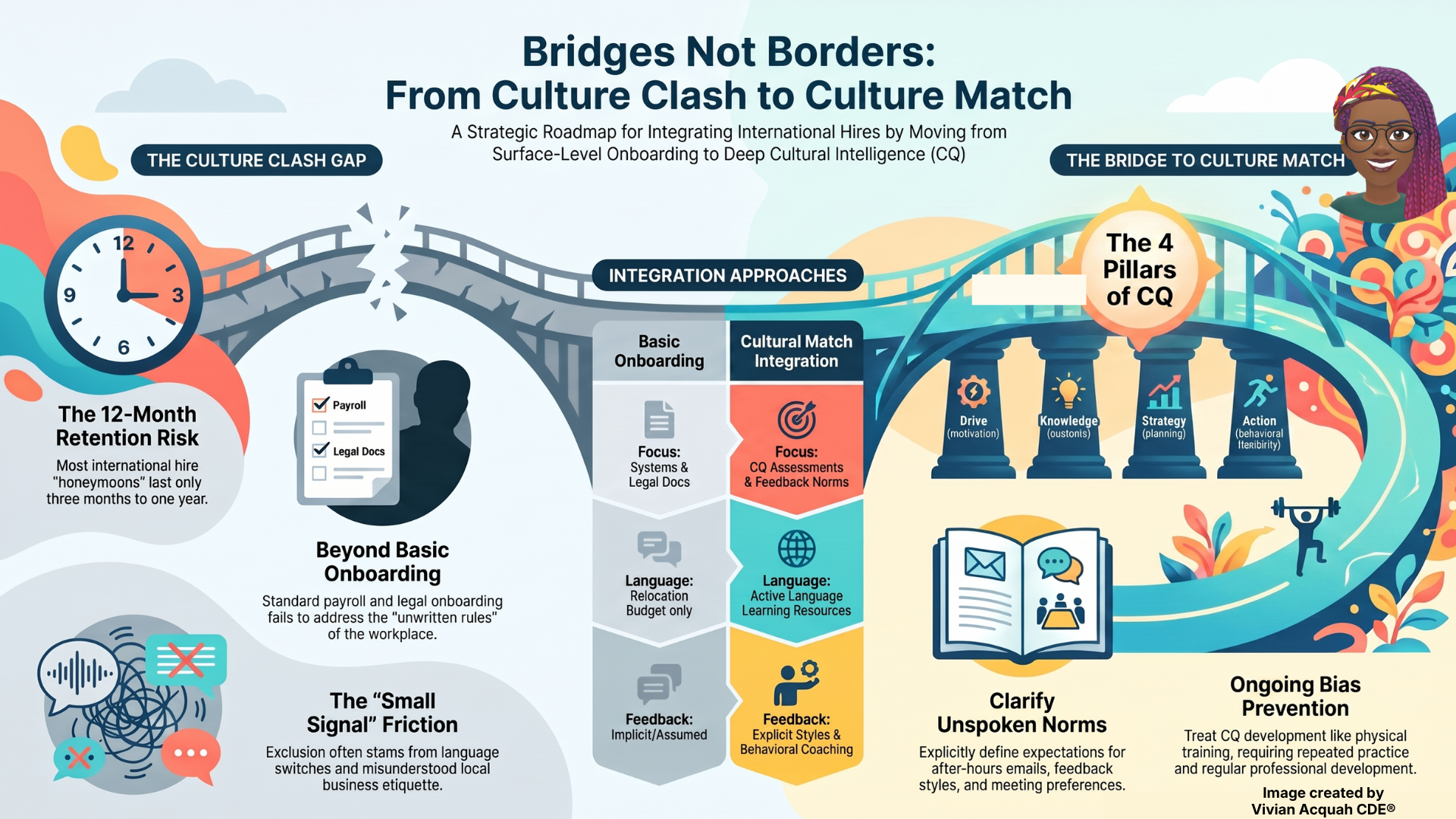
The search for a “culture match” risks being a code for turning your back on the different. Some interviewers like to hire people who are most like them. This results in missed opportunities and can stunt the growth of the team.
To counteract this, use a clear, ongoing approach:
Use the following checklist for practical purposes.
For leaders, teams and employers:
For global hires:
There are strengths and challenges inherent in global teams. Early preparation and honest communication helps retain talent and prevent early exits. Ongoing collaboration is grounded in a structured plan to improve cultural intelligence. Trust is built as employees have ongoing conversations about their feedback and work habits. Training regularly develops new skills over time. Companies that follow these steps have better retention and productivity.
Incorporating cultural onboarding and CQ development into your process on a regular basis sets your team up for greater success. Hold curiosity and respect at the center. Encourage open dialogue. This is how you make culture clashes into culture matches, through consistent action, not just good intentions.
Keywords: Leadership, Culture, Diversity and Inclusion
 You are not your diagnosis
 Is GenAI good for anything?
 “I didn’t write an award acceptance speech because I didn’t expect to win.”
 AI Is Exposing the Data Problems Humans Used to Hide
 "The AI may in fact be conscious." Really?