Feb16
FCRQ185 Leadership Learning!
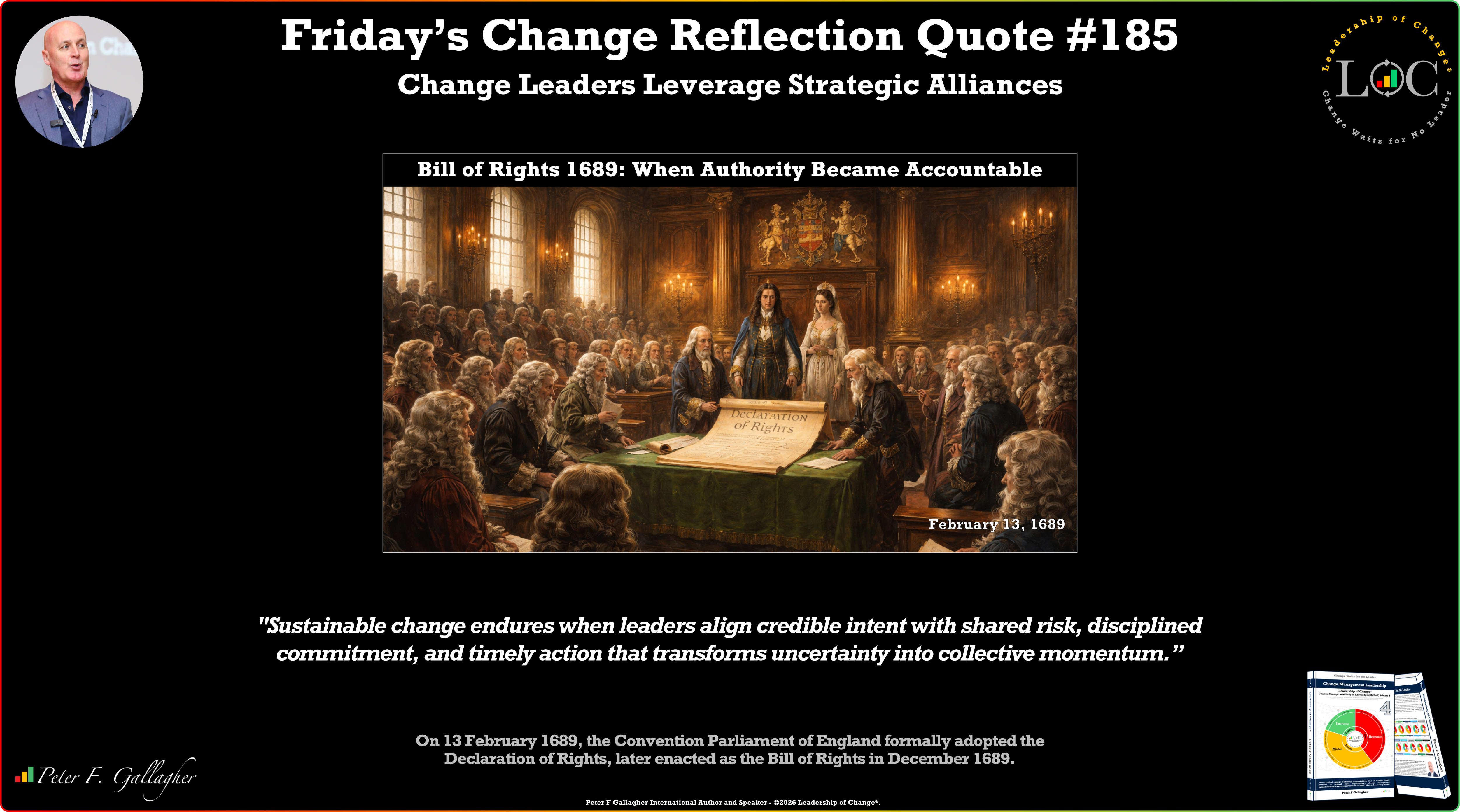
On 13 February 1689, the Convention Parliament of England formally adopted the Declaration of Rights, later enacted as the Bill of Rights in December 1689. This milestone followed the Glorious Revolution of 1688, which saw the Catholic King James II flee England after William of Orange landed with Dutch forces at the invitation of seven English nobles. The Bill of Rights established that Parliament possessed supreme authority over the Crown, prohibited the monarch from suspending laws without parliamentary consent, guaranteed free elections, and ensured regular parliamentary sessions. These provisions fundamentally transformed English governance by constraining royal prerogative and establishing parliamentary sovereignty as the cornerstone of constitutional monarchy. The events leading to this transformative moment reveal the culmination of decades of constitutional struggle between Crown and Parliament. James II's attempts to expand royal power, his promotion of Catholic interests in a predominantly Protestant nation, and his establishment of a standing army without parliamentary approval created widespread alarm among political and religious leaders. When James's second wife gave birth to a son in June 1688, ensuring a Catholic succession, Protestant nobles took decisive action. Their invitation to William of Orange, husband of James's Protestant daughter Mary, precipitated James's abdication and flight to France in December 1688, enabling a largely peaceful transition of power. The Convention Parliament convened in January 1689 faced an unprecedented constitutional question. England had no monarch, yet the traditional understanding held that Parliament existed only through royal summons. This paradox forced parliamentary leaders to articulate fundamental principles about the source and limits of political authority. The Declaration of Rights, presented to William and Mary before their coronation, represented not merely a list of grievances but rather a contractual framework establishing conditions for legitimate rule. By accepting these terms, William and Mary acknowledged that sovereignty ultimately rested with the political nation represented in Parliament rather than deriving from divine right or hereditary succession alone.The Bill's provisions reflected practical responses to recent abuses whilst establishing enduring principles of governance. It prohibited the Crown from levying taxes without parliamentary consent, maintaining a peacetime standing army without parliamentary approval, or interfering with parliamentary debates and elections. It guaranteed subjects the right to petition the monarch, established that parliamentary elections must be free, and required frequent parliamentary sessions. These measures institutionalised the principle that executive authority operates within legal constraints established through representative institutions rather than personal royal discretion. The 1689 settlement created a constitutional framework that influenced democratic development far beyond England's shores. The principles of limited government, separation of powers, and parliamentary sovereignty became foundational concepts for subsequent constitutional democracies. The American Bill of Rights drew directly from these English precedents, whilst constitutional movements across Europe cited the 1689 settlement as evidence that monarchical absolutism could be successfully constrained through law. The transformation achieved on 13 February 1689 demonstrated that profound political change could occur through institutional innovation rather than violent upheaval, establishing patterns of constitutional evolution that continue shaping governance worldwide. The moment represented not merely a redistribution of power between existing institutions but the articulation of new principles defining legitimate authority itself. This constitutional settlement represents a classic Saeculum LeadershipTM moment, where a society redefines the long‑term architecture of authority. The shift from monarchical prerogative to parliamentary sovereignty created a new governing Signal that would guide political behaviour for generations. Understanding this Signal transformation provides a foundation for interpreting the deeper lessons about systemic change that follow.
Application - Change Leadership Responsibility 3 - Intervene to Ensure Sustainable Change: These lessons transcend history and point directly to the responsibility leaders carry to intervene when governance structures fail to meet contemporary needs. Change leaders must identify the precise moments when existing institutional arrangements undermine rather than support organisational effectiveness. Sustainable change requires recognising when current authority models produce consequences that erode legitimacy rather than reinforcing accountability. Within organisations, this manifests when leaders maintain hierarchical decision-making structures despite evidence they prevent necessary adaptation, delaying critical structural intervention. Deferred redesign compounds dysfunction by preserving outdated power relationships beyond their useful lifespan. Effective leadership intervention demands establishing explicit contractual frameworks that replace inherited privilege with earned authority through demonstrated performance. Leaders are accountable for creating binding accountability mechanisms that institutionalise transparency and constrain arbitrary exercise of power, transforming informal understandings into enforceable structural constraints. This requires decisive action to redesign governance architecture whilst building evolutionary frameworks that enable ongoing adaptation across changing circumstances, ensuring transformation endures beyond initial implementation.
Further Reading: Change Management Leadership - Leadership of Change® Volume 4.
For further reading please visit our websites: https://www.a2b.consulting https://www.peterfgallagher.com Amazon.com: Peter F Gallagher: Books, Biography, Blog, Audiobooks, Kindle
Leadership of Change® Body of Knowledge Volumes: Change Management Body of Knowledge (CMBoK) Books: Volumes 1, 2, 3, 4, 5, 6, 7, 8, 9, 10, A, B, C, D & E available on both Amazon and Google Play:
~ Leadership of Change® Volume 1 - Change Management Fables
~ Leadership of Change® Volume 2 - Change Management Pocket Guide
~ Leadership of Change® Volume 3 - Change Management Handbook
~ Leadership of Change® Volume 4 - Change Management Leadership
~ Leadership of Change® Volume 5 - Change Management Adoption
~ Leadership of Change® Volume 6 - Change Management Behaviour
~ Leadership of Change® Volume 7 - Change Management Sponsorship
~ Leadership of Change® Volume 8 - Change Management Charade
~ Leadership of Change® Volume 9 - Change Management Insanity
~ Leadership of Change® Volume 10 - Change Management Dilenttante
~ Leadership of Change® Volume A - Change Management Gamification - Leadership
~ Leadership of Change® Volume B - Change Management Gamification - Adoption
Keywords: Business Strategy, Change Management, Leadership
 Consumer vs. enterprise AI agents
 Best Supply Chain AI Tools in 2026: SCM SENSEI AI and Ask Lora Compared
 Making Silos Permeable
 The Corix Partners Friday Reading List - October 2, 2026
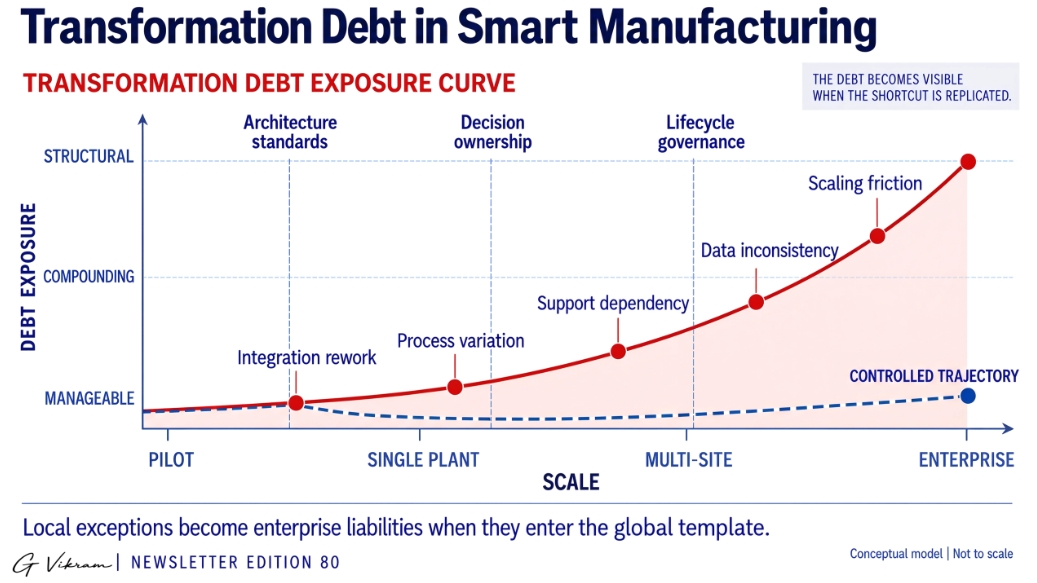 The most dangerous debt in a smart factory isn’t financial.