
Apr17
FCRQ194 Leadership Learning!
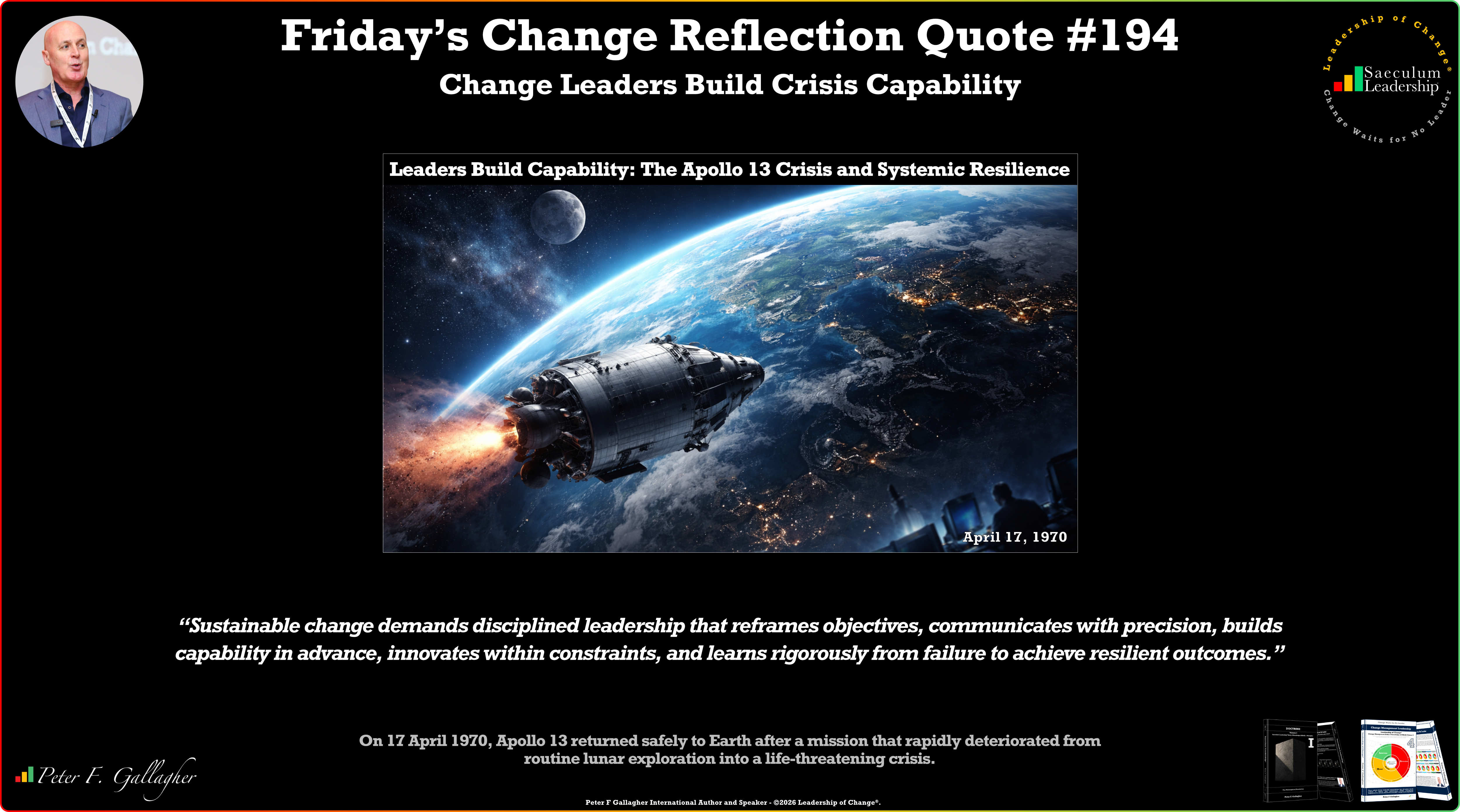
On 17 April 1970, Apollo 13 returned safely to Earth after a mission that rapidly deteriorated from routine lunar exploration into a life-threatening crisis. What began as the third crewed mission intended to land on the Moon was abruptly transformed when an oxygen tank exploded two days after launch, crippling the spacecraft and eliminating the possibility of completing its primary objective. The incident required an immediate redefinition of purpose, shifting from exploration to survival. The crew, along with mission control in Houston, were confronted with severe constraints. Electrical power was critically limited, oxygen supplies were compromised, and carbon dioxide levels began to rise to dangerous levels, forcing the crew to rely on the LM Aquarius as a lifeboat far beyond its intended capacity. The spacecraft’s systems, designed for a different operational profile, were reconfigured in real time to support a circumlunar free‑return trajectory and enable a safe return to Earth. This required not only technical precision but coordinated execution across multiple teams operating under intense pressure. The response followed a methodical approach to problem solving. Engineers on the ground rapidly designed improvised solutions using only materials available onboard, most notably the adaptation required to stabilise carbon dioxide levels. Every action was calculated, tested, and communicated with clarity. There was no margin for error, yet decision making remained structured rather than reactive. The safe return of Apollo 13 did not represent mission success in its original sense, but it demonstrated an alternative form of success. It revealed the depth of capability embedded within the system, from engineering design to operational discipline. It also exposed vulnerabilities, particularly the reliance on assumptions about system resilience and the limits of contingency planning. The historical significance of Apollo 13 lies in how failure was stabilised and redirected into recovery. It stands as a defining example of how complex systems behave under stress and how outcomes are shaped not by the absence of failure, but by the quality of response when failure occurs. In broader terms, this event underscores the importance of preparedness, adaptability, and collective expertise in high stakes environments. It illustrates that success is not defined solely by the original objective, but by the ability to navigate disruption with discipline and coherence. The legacy of Apollo 13 continues to inform how organisations think about risk, resilience, and operational integrity in the face of uncertainty. Apollo 13 stands as a Signal in the Saeculum Leadership® sense: a moment where assumptions collapse and system truth becomes visible. It demonstrates that resilience is not the absence of failure, but the disciplined capability to stabilise, reframe, and recover under extreme constraint.
Change Leadership Lessons: The Apollo 13 crisis response stands as a defining example of what effective leadership under pressure requires. Leaders of change must redefine objectives decisively when conditions shift to maintain alignment and ensure coherent action under pressure. They communicate with precision and consistency to enable coordinated execution and eliminate ambiguity in critical moments. Change leaders build capability before disruption occurs, ensuring teams can respond with discipline rather than emotion when challenged. They enable innovation within constraints, turning limitations into practical solutions that sustain progress under difficult conditions. Leaders of change learn rigorously from failure to strengthen systems, challenge assumptions, and reinforce long-term resilience. Change Leaders Build Crisis Capability.
“Sustainable change demands disciplined leadership that reframes objectives, communicates with precision, builds capability in advance, innovates within constraints, and learns rigorously from failure to achieve resilient outcomes.”
Application - Change Leadership Responsibility 3 - Intervene to Ensure Sustainable Change: These lessons extend beyond a spacecraft and define the leadership responsibility to intervene before disruption escalates into irreversible system failure. Change leaders must recognise the critical inflection points where assumptions persist despite emerging evidence, and where inaction allows risk to compound. Sustainable change requires the discipline to pause, reassess, and redirect action when conditions no longer align with original plans or expectations. Within organisations, this becomes evident when leaders continue to operate against outdated assumptions, despite clear signals that conditions have fundamentally shifted. The Apollo 13 response demonstrated that survival depended not on maintaining the original mission, but on decisively redefining it. Failure to intervene at that moment would have resulted in catastrophic consequences. Unchecked momentum can disconnect leadership from operational reality, particularly when prior success creates false confidence in system resilience. When leaders fail to challenge underlying assumptions, risk accumulates silently until it manifests as crisis. Intervention requires more than authority. It demands structured awareness, technical understanding, and the willingness to act decisively under pressure. Effective intervention is grounded in disciplined decision making, verified information, and collective accountability. It requires leaders to create conditions where concerns are surfaced early, solutions are tested rigorously, and actions are aligned to the current reality rather than past intent. Leaders of change must intervene to ensure that no pressure, whether operational or cultural, overrides clear thinking, validated data, and coordinated execution required to sustain outcomes. Leaders of change must pre‑build crisis capability, not assemble it under pressure.
Final Thoughts: Apollo 13 demonstrates that disciplined intervention under extreme constraint defines the difference between systemic failure and controlled recovery. As organisations become increasingly dependent on AI and complex technologies, the ability to recalibrate rapidly, align expertise, and act with precision will determine leadership effectiveness. Change leaders must visibly model this discipline to ensure clarity, coordination, and informed judgement prevail in moments of uncertainty.
Further Reading: Change Management Leadership® - Leadership of Change® Volume 4 and Saeculum Leadership®: Doctrine – Volume I.
For further insights please visit our websites: https://www.a2b.consulting https://www.peterfgallagher.com Amazon.com: Peter F Gallagher: Books, Biography, Blog, Audiobooks, Kindle
Leadership of Change® Body of Knowledge Volumes: Change Management Body of Knowledge (CMBoK) Books: Volumes 1-10.A-E & I-5
~ Leadership of Change® Volume 1 - Change Management Fables
~ Leadership of Change® Volume 2 - Change Management Pocket Guide
~ Leadership of Change® Volume 3 - Change Management Handbook
~ Leadership of Change® Volume 4 - Change Management Leadership
~ Leadership of Change® Volume 5 - Change Management Adoption
~ Leadership of Change® Volume 6 - Change Management Behaviour
~ Leadership of Change® Volume 7 - Change Management Sponsorship
~ Leadership of Change® Volume 8 - Change Management Charade
~ Leadership of Change® Volume 9 - Change Management Insanity
~ Leadership of Change® Volume 10 - Change Management Dilenttante
~ Leadership of Change® Volume A - Change Management Gamification - Leadership
~ Leadership of Change® Volume B - Change Management Gamification - Adoption
Keywords: Business Strategy, Change Management, Leadership
 Two Clocks, One Truck: The Army's Need for Speed Meets New Defense Sourcing Rules
 Sustainable Transformation: The Elephant and The Mouse In The Room
 The Price of Standing Alone: Strategic Autonomy in a World Where Nobody Can Do It Alone
 The Potter’s Hands: Why Great Leaders Shape Environments, Not People
 The Corix Partners Friday Reading List - October 16, 2026