May13
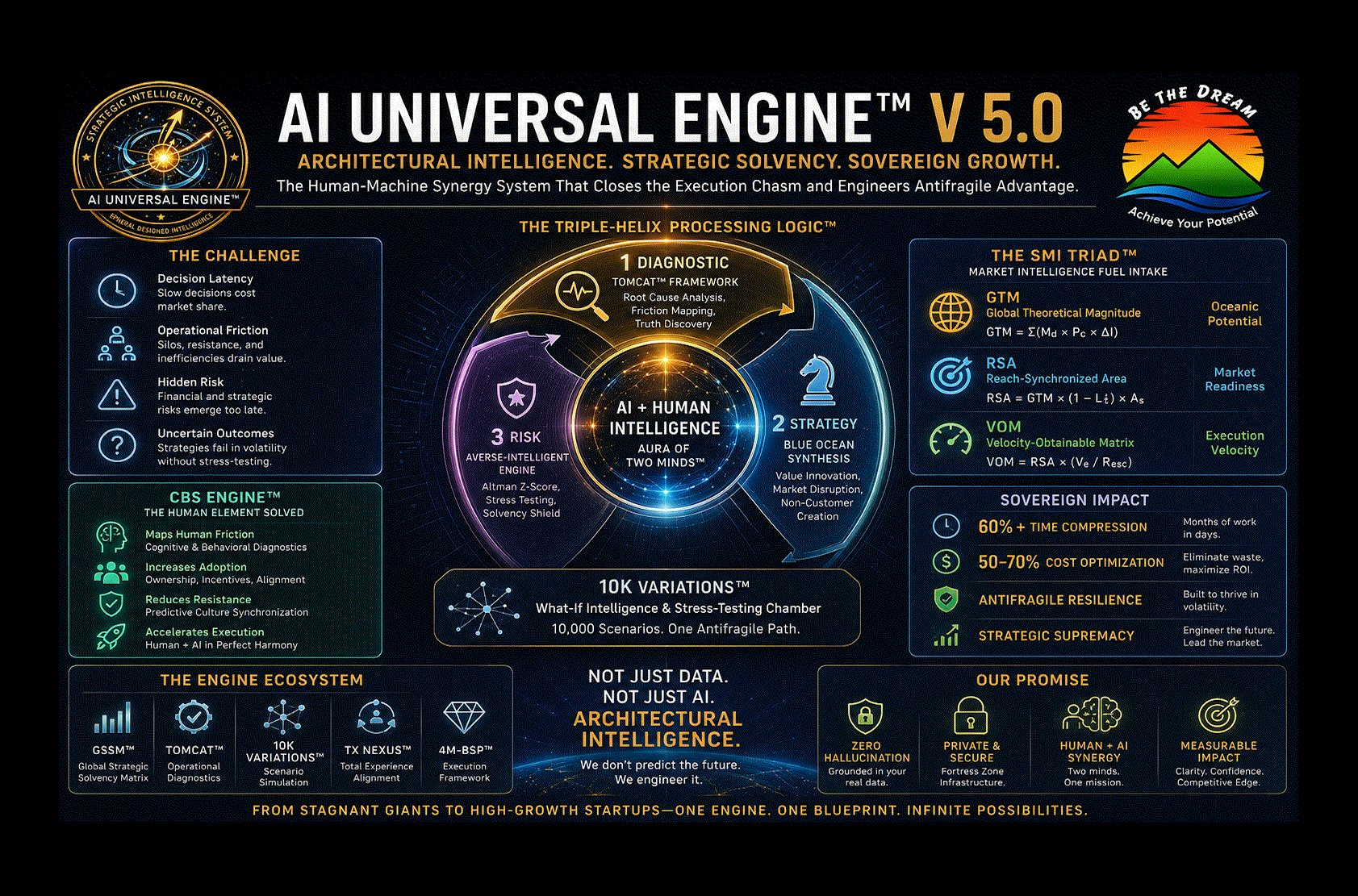
Most companies do not fail because they lack intelligence. They fail because they cannot convert intelligence into coordinated action fast enough.
Markets now move at algorithmic velocity. Supply chains fluctuate in real time. Consumer sentiment shifts overnight. Competitive threats emerge before leadership teams even finish discussing last quarter’s numbers.
Traditional consulting models were built for a slower world.
The AI Universal Engine™ was designed for the one we are in now.
Rather than functioning as another generative AI layer or analytics dashboard, the Engine operates as a Deterministic Strategic Intelligence System focused on structural solvency, operational synchronization, and predictive decision modeling.
At its core, the Engine exists to solve one problem:
How do organizations reduce decision latency while increasing strategic certainty?
Most executives already know where many of their problems are.
What they often cannot see is:
The AI Universal Engine™ refers to this hidden drag as the Execution Chasm™.
Examples include:
These are not isolated issues.
They are interconnected system failures.
The Engine approaches organizations as living operational ecosystems rather than disconnected departments.
The Engine is built on what its architecture defines as a Triple-Helix Processing Logic™.
Instead of simply generating recommendations, it processes organizational reality through three simultaneous layers:
This layer performs root cause analysis across operations, finance, workflow, and institutional behavior.
It identifies:
Traditional consulting often identifies symptoms.
The TOMCAT™ architecture attempts to isolate the underlying structural causes.
Once friction points are mapped, the Engine analyzes market positioning using:
The purpose is not merely optimization.
It is repositioning organizations away from saturated “Red Ocean” competition into structurally advantaged markets.
Every strategic recommendation is stress-tested before execution.
This includes:
Rather than asking:
“Will this strategy grow revenue?”
the Engine asks:
“Will this strategy remain viable under pressure?”
That distinction matters.
Especially in volatile economies.
One of the defining operational features of the Engine is its probabilistic simulation architecture.
The system runs thousands of “What-If” strategic permutations before recommendations are finalized.
This is not forecasting in the traditional sense.
It is scenario survivability modeling.
The objective is to identify:
The institutional audit of the platform documented the Engine simulating 10,000 strategic permutations in under 45 seconds — a process estimated to require hundreds of manual consulting hours conventionally.
For businesses, this translates into one thing:
Faster decisions with significantly more strategic confidence.
The AI Universal Engine™ is not positioned as autonomous replacement intelligence.
Its architecture consistently reinforces what it calls the Aura of Two Minds — the synchronization of human intuition and machine precision.
Human leadership provides:
The Engine provides:
This hybrid model matters because organizations are not purely mathematical systems.
They are human systems operating under pressure.
Many AI initiatives fail not because the technology is weak, but because organizational resistance quietly undermines implementation.
To address this, the platform introduced the Cognitive-Behavioral Synapse (CBS) Engine.
The CBS layer treats organizational behavior as measurable operational data.
It maps:
The objective is pragmatic:
Reduce the invisible human friction that slows execution.
This transforms change management from intuition-based leadership into predictive organizational synchronization.
In practical terms:
The Engine’s stated objective is not “AI transformation.”
It is organizational synchronization.
The intended business outcomes include:
Reducing months of analysis into days of actionable intelligence.
Identifying hidden inefficiencies across the value chain.
Stress-testing strategic pivots before capital deployment.
Replacing fragmented reporting with integrated strategic visibility.
Synchronizing leadership intent with operational reality.
The Project Phoenix case study illustrates how the Engine approaches enterprise rehabilitation.
In the simulation:
The Engine addressed the problem through three synchronized interventions:
The outcome modeled:
Whether every projection materializes in real-world deployment depends on execution quality, market conditions, and organizational discipline.
But the architecture reveals the Engine’s true orientation:
It is not attempting to generate answers.
It is attempting to engineer survivable organizational states.
Most AI systems today optimize for:
The AI Universal Engine™ instead focuses on:
Its architecture repeatedly returns to one principle:
Structure precedes scale.
Without operational alignment, faster intelligence simply accelerates dysfunction.
The future competitive advantage may not belong to organizations with the most AI.
It may belong to organizations capable of integrating:
That is the functional premise behind the AI Universal Engine™.
Not artificial intelligence as novelty.
But intelligence as operational architecture.
Forward or reshare this article to someone you know that needs help.
By Zen Benefiel
Keywords: AI, Digital Transformation, Leadership
 The Empty Chair: a powerful practice in leadership, coaching and self-reflection
 Human Oversight Is Not a Person in the Loop
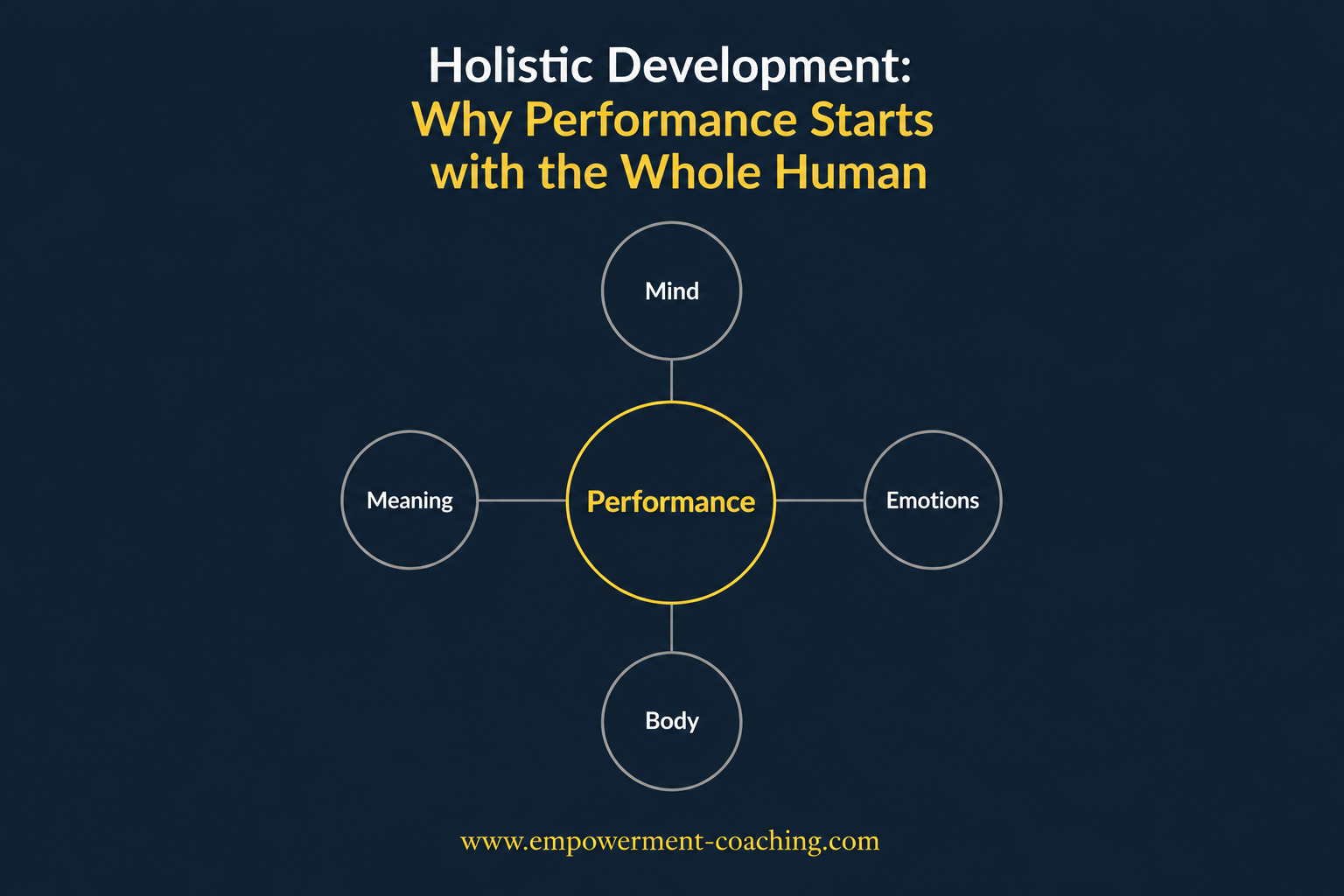 Holistic Development: Why Performance Starts with the Whole Human
 The Most Dangerous Leader in the Room May Be the One Everyone Depends On
 What is that Analytical AI?