Apr09

Succession planning has become one of those phrases that sounds responsible, strategic, and forward-thinking. Most companies will tell you they’re “working on it.” Some even have org charts with names in boxes that suggest a plan exists.
But in reality, many organizations aren’t ready for succession planning at all.
And that’s not a criticism—it’s a diagnosis.
Because succession planning only works when the organization has the foundation to support it. Without that foundation, what companies call a “plan” is usually just a collection of assumptions, wishful thinking, and untested “future leaders.”
Here are five signs your company isn’t ready—yet.
Ask a leadership team to identify their “key roles,” and you’ll often get a vague or overly inclusive list.
“Everyone is important.”
That may be true culturally, but it’s not helpful operationally.
Succession planning starts with clarity about which roles would create real disruption if they were suddenly vacant. Not just inconvenient—but damaging to revenue, operations, customer relationships, or strategic momentum.
If you haven’t defined those roles—and aligned as a leadership team on them—you’re not ready to build a succession plan. You’re still in the discovery phase.
Every company has a few names that come up quickly when succession is mentioned.
“Jim could probably step in.”
“Sarah’s been here forever.”
“Mike is a high performer.”
None of those statements answer the only question that matters: Are they ready to lead at the next level?
In privately held companies especially, internal candidates often have deep experience in one function but limited exposure to the broader business. They’ve never owned enterprise-wide decisions. They haven’t navigated external pressure, financial trade-offs, or cross-functional complexity.
That’s not a people problem. It’s an exposure problem.
If key leaders walked out tomorrow, how much of your company would go with them?
In many organizations, the answer is: more than anyone is comfortable admitting.
Critical processes, customer relationships, decision-making frameworks, and operational “know-how” often live inside people’s heads. Over time, those individuals become indispensable—not because of their role, but because of what only they know.
This is a significant risk.
Succession planning requires that knowledge be transferred, documented, and shared. Intentionally and rigorously.
Without this, every one of your current leaders is a potential point of failure.
Most leadership development happens by accident.
Someone gets promoted. Maybe they’re sent to training. Maybe they get a coach. Generally, they are left to figure it out on their own.
That’s risk, risk, RISK.
Strong succession systems are built on intentional experiences, not just training programs. Future leaders need exposure to parts of the business they don’t currently understand. They need ownership of decisions before they hold the title. They need to lead through ambiguity, not just execute within structure.
The most effective organizations use stretch assignments, cross-functional projects, and lateral moves to build both breadth and depth.
If your approach to development is reactive—or limited to generic programs and topics —you’re not preparing leaders for succession. You’re hoping they grow into it.
“They’ll grow into it” is not a strategy.
One of the most overlooked barriers to succession planning is a lack of clarity about the future.
What kind of company are you building over the next five years?
What will be different about your market, your customers, your strategy?
Because the leaders you need for the next phase may not look like the leaders who got you here.
Too often, companies try to identify successors based on current roles instead of future requirements. They look for “the next version” of the current leader, rather than asking what capabilities will matter going forward.
Without alignment on the future, succession planning becomes an exercise in replacing leaders instead of an evolution of the business.
And that’s how organizations lose their footing (fast).
So what does readiness actually look like?
It doesn’t mean you have everything figured out.
It means you’ve done the foundational work:
Only then does succession planning become what it’s supposed to be:
A sustainable growth strategy—and a risk management imperative.
Keywords: Leadership, HR, Entrepreneurship
 AI Is Exposing the Data Problems Humans Used to Hide
 "The AI may in fact be conscious." Really?
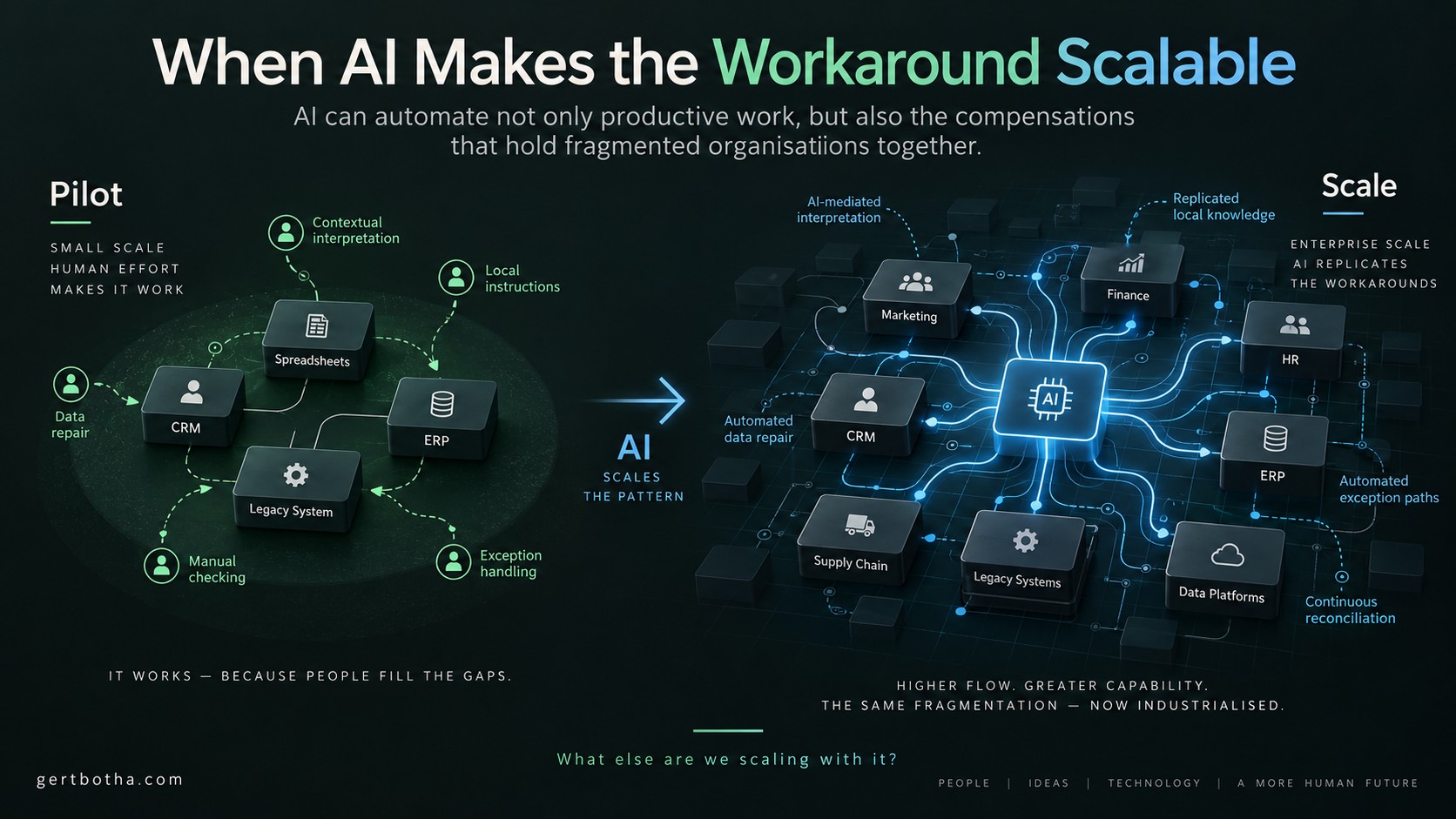 When AI Makes the Workaround Scalable
 The Age of Continuous Shocks: Why the coming downturn will be decided in your supply chain
 Friday’s Leader Reflection Quote – Saeculum Leadership Leaders Accept Decisions Create Responsibilities