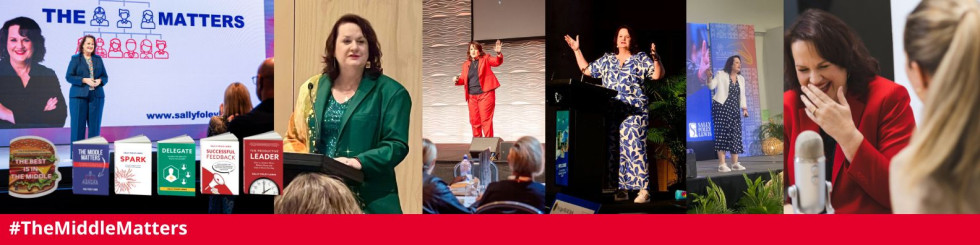

I solve the gap between your people being promoted into middle management and them actually knowing how to lead effectively from the middle - up, across and down.
Available For: Advising, Authoring, Consulting, Speaking
Travels From: Brisbane
Speaking Topics: The 5 Key Ingredients (& Secret Sauce) of High Performing Middle Managers; Lift Them To Lead - The future of middle managers; Leadership Skills for Mi
| Sally Foley-Lewis | Points |
|---|---|
| Academic | 0 |
| Author | 448 |
| Influencer | 133 |
| Speaker | 14 |
| Entrepreneur | 20 |
| Total | 615 |
Points based upon Thinkers360 patent-pending algorithm.

 Have you ever lost it?
Tags: Coaching, Leadership, Management
 Cadence over chaos: how rhythms build trust and speed
Tags: Coaching, Leadership, Management
 Boundaries and expectations set early protect time and focus
Tags: Coaching, Leadership, Management
 Strategy translated into team-sized goals turns ambiguity into action
Tags: Coaching, Leadership, Management
Tags: Coaching, Leadership, Management
 Rhythm, Rituals and Routines: How Teams Stay Together When It Gets Hot
Tags: Coaching, Leadership, Management
 Succession-ready teams make the manager promotable
Tags: Coaching, Leadership, Management
Say it, do it, earn it: the fast way leaders build trust
Tags: Coaching, Leadership, Management
 From Squeeze to Sync: Align the Top, Unleash the Middle
Tags: Coaching, Leadership, Management
 Culture and candour: why direct turns damaging when insight is missing
Tags: Coaching, Leadership, Management
Order by ingredients, not by hunger: why values must drive trade-offs
Tags: Coaching, Leadership, Management
 Surviving the Hardcore Culture Shift Without Burning Out
Tags: Coaching, Leadership, Management
Tags: Coaching, Leadership, Management
 Hybrid Teams Are Here to Stay. Is Your Culture Keeping Up?
Tags: Coaching, Leadership, Management
 Global Recognition Awards
Tags: Coaching, Leadership, Management
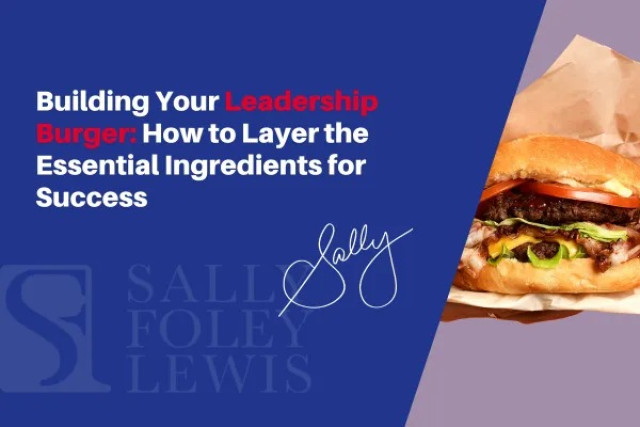 Building Your Leadership Burger: How to Layer the Essential Ingredients for Success
Tags: Coaching, Leadership, Management
 Career Plateaus: Recognising When You're Stuck and How to Break Through
Tags: Coaching, Leadership, Management
 What if your leadership style doesn't have to fit in a box?
Tags: Coaching, Leadership, Management
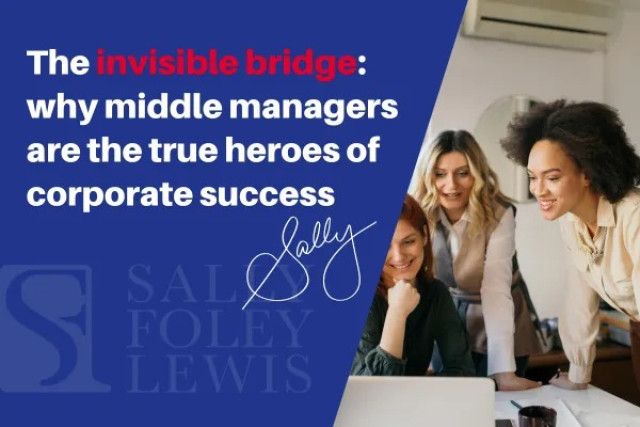 The invisible bridge: why middle managers are the true heroes of corporate success
Tags: Coaching, Leadership, Management
 Are Gen Z Leaders the Key to Transforming Middle Management?
Tags: Coaching, Leadership, Management
 Why Skills Management Should Be Every Leader’s Priority
Tags: Coaching, Leadership, Management
 5 Training Tips to Empower Your Managers Today!
Tags: Coaching, Leadership, Management
 Do You Think Middle Managers Should Be Erased?
Tags: Coaching, Leadership, Management
 Are Gen Z Leaders the Key to Transforming Middle Management?
Tags: Coaching, Leadership, Management
 2025 is Approaching: Are You Ready to Lead Confidently?
Tags: Coaching, Leadership, Management
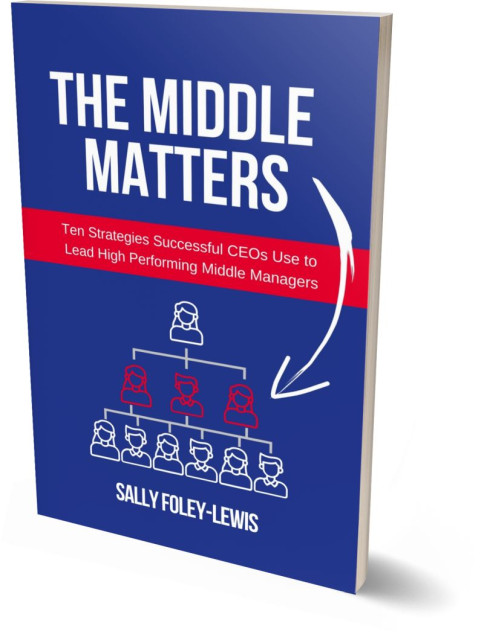 The Middle Matters
Tags: Management, Leadership, Coaching
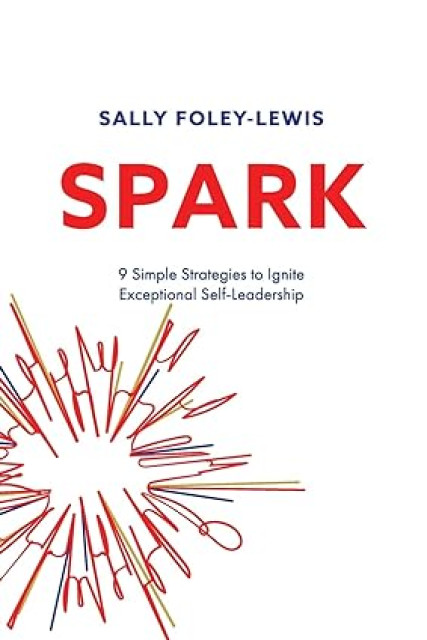 Spark: 9 Simple Strategies to Ignite Exceptional Self-Leadership
Tags: Management, Leadership, Coaching
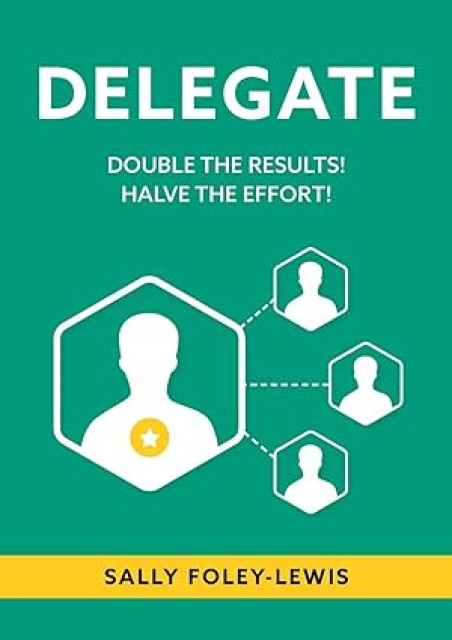 Delegate: Double the Results! Halve the Effort!
Tags: Management, Leadership, Coaching
 Successful Feedback: How Leaders Can Increase Performance, Motivate and Engage Their Team
Tags: Management, Leadership, Coaching
 The Productive Leader: How to Achieve More, Reduce Stress and Gain 2 Hours Per Day
Tags: Management, Leadership, Coaching
 Sally Foley-Lewis CSP FILP MBA
Tags: Management, Leadership
 Certified Speaking Professional
Tags: Management
 Rule 2025: EmpowerME Masterclass
Tags: Careers, Leadership, Management
Tags: Future of Work, Leadership, Management
Tags: Coaching, Leadership, Management
 Mirror the Mission: Build a Team Scoreboard that Drives Strategy
Growing up I've always played team sports, more for the collaboration and camaraderie than the competition against the opposing team ... of course, winning is always nice ;-)
I'm actually very self-competitive, meaning, I want to be a better me today than I was yesterday. I'm less focused on competing with or against others. I am not a good fit for a highly competitive, win at all costs, incentivised sales team. Where do you see yourself on a scale of competitiveness?
How do you know your team or you have won, or even are simply better today than yesterday? The answer is simply: metrics and scoreboards.
Here’s how a scoreboard changes behaviour: in 1998 McDonald’s rebuilt its kitchen around “Made For You”, a just-in-time system that assembles burgers after you order. That pivot did not just add a new kit. It rewired what restaurants measured: not only speed and accuracy but freshness, made-to-order compliance and holding times. Franchisees who adopted the new metrics saw better service with hotter food because their day-to-day attention mirrored the strategy they were executing. The original playbook, QSC&V, had already hard-wired Quality, Service, Cleanliness and Value into audits and mystery shopper reviews. When the strategy shifted, the scoreboard shifted with it. That is the point. (1)
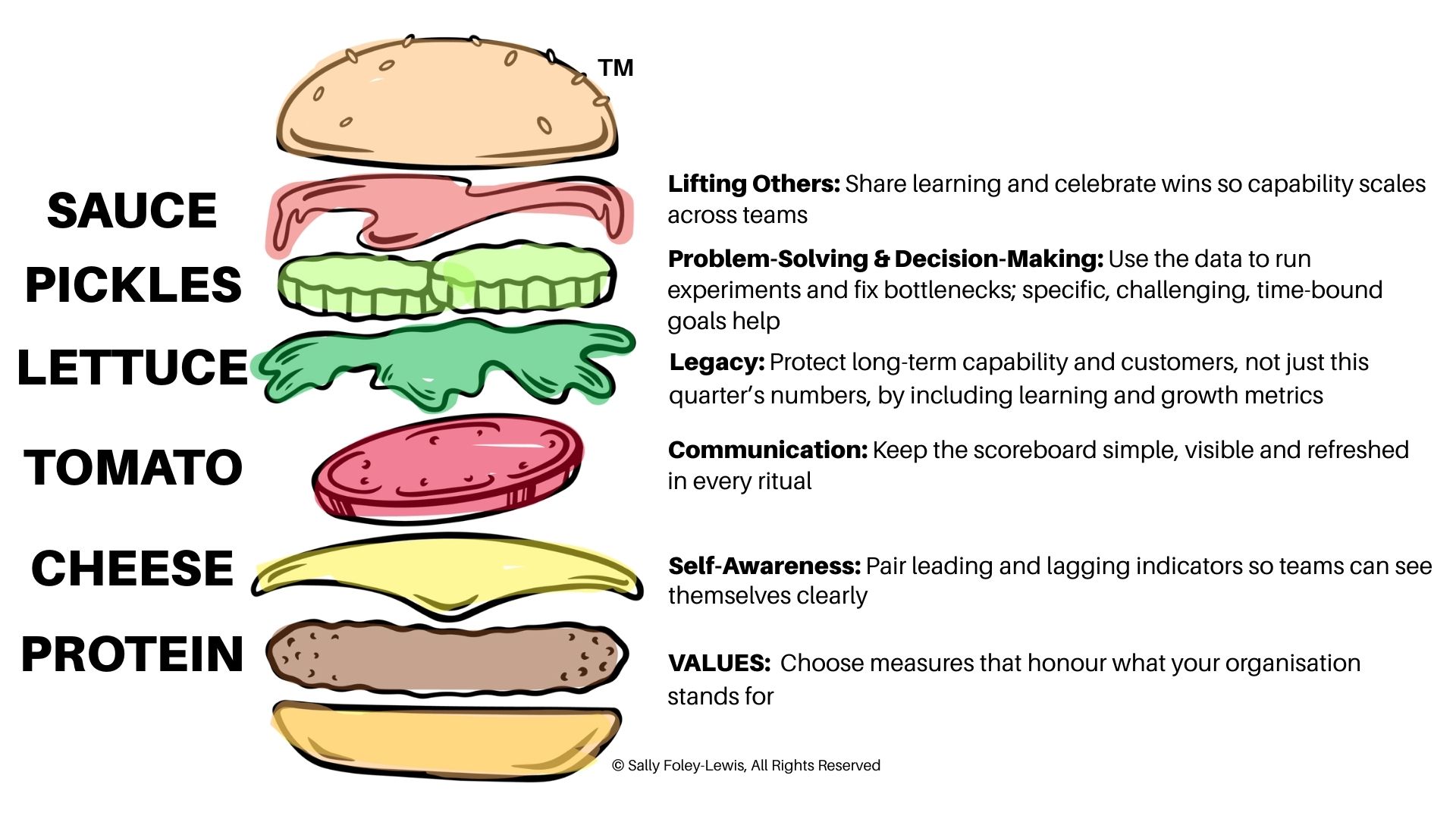
When teams track what the strategy needs, execution accelerates. The fastest way to give people line of sight from their daily work to enterprise priorities is a visible, strategy-linked scoreboard that turns activity into outcomes. The Balanced Scorecard has shown for decades that strategy becomes real when it is translated into a small set of measures across financial, customer, process and learning perspectives.(2)
The Strategy-to-Scoreboard Cascade
Strategy map. Clarify enterprise objectives.
Team objectives. Translate the few strategic objectives your team materially drives. Line of sight matters because employees who understand strategy focus effort and commit more.
Key results and measures. Make goals specific and challenging and tie them to feedback. Goal-setting theory is unequivocal on the performance lift. (4)
Scoreboard. Publish a short set of leading and lagging indicators. Operational transparency increases engagement and performance when people can see the work.
Drive-thru brands live and die by what they measure. Every year, QSR Magazine and Intouch Insight (3), run a national mystery-shopper study scoring speed, accuracy and experience. Chains that obsess over those categories improve where it counts because the scoreboard keeps everyone’s eyes on the same prize. The specifics vary by year, yet the principle holds: measured drivers move.
What should you start measuring from today, {{contact.first_name}}?
Activity trap. You get busyness, not value, because people optimise task counts, not outcomes. Balanced Scorecard research warned us about over-indexing on financial or volume measures alone.(2)
Goal confusion. Without line of sight, effort fragments and engagement drops.
Short-termism. You hit today’s target while eroding tomorrow’s customer value and capability.
McDonald’s story is a reminder: if your strategy evolves, your metrics must evolve with it. “Made For You” refocused measurement on freshness and made-to-order compliance while preserving core pillars like speed and accuracy. The shops that tracked and coached to those measures improved exactly where the strategy asked them to. That is the mirror effect your team needs. (1)
Ask you team what they see needs to be measured, that might just be a surprising, productive and profitable conversation!
Let me know how you get on.
...
Source:
1. https://journalrecord.com/1998/06/04/mcdonald39s-new-system-is-39made-for-you39
2. https://hbr.org/1992/01/the-balanced-scorecard-measures-that-drive-performance-2
3. https://www.qsrmagazine.com/story/the-2025-qsr-drive-thru-report
4. https://med.stanford.edu/content/dam/sm/s-spire/documents/PD.locke-and-latham-retrospective_Paper.pdf
Tags: Leadership, Management
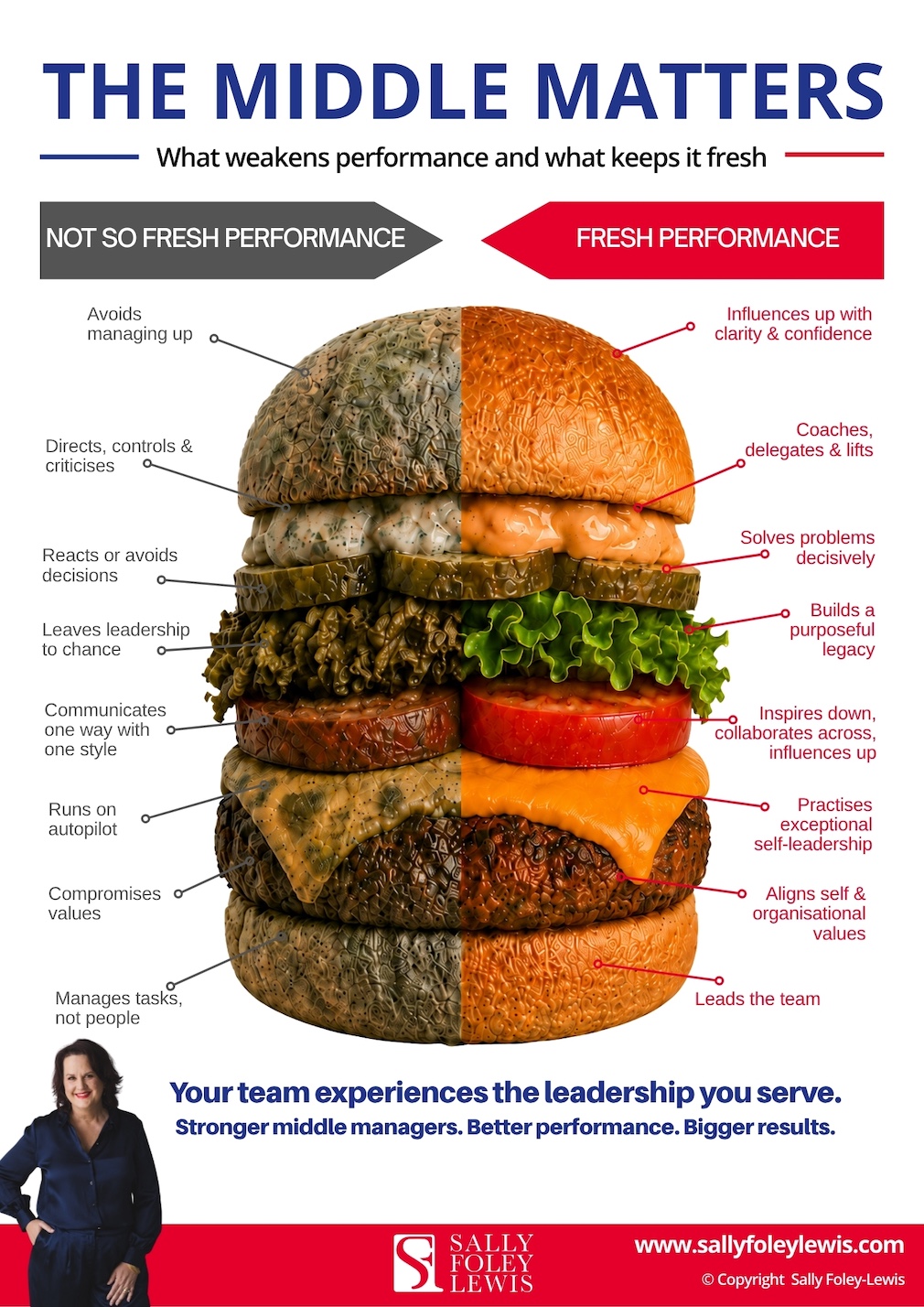 How Fresh is Your Leadership
Middle managers do not become ineffective overnight. Performance deteriorates ingredient by ingredient: values are compromised, communication becomes one-directional, decisions are avoided, self-leadership slips, and developing others gives way to controlling them.
That is why the burger is more than a playful metaphor. Every layer represents a capability that contributes to high performance. Values provide the substance. Self-leadership builds credibility. Communication enables managers to inspire down, collaborate across and influence up. Problem-solving keeps work moving. A clear leadership legacy gives people something meaningful to follow. The secret sauce is the ability to lift others through feedback, coaching, delegation and performance management.
The top and bottom buns matter too. Middle managers must influence upwards while leading the people who report to them. They translate strategic direction into daily priorities, then bring frontline insight back to decision-makers. When either connection breaks down, senior leaders lose visibility, employees lose clarity and the manager in the middle absorbs the pressure from both directions.
When one ingredient is neglected, the effect spreads. Poor decisions create delays. Weak communication fuels confusion. Avoided feedback lowers standards. Misaligned values damage trust. Eventually, a capable manager can look like the problem when the real issue is an underdeveloped leadership system.
The warning signs are often visible before performance seriously declines. Meetings become updates rather than conversations. The manager answers every question instead of building the team’s judgement. Difficult feedback is postponed. Problems travel upwards without possible solutions. Employees wait for permission, while senior leaders wonder why the middle is not taking greater ownership.
None of this is fixed by adding another generic leadership course to the calendar. Development must connect directly to the work middle managers are expected to perform. They need opportunities to practise difficult conversations, make decisions with incomplete information, delegate meaningful responsibility and influence stakeholders without relying on positional authority. Learning becomes useful when it changes what managers do the very next day.
Keeping performance fresh requires attention from both sides. Middle managers must own their development, examine their habits and practise the skills their role demands. Senior leaders must provide clear expectations, useful feedback, appropriate authority and genuine development. Organisations can not simply promote strong technical performers and hope leadership appears.
For middle managers, the practical starting point is an honest ingredient check. Where are you strongest? Which capability has been neglected? What behaviour is your team experiencing from you consistently? Choose one ingredient and improve it deliberately. Better leadership is built through repeated behaviour, not occasional bursts of inspiration.
Freshness also depends on regular maintenance. Like a commercial kitchen, cleanliness, food use-by dates, temperature controlled environments, avoiding cross contamination of different food stuffs all leads to a safe and well maintained kitchen that leads to, or at least strongly contributes to, great food.
Leadership capabilities weaken when workloads increase and reflection disappears. Short, frequent conversations about priorities, decisions, relationships and team capability are more valuable than waiting for an annual review. They help managers adjust early, before a neglected ingredient becomes a serious costly performance problem.
For executives, the question is not simply whether middle managers are performing. It is whether the organisation has created the conditions in which they can perform. Conflicting priorities, unclear decision rights, excessive reporting and constant escalation can spoil even capable leadership. Accountability without authority is not development; it is a pressure cooker.
High-performing organisations do not leave the middle to chance. They deliberately strengthen every leadership ingredient and ensure managers can lead their teams while navigating competing demands from above and across the business.
That is why strengthening the middle is not a training initiative; it is a core business performance strategy.
When every leadership ingredient is working, the middle becomes the engine of performance. Because the middle does not merely carry strategy, it determines whether strategy reaches people, shapes behaviour and produces results.
...
Check out the Burger Program: https://www.sallyfoleylewis.com/burger-workshop-pub or reach out if you would like to discuss this program for your mid-level leaders.
Tags: Leadership, Management
 African Safari and Elephant Leadership
My husband and I have just returned from a trip to South Africa, we got to tick off a huge bucket list item we've had for over 15 years - a safari experience!
It was a phenomenal experience, better than what I had been dreaming it would be like!
We had blocks of 3 hours out driving and looking for animals: one afternoon spent searching for elephants to no avail but the very next morning we had word where they could be so we set off with our expert guide...
There’s a strong leadership metaphor here because elephant herds challenge the assumption that leadership means being the person visibly out front. In elephant family groups, the matriarch’s value is strongly linked to experience, social knowledge, memory and judgement, particularly when the herd faces uncertainty or threat.
The matriarch doesn’t need to physically lead every movement of the herd. Her influence comes from the herd’s accumulated experience of her judgement.
Leadership lesson: If your team can only move when you are at the front telling them what to do, you haven't really created leadership, you've created dependency.
The leadership question becomes: “If I stepped out of the way, would my people still know where we’re going and how to get there?”
That’s particularly powerful for middle managers. Your job isn't to be the GPS constantly announcing every turn. It's to make the destination and the principles for getting there sufficiently clear that people can navigate.
The matriarch's experience becomes especially valuable when the herd encounters something unfamiliar, dangerous or uncertain. Research on elephant leadership has found that older matriarchs can be better at assessing threats and responding appropriately because they possess decades of accumulated social and environmental knowledge.
Leadership lesson: Experienced leaders don't need to intervene in everything. Their greatest value may be knowing when they need to intervene. You would have no doubt read or heard that leaders need to learn when to not intervene, this is absoltuely true, but nuance here is knowing when and to what degree and when not to. Is it easy, o course not, that's leadership and if that was easy, everyone would be stepping up!
That creates a lovely distinction:
Novice leadership: “I need to have the answer.”
Mature leadership: “I know when my judgement is needed.”
For middle managers, this is the shift from being a problem solver to more of a capability builder and trusted source of judgement.
Elephants operate as a highly social group. Knowledge, behaviours and responses aren't held exclusively by one animal. Younger elephants learn through observing and interacting with more experienced members of the herd.
Leadership lesson: Your leadership shouldn't live inside you. It should live inside the team.
The strongest leader isn't necessarily the person everyone continually turns toward. It may be the leader who has created enough clarity, confidence and capability that people don't need to.
Let me know what you think: when has being out front worked and when has it stalled a project or hindered team performance or growth?
I appreciate you
Sally
Tags: Leadership, Management
 Fair and Fast: The Performance Conversation Every Manager Needs
Walk into any busy burger restaurant at lunchtime and you'll notice something interesting. The rush isn't won by the team that works the hardest. It's won by the team that works from the same recipe.
The grill cook knows exactly when a patty is done. The person assembling burgers knows precisely how each burger should be built. The cashier understands how orders are entered. The shift manager knows what to check, when to step in, and how success is measured. Nobody is relying on memory or hoping everyone has interpreted "make it right" the same way. Expectations are visible, roles are clear, and everyone is working from the same playbook.
Now imagine the opposite.
One team member thinks a burger should have three pickles, another adds six. Fries leave the fryer whenever someone remembers. Nobody knows who should refill ingredients, and every customer complaint turns into a debate about who was responsible. The manager spends more time sorting out misunderstandings than serving customers. Even good people begin looking average because they were never working from the same agreement.
Organisations are no different.
Many performance conversations become difficult not because people aren't capable or committed, but because managers and employees neglected, avoided, forgot to agree on what success actually looked like. Many times, a shared understanding is assumed without confirmation. When expectations are assumed instead of discussed and documented, performance reviews can easily slide right into arguments about memory [they said:they said] rather than discussions about evidence.
High-performing burger restaurants know that consistency starts long before the lunch rush. High-performing leaders know exactly the same thing. The fairest and fastest performance conversations begin before the work even starts. It begins with a clear accountability agreement that everyone helped create.
I’ll repeat that: a clear accountability agreement that everyone helped create!
Many managers believe performance conversations are difficult because people become defensive. In reality, most conversations become difficult because expectations were never completely clear in the first place.
Instead of discussing evidence, people debate memories.
"I thought you meant..."
"I didn't realise..."
"That's not what we agreed."
Those conversations consume time, create frustration and often damage trust.
Research consistently shows that people perform better when goals are specific, challenging and accompanied by regular feedback. Edwin Locke and Gary Latham's Goal Setting Theory remains one of the strongest evidence-based models in organisational psychology and demonstrates that clarity is one of the biggest drivers of improved performance. (1)
The solution isn't tougher conversations. It's better agreements, early!
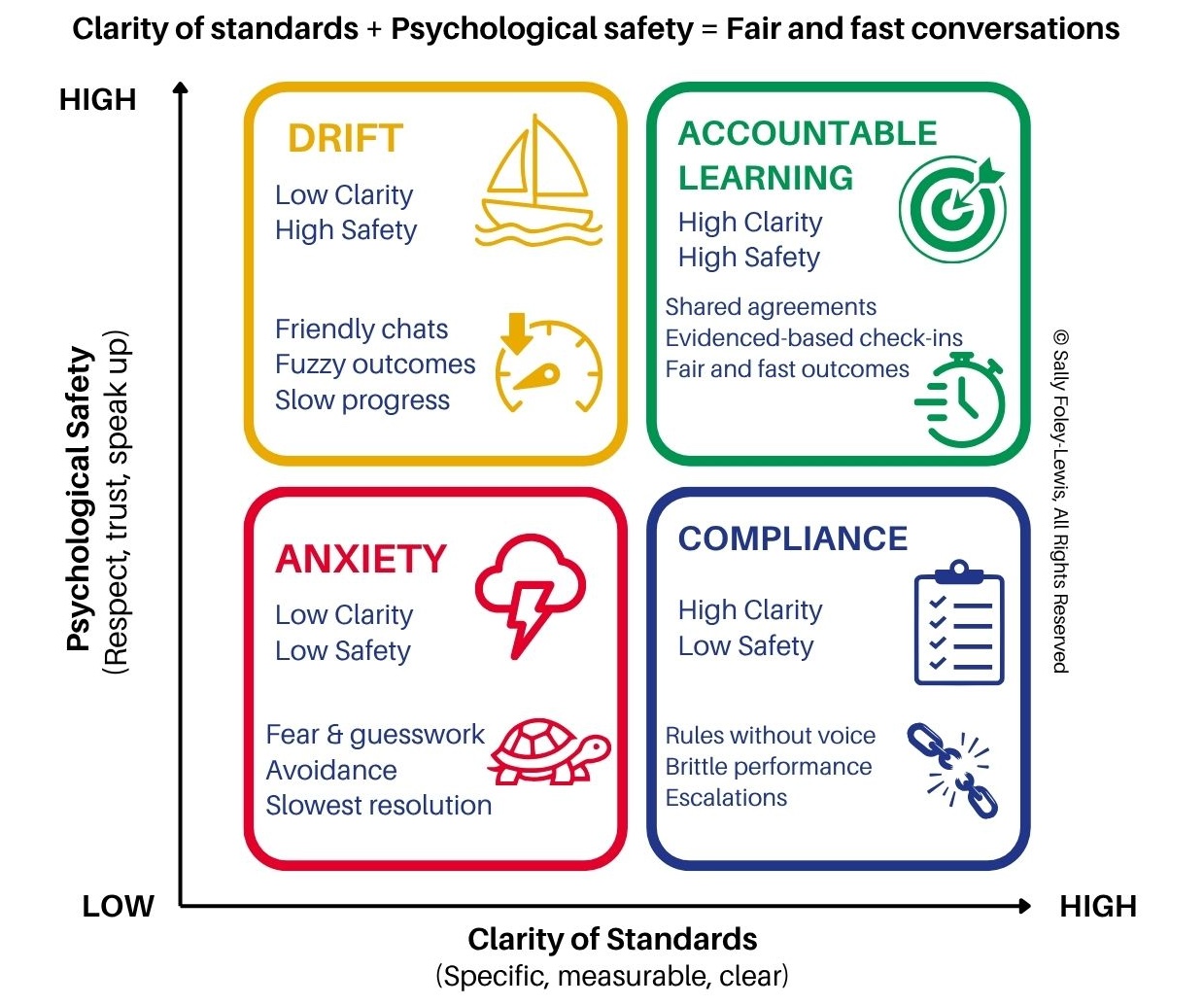
Imagine performance management on two dimensions: clarity of standard and psychological safety. This gives us four different workplaces:
Low clarity + High safety.
People enjoy working together.
Everyone is supportive.
Unfortunately, nobody is completely sure what success looks like.
Progress is slow because expectations are fuzzy.
Low clarity + Low safety.
People spend more energy protecting themselves than improving performance.
Mistakes are hidden.
Questions go unasked.
Resolution becomes painfully slow.
High clarity + Low safety.
Rules exist.
Checklists exist.
People comply because they have to, not because they feel ownership.
Performance becomes brittle and innovation disappears.
High clarity + High psychological safety.
This is where high-performing teams operate.
Expectations are explicit.
Evidence is agreed in advance.
People can raise problems early because speaking up is encouraged.
Accountability becomes something people participate in—not something done to them.
Harvard professor Amy Edmondson has repeatedly emphasised that psychological safety is not about lowering standards. It is about making it safe to discuss mistakes while maintaining high accountability. (2)
The NeuroLeadership Institute similarly describes high-performing organisations as combining both psychological safety and accountability rather than choosing between them. (3)
If you've followed the Burger Framework™, you'll recognise that accountability agreements require every ingredient.
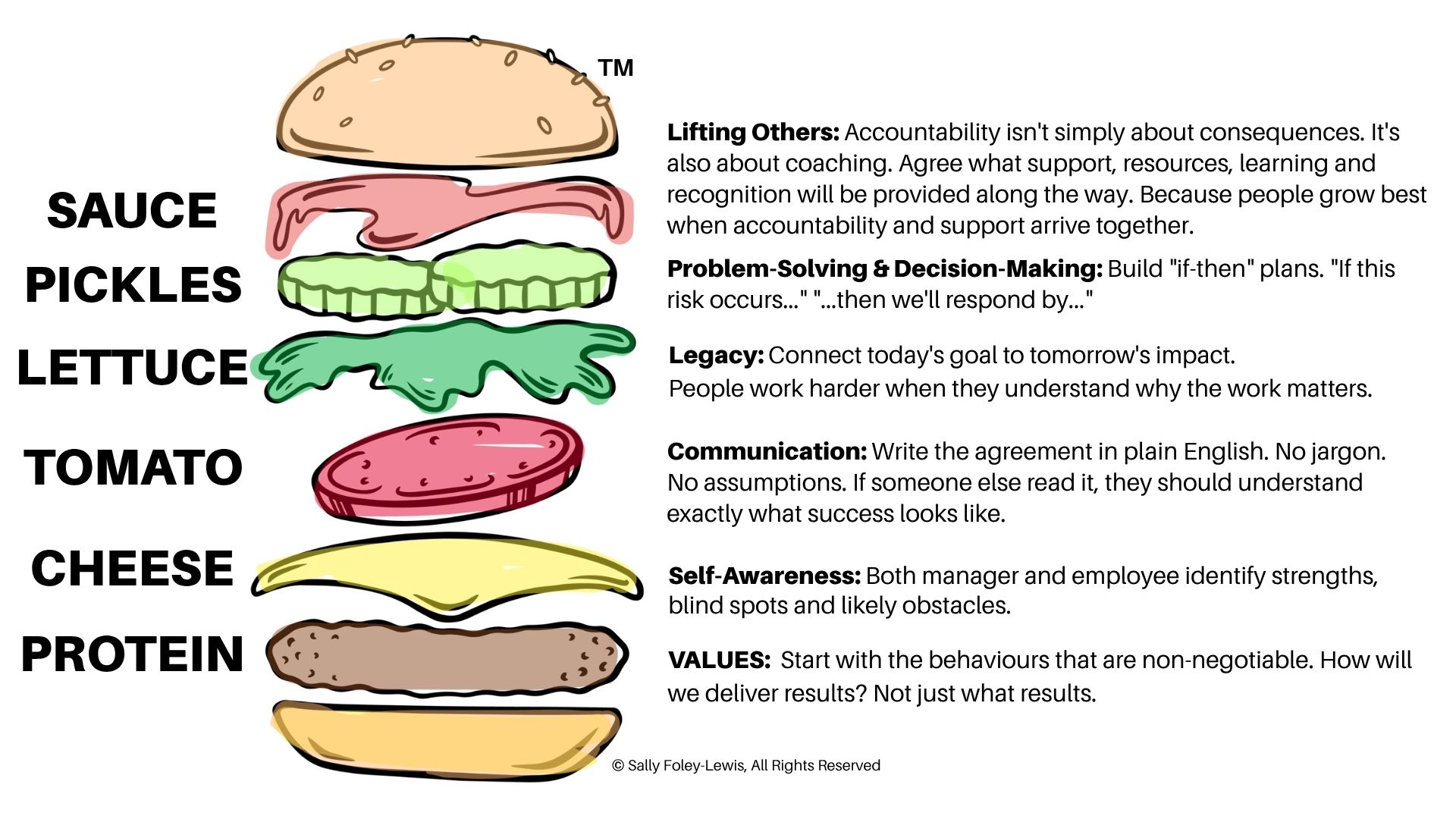
Research on implementation intentions by Peter Gollwitzer and Paschal Sheeran shows that these simple if-then plans significantly improve goal achievement because they reduce the gap between intention and action. (4)
Five Guys provides an excellent example of accountability through visible agreements.
Stores receive regular mystery-shopper assessments against clearly defined service standards. Everyone understands the expectations. Everyone knows how performance is measured.
Managers don't spend performance discussions debating opinions. They review the scorecard, celebrate what worked and coach the few areas needing improvement.
The standards are visible. The evidence is objective. The conversations become shorter, fairer and more productive. (5 & 6 & 7)
Before discussing performance, create a one-page Accountability Agreement containing:
Focus outcome
Agreed evidence
Check-in rhythm
If-then plans
Support required
Recognition and consequences
Then place that agreement at the top of every regular short check-in / one-to-one.
Finish every meeting with two questions:
Are we on track?
What help do you need?
This makes in simple, fair, and fast.
When accountability agreements exist, performance conversations stop being arguments about the past and become collaborative discussions about the future.
I'd love to know your thoughts.
Tags: Leadership, Management
 Speed Without Regret: Empowering Decisions at the Edge
I want to chat with you about values-based decisions and the speed at which they travel.
In a busy London Pret A Manger, a barista quietly slid a free cappuccino across the counter to a frazzled commuter. There was no coupon, no points card to scan, and no manager approval needed. It was simply a human judgment call, backed by a clear, lived value: be generous. Pret gives each shop a budget for "random acts of kindness", trusting frontline teams to use their discretion. Staff are given freedom to gift items as they see fit, precisely because a loyalty card system or a call for manager approval would be slower and less personal. The Independent (1) reported on this policy, noting how it bypasses bureaucracy for speed and customer connection.
This frontline empowerment isn't just a nice story; it is the fundamental principle of high-velocity decision-making. Values-based decisions travel faster through an organisation because shared, explicit values create vital guardrails. When people know what good looks like, when they understand the core principles of the organisation’s mission, they are empowered to move quickly without waiting for layers of approval.
The Decision Velocity Matrix
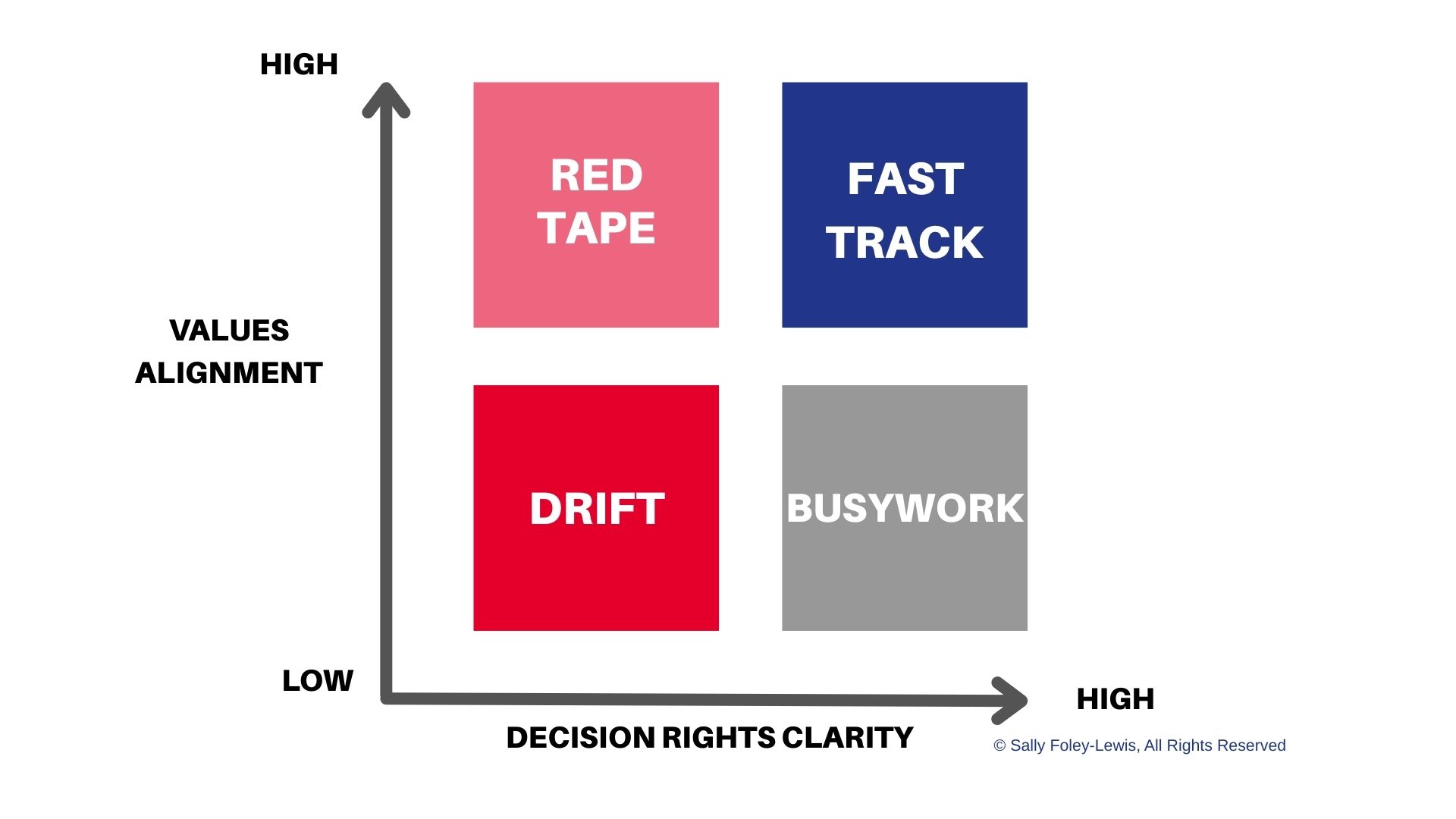
To understand this speed advantage, consider the Decision Velocity Matrix, a tool for mapping where your team’s decisions currently land. The two axes are:
Your primary goal is to migrate every recurring decision type toward Fast-Track by simultaneously tightening up your shared values and clarifying who decides what, where, and when. The Leadership Burger, Served Express!
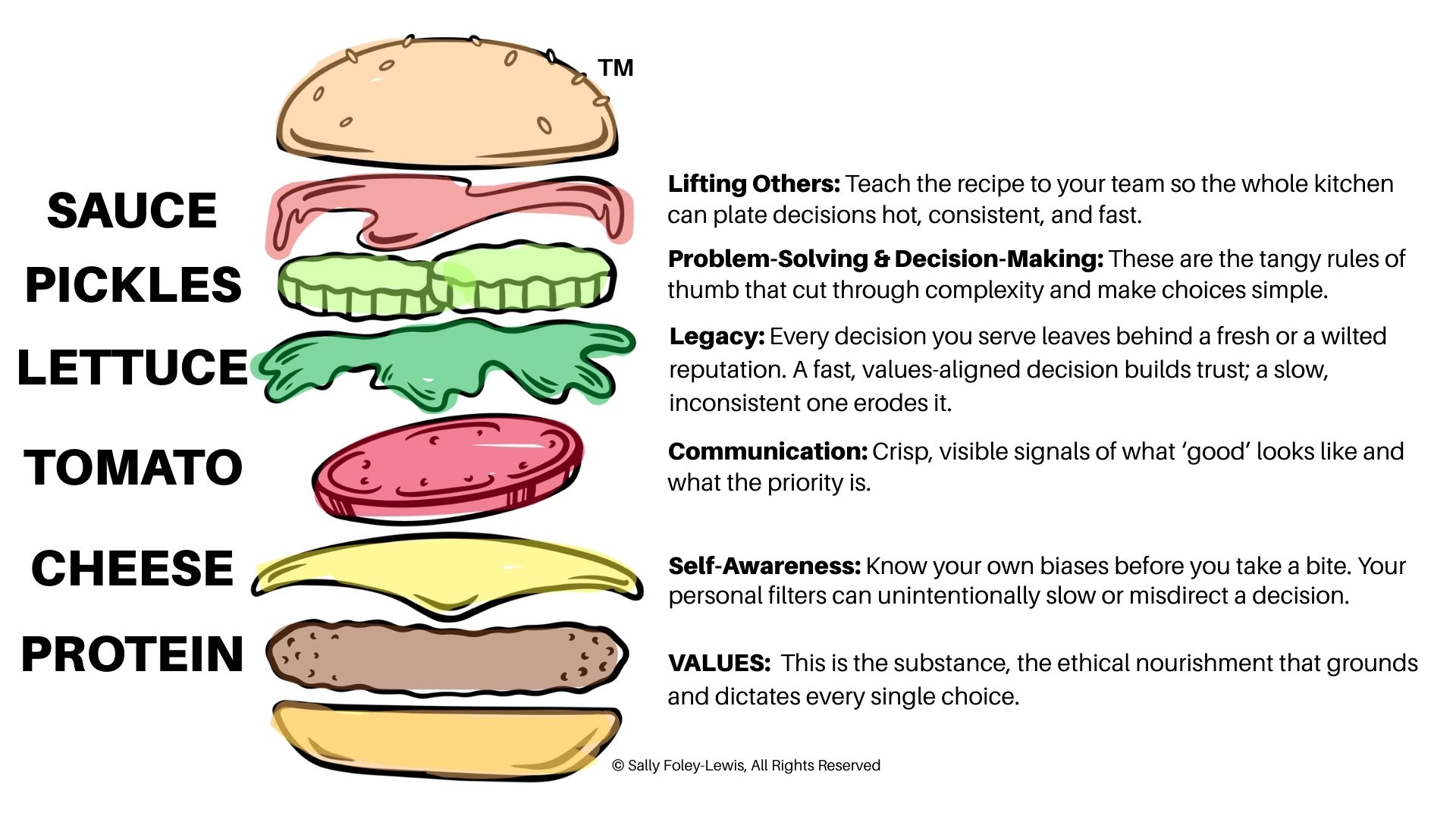
A helpful way to remember the ingredients for high-velocity decision-making is to think of it as The Leadership Burger, served “express”, a recipe for empowered choices:
Why Values Speed Things Up
Values alignment is not a soft, abstract concept; it is a demonstrable speed advantage. Research continually proves this link. Bain & Company’s “The Decision-Driven Organization” (2) shows that performance rises when leaders focus on who decides, how, and with what information, rather than on structural change alone.
Furthermore, McKinsey’s (3) research highlights that organisations designed for speed outperform their peers, especially when authority is pushed down, decision-making forums are simplified, and the number of people in the room is reduced. This is supported by decades of study, such as Kotter and Heskett’s (4) research linking strong, lived cultures and shared norms with superior long-term economic performance across hundreds of firms.
The Ritz-Carlton is a classic example. (5) Their famous ‘$2,000 Rule’ empowers any employee to resolve a guest issue immediately, up to that value, without escalating to a manager. This is a vivid example of values (unwavering commitment to service) plus discretion (trust in the employee) speeding up customer recovery cycle time at the edge of the organisation.
Five Moves for Middle Managers
For middle managers who live at the intersection of strategy and execution, here are five immediate moves to push your team’s decision-making into the Fast-Track quadrant:
If you fail to act, you will find the opposite occurs: slow escalations, shadow approvals, and a risk-off culture that breeds bureaucracy. Conflicting decisions will erode trust and brand value, and your best, most autonomous people will disengage as their ability to act stalls. Speed, empowerment, and values alignment are mutually reinforcing, they are the engine for a high-performing team.
When your team knows the protein, the cheese, the tomato, the lettuce, the pickles, and the secret sauce, they can serve decisions hot, consistent, and fast, just like the best experiences from Pret A Manger and The Ritz-Carlton.
I’d love to know your thoughts, even better, share which one of the five moves you will focus on first this coming week.
I appreciate you
Sally
Source:
Tags: Leadership, Management
 Is your legacy about impact or presence?
|
On Friday 15 March 2024, a routine configuration change by a third-party provider took McDonald’s ordering systems offline across multiple countries. Stores in Australia turned away customers, outlets in Japan and the UK paused service, and many restaurants reverted to cash and pen-and-paper until systems returned a few hours later (1). The outage made headlines precisely because the system is usually invisible and ultra-reliable. The brand’s consistency has never depended on a single heroic manager on shift. It rests on teachable, auditable systems that run the restaurant when no one famous is in the building. That is the point for middle managers: your legacy is the system you leave, not the spotlight you stand in. Why systems outlast presenceDocumented and auditable systems are not bureaucracy, they are compounding assets. A meta-analysis published by the International Organization for Standardization summarised findings from 42 empirical studies and concluded that ISO 9001 quality management systems are associated with better financial and operational outcomes, particularly when they drive genuine internal improvement rather than a tick-the-box certification. (2) Likewise, research on Toyota’s codified management system shows sustained links between Toyota Way practices and improved operational performance and long-term growth. (3) And if you need a practical risk lens, the bus factor is a vivid measure of fragility when too few people hold critical know-how. Low bus factor equals single point of failure; systems raise the bus factor by spreading knowledge across roles. (4) This is where AI can be your best assistant, using AI, within the frameworks your organisation allows, to draft, summarise, streamline, test, organise systems will amplify productivity, save vital time; time middle managers could be spending doing the critical people leadership work. The Legacy Ladder in practice Managers move from Heroics to Habits to Playbooks to Platform. The climb is a mindset shift from ‘only I can do this’ to ‘any trained person can do this’ to ‘the system ensures it happens.
|
|
|
|
McDonald’s standard work and visual management are well-documented lessons in how to scale quality, speed and consistency. The 2024 outage did not nullify that lesson. If anything, it underlined a second truth: robust systems also include contingency playbooks for inevitable exceptions, from failovers to cash-only modes to manual order capture. (6) Your Burger Framework for Legacy Let’s keep this tasty and tactical using the High-Performing Manager Burger: |
|
|
|
Eight practical moves to climb the ladder
Ignoring this or not seeing this through completely leads to a high risk of performance becoming brittle. Leave, promote or lose one key person and you expose single points of failure, delay decisions, and erode customer trust. The bus factor drops, the firefighting spikes, and growth stalls. By contrast, codified systems turn good days into standard days. I'd love to know your thoughts Source: 2. https://www.iso.org/news/2012/ 3. https://www.qip-journal.eu/ 4. https://en.wikipedia.org/wiki/ 5. https://www.reuters.com/ |
Tags: Leadership, Management
 The High-Performing Manager’s Burger: A Practical DoD that Reduces Defects and Shortens Cycle Time
A hospital story that changed how teams “finish”
In 2004, more than 100 intensive care units across Michigan adopted a simple, explicit checklist for central line procedures. The team behind it, led by Peter Pronovost, treated “done” as objective and observable: hand hygiene completed, sterile drape in place, chlorhexidine used, line site reviewed, and unnecessary lines removed. Within 3 months the median bloodstream infection rate fell to zero; at 16 to 18 months the mean fell from 7.7 to 1.4 infections per 1,000 catheter-days, a roughly 66 percent reduction, and the gains were sustained years later (1)
That is the Definition of Done in the wild. When “done” is a clear, jointly owned standard, throughput rises and rework collapses. The same principle scales beyond hospital theatres and wards.
What is DoD - Definition of Done
A DoD is a single, visible, shared list of exit criteria that every increment must meet before it leaves the team’s hands.
Model: the five rungs of “done” clarity

Ad hoc: “Done” lives in people’s heads, so work ships on gut feel and standards vary by whoever shouts loudest.
Implied: A loose list exists somewhere, yet it is inconsistent, unenforced and easy to ignore when deadlines bite.
Explicit: One visible, team-owned Definition of Done is written as observable checks that apply to every increment.
Embedded: The DoD is wired into the workflow, pull requests, tests and reviews so items cannot progress without meeting it.
Engineered: The DoD is measured, audited and continuously improved using telemetry and feedback to lift speed and quality.
At the top rung, DoD is engineered into your workflow, tests and audits. It is not a poster on a wall, it is the wall.
Why a strong DoD accelerates flow and quality
Checklists work in high-risk domains. Systematic reviews of the WHO Surgical Safety Checklist show significant reductions in complications and mortality when teams use explicit, shared “done” steps before sign-off (2). More recently, when hospitals re-implemented and audited the checklist as a system, they improved safety culture, behaviour and outcomes (3).
Specific standards plus feedback drive performance. Goal-setting research shows that clear, specific standards with frequent feedback outperform vague intentions. In management contexts this shows up as F.A.S.T. (4) goals that are frequently discussed and transparently measured. F.A.S.T. standing for frequent discussions; ambitious in scope; specific; and transparent. In performance settings, a 2022 systematic review and meta-analysis in sport found goal setting improves task performance and key psychological outcomes, reinforcing the value of explicit, measured standards (5)
DoD operationalises high-performing delivery. A clear Definition of Done makes good delivery habits automatic: every item must meet the same basic checks, the same reviews, and the same tests before it moves on. That consistency cuts surprises, reduces defects, and shortens lead time, so small changes ship more often with less fuss.
Applying the Burger Framework to DoD

Here is a simpler, no-nonsense version.
How to implement a DoD that actually moves the needle
Write it together. Get the team in a room and agree one shared Definition of Done. Keep it to one page.
Make every check observable. Use plain tests like “all automated tests pass,” “no critical security issues,” “docs updated,” “feature toggled on.” (6)
Separate it from acceptance criteria. Acceptance criteria are for a single story. The DoD is the basic quality bar for everything. You need both.
Put it where work happens. Add the checks to your board, pull request template, CI pipeline and release checklist.
Pin it where people can see it. Post it near the team board and in the repo README so no one can miss it.
Measure the basics. Track cycle time, escaped defects and change failure rate. Review these in the retro and tighten the DoD monthly.
Teach it. Walk new starters through the DoD on day one. Rehearse it in refinement, stand-ups and reviews.
Keep it lean. Focus on outcomes, not process. If a check does not add quality or speed, remove it.
Use WIP limits. Do not start new work until you finish what is already in progress. Finished beats started.
Make improvements easy. Treat the DoD like a living document. Update it when you learn, and tell the team what changed.
If you want a quick reminder, think burger: e.g. the DoD is the bright tomato slice everyone can point to. If it is missing, the burger is not ready to serve.
Risks if you ignore this
Skip a clear Definition of Done and you invite rework, delays and endless test–fix loops as people ship to different, shifting standards; WIP swells with “done-ish” items that boomerang back, cycle times stretch, defects leak to customers, and credibility with stakeholders erodes, which means more escalations, less trust, more cost and a team stuck firefighting instead of flowing. A parallel from kitchens that never ship undercooked
Atul Gawande described how the Cheesecake Factory turns “done” into production reality: layouts, recipes, plating standards and timing make quality unambiguous. Orders appear on screens with step lists and countdown timers, and nothing leaves the pass until it meets the agreed standard. In other words, the kitchen’s DoD is explicit, embedded and engineered (7).
Bottom line
A crisp, co-created, enforced DoD accelerates throughput and quality because it removes argument at the finish line, converts quality into observable checks and wires those checks into the work. The result is fewer defects, shorter cycle times and calmer reviews. As the hospitals learned with checklists, speed and safety are not a trade-off when “done” is designed.
Tags: Agile, Change Management, Leadership
 The best is in the middle: why the C-suite must be the top bun
In the late 1990s, Rover Group used Hoshin Kanri’s catchball to deploy a quality strategy across engineering, manufacturing and supplier networks. The method was simple but powerful. Executives set clear, measurable outcomes, then tossed them to middle managers who tested feasibility, surfaced constraints and threw back refined plans. The process clarified ownership, sequencing and capacity, which meant the strategy did not buckle under real-world pressures. It is a documented case that still stands as a practical example of how clear direction, paired with middle-manager translation, delivers execution at scale. (1)
That story is not nostalgia. It is a reminder that the best results happen in the middle when the top bun is firm and fresh.

Think of your organisation as a burger. The top bun is C-suite direction. It is a could look like a short list of enterprise outcomes for the next 6 to 12 months, each expressed as measurable Key Results. When executives are explicit and consistent, middle managers become the engine of transformation rather than its bottleneck.
The middle is where value is created. Managers translate outcomes into plans, coach people and solve problems where reality bites; done well, this correlates strongly with organisational health and performance.
The bottom bun is operating reality. Customers, risk, compliance, finance and capacity keep ambition grounded so commitments are deliverable and safe.
Why does this model matter? Because role clarity is not a flavour-of-the-month idea. Research shows perceived role clarity boosts intrinsic motivation and innovative work behaviour, which are essential for better performance. (2)
A recent peer-reviewed study also finds that role clarity and motivation predict job performance and organisational effectiveness, reinforcing the case for crystal-clear direction from the top that managers can translate locally. (3)
The C-suite’s job is not to produce a long initiative list. It is to define a small set of outcomes that frames every other choice. This could be a published one-page direction with 3 to 5 Objectives and quantified Key Results. Keep the language plain. If a new starter cannot explain a Key Result, rewrite it.

Before you lock plans, pressure test them with the people who must deliver them. Catchball is a structured dialogue where leaders throw objectives to managers who test feasibility, identify interdependencies and throw back a sharper plan. It aligns ambition with capacity and builds genuine buy-in because the plan changes in response to frontline insight (4).
The Rover Group example shows how catchball clarifies sequencing and ownership so quality and timing survive contact with real operations (1).
If you prefer a concise primer, this overview explains catchball as bidirectional strategy alignment that reduces rework and speeds decision making across levels (5).
Weeks 1 to 2: Publish the one-page direction. Agree Objectives and Key Results, then share the draft and invite tight feedback windows. Ensure team-level OKRs, not individual ones, to emphasise cross-functional delivery.
Weeks 3 to 4: Run catchball. Hold short cycles with managers to map interdependencies, highlight risks and decide what must stop to make room. This reduces escalations later because decision rights are explicit upfront.
Weeks 5 to 6: Cascade with care. Translate company Key Results into team Key Results only where there is clear ownership and line of sight. Use proven cascading patterns and avoid creating a tangle of metrics that compete with one another.
Weeks 7 to 12: Monthly bun checks [pun intended]. Run a 30-minute ritual:
Use a shared language to reinforce leadership behaviours and keep culture aligned with outcomes:

These behaviours are consistent with a wider shift that asks managers to coach more and command less, which research highlights as a winning pattern in complex work (6).
If you remember one thing, make it this: the best is in the middle, but only when the top bun holds the whole burger together. Publish a one-page direction, practise catchball to respect reality, and commit to monthly bun checks. Your customers will feel the difference, your risks are managed in daylight, and your performance becomes reliably delicious.
Tags: Careers, Coaching, Leadership
 From Squeeze to Sync: Align the Top, Unleash the Middle
In 1999, as McDonald’s rolled out its “Made For You” kitchen redesign across the United States, the early phases were messy. Divisions pushed in different directions, schedules slipped, and store teams were overwhelmed. Then the company tightened the top-level alignment: a cross-functional board was created, shared artefacts were put in place, and a central cadence for communication and implementation was set. Progress accelerated and conversions landed on schedule, easing the load in the middle of the organisation. Contemporary reports describe the pivot clearly, including a 1999 news piece on the statewide rollout and a trade article noting the plan to equip all U.S. restaurants by year end (1)
This story is a tidy metaphor for many organisations today: when the top bun is misaligned, the middle gets squashed and capability spills.
Senior teams often believe they are aligned, yet the signal that reaches the middle is fuzzy. MIT Sloan research found that even leaders charged with execution struggled to name their company’s strategic priorities, a warning sign that alignment at the top is not the same as clarity in the middle. (2)
At the same time, removing or bypassing middle managers in the name of efficiency weakens execution. Middle managers are the connective tissue for delivery, inclusion, and safety. Harvard Business Review argues strongly not to eliminate them; see “Don’t Eliminate Your Middle Managers.” (Harvard Business Review)
When direction is vague, middle managers fill the gaps, often creating unintended strategies that drift from executive intent. And if misalignment persists, engagement erodes. Gallup estimates low engagement costs the global economy 8.8 trillion dollars, (3). In 2024, manager engagement fell to 27 percent, dragging team engagement with it, as reported by the Wall Street Journal: WSJ. (Forbes)

Alignment test: lightly squeeze the top bun. If the middle squirms, your model is misaligned.
Square the top bun. Produce a one-page strategy with six quarterly priorities in plain English. Validate each against your values before finalising. The Father of Management, Peter F. Drucker’s reminder fits here: “There is nothing so useless as doing efficiently that which should not be done at all.”
Cascade without crush. Translate each priority into no more than three team outcomes, then individual commitments on a single page. Kill duplicates and non-value work. Harvard Business Publishing underscores the leverage of midlevel leaders in volatile contexts: Midlevel leaders are the connective glue of execution, positioned to sense market shifts, shape strategy, and mobilise teams with speed and agility. The Build Muscle In The Middle white paper urges firms to deliberately “build muscle” here by developing critical capabilities, applying learning to real work, and creating supportive contexts so these leaders can drive results in volatile conditions.(4)
Map decision rights. For recurring decisions, define who decides, who inputs, who is consulted, and who is informed. Publish the map. Make problem solving and decision making a standing agenda item. This limits the drift toward unintended strategy.
Set the middle-manager rhythm. Schedule a 30-minute weekly huddle, a monthly retro [review] on blockers, and a quarterly reset with the executive sponsor. Track no more than five measures per team. These simple rituals link top bun to bottom bun.
Invest in the secret sauce. Require monthly coaching conversations, skill clinics on problem solving, and peer consulting circles for managers. HBR’s guidance on the value of middle managers is clear: don’t thin the middle, strengthen it (5)
Improve communication hygiene. Every change ships with five points: why now, what changes, what stays the same, the first two weeks, where to get help. This reduces noise and raises role clarity, a known driver of engagement that links to the global cost of disengagement.
Capability spill: your best people are diverted to noise, rework increases, and hidden queues grow.
Unintended strategy: teams optimise locally in ways that conflict with enterprise value
Engagement drop: clarity and development decline, performance lags, and attrition rises.
Senior alignment is not a slogan, it is a visible chain from boardroom to front line. When the top bun sits squarely on the burger, every ingredient adds flavour and bite. Strategy, values, communication, legacy, decision rights, and the deliberate development of managers all hold together. Get that right and the middle does not have to firefight. It can lead.
Finally, keep Drucker’s line on your steering wheel: effectiveness before efficiency. There is no point in perfectly executing misaligned work.
Tags: Business Continuity, Careers, Coaching
 Order by ingredients, not by hunger: why values must drive trade-offs
Southwest Airlines grew by saying no. No meals, no assigned seats, no interline baggage transfers, no premium cabins. Those choices protected what mattered most: low cost and reliable, frequent service. That is values in action. It is also strategy in action, because strategy depends on trade-offs. When everything looks important, values tell you what to do now, what to do next, and what not to do at all.
Middle managers sit where competing priorities collide. A senior stakeholder wants speed. Risk wants guardrails. Customers want clarity. Your calendar wants a rest. In that noise, values are your non-negotiable filter. They let you say a confident yes to the right work and a respectful no to the rest.
Fit Before Force

A sustainable strategy is not just choosing what to do, it is choosing what not to do. That is why the filter starts with values. If a piece of work misses values alignment, it is either redesigned or deprioritised, even when it looks urgent or politically attractive. Values give you permission to hold the line.
There is strong psychology behind this discipline. Schwartz’s theory of Basic Values shows that values are the criteria we use to evaluate actions, and that universal value tensions make trade-offs inevitable. (1) Clarity about values reduces friction in decisions. When goals align with personal values, people pursue them more consistently and achieve more, which also lifts wellbeing. This is the essence of self-concordance: value-fit fuels persistence and performance. (2) At work, value congruence is linked with higher job satisfaction and engagement, strengthening execution once priorities are set.

A practical trap to avoid is mistaking urgency for importance. Tools like the Eisenhower Matrix help teams keep reactive work from crowding out values-aligned priorities. (3) Combine that urgency-importance lens with your values filter and you get both speed and sanity.
The burger makes it memorable. Order by ingredients, not by hunger:

Here is how to apply this:
Name the protein. Clarify 3 to 5 organisational values and two personal leadership values. Write one sentence for each that defines what you will not do because of it.
Translate values into rules. For each value, create a simple test. For example, “If it reduces customer trust, we do not ship it.”
Map the work. Place every live initiative in the Venn. Anything outside Values is paused and re-scoped first.
Run the 2×2. Rate Values Alignment and Strategic Impact high or low. Decide by quadrant, not by queue order.
Communicate the trade-off. State the value driving the choice, the impact you are prioritising, and what you are stopping or delaying.
Cadence and calibration. Review weekly as a team and monthly with your manager to protect alignment up and down.
If you need a second real-world proof point, look at IKEA. Customers pick up and deliver their own flat-packs. IKEA will even sell you a roof rack. That is a values-driven trade-off in service of price and speed. It is deliberate and it works (4)
What if you do the opposite?
You chase urgency, quality drops, and burnout rises. Priorities swing with the loudest stakeholder, trust erodes, and your team escalates everything because decisions feel arbitrary. A values misfit undermines satisfaction and performance.
Values do not slow you down. They speed you up by removing debate about the wrong work. That is why Michael E. Porter’s (Harvard Business School Professor), famous warning about confusing operational excellence with strategy still matters. Strategy is choice, and choice is anchored in values. So, the next time your inbox screams, “Everything is urgent,” take a breath and order by ingredients. Get the protein right first. Your future self, your stakeholders, and your team will thank you for the better burger
Tags: Management, Leadership, IT Leadership
 Would You Let ChatGPT Fire Someone?
Sounds extreme, right? And maybe there is one or two people you could suggest to AI for ‘employment reassignment’. But the reality is we already have AI tools increasingly making hiring, scheduling, and even performance decisions, so ethical leadership has never been more urgent. Just because the tech can do it, does not mean it should.
Here is the tricky part: AI is not neutral. Algorithms are built by humans, trained on historical data, and often carry forward the very biases we are trying to eliminate. Studies have already shown gender and racial bias in recruitment algorithms. Left unchecked, AI could amplify inequality rather than reduce it.
For middle managers navigating hybrid work, digital transformation, and performance pressure, AI can feel like a godsend. But without ethical oversight, it becomes a governance risk.
Before adopting any AI-driven tool, here are 3 questions every manager should ask:
What bias could be baked into this tool? Understand how the tool makes decisions. What data was it trained on? Does it reinforce stereotypes or skew outcomes unfairly?
What human oversight is in place? AI can support decisions, but it should not replace your judgment. Is there a review process? Can decisions be appealed or explained?
Does this align with our values? If a tool's decisions cannot be explained in a way that reflects your organisation's ethics, it's time to reassess.
Responsible AI Checklist for Middle Managers
Have I tested the tool for fairness across gender, age, and background?
Do I understand the logic behind the AI’s outputs?
Is there transparency in how decisions are made?
Can I override or challenge the AI's decisions if needed?
Have I communicated with my team about how AI will be used?
Ethical leadership is not about avoiding AI. It is about using it wisely.
Middle managers are uniquely placed to balance tech adoption with human-centred values. You are the ones translating policies into practice and protecting people while driving performance.
Because confident, considerate and conscious middle managers? They get the work done and do the right thing.
Tags: AI Ethics, Leadership, Management
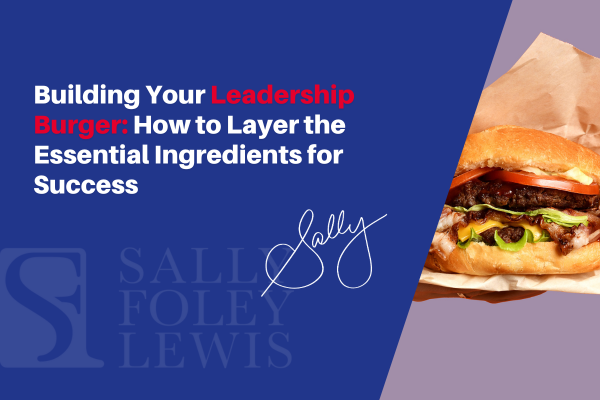 Building Your Leadership Burger: How to Layer the Essential Ingredients for Success
Ever thought about how your leadership style is a bit like making a ripper burger? No? Well, stick with me here because this tasty metaphor might just change how you approach your role as a middle manager.
Middle managers are the burgers of the workplace, not just a filler between two buns, but where all the magic happens. Without the middle, organisations would be left with an empty bread bun. So how do we make sure your leadership burger isn't some soggy takeaway disaster, but rather a mouth-watering, nutritious masterpiece that has everyone coming back for seconds? Let's break down each ingredient and explore how you can develop them intentionally.
Just as a burger needs a solid protein base, your leadership needs strong values. But here's the thing, you can't just slap any old values on your leadership burger and expect it to taste right.
Quick Exercise: Grab a cuppa and jot down your top 5 values. Now for the real test, ask yourself honestly: "Did these guide my decisions last week?" If you're umming and ahhing, it might be time to revisit what truly matters to you.
When you're crystal clear on your values, decision-making becomes less of a headache and more of a straightforward process.
Like a beautiful aged cheddar, self-awareness develops complexity and depth over time. But unlike cheese, self-awareness doesn't happen by just sitting around in a cool, dark place (though some quiet reflection time isn't a bad idea).
Practical Tip: Start a "leadership reflection journal", but before you roll your eyes, I'm only talking about 3-5 minutes at the end of your day. Ask yourself:
What situation today brought out my best leadership qualities?
What triggered a reaction I'm not proud of?
What would I do differently next time?
The more you understand about your triggers, strengths, and blind spots, the more effectively you can lead. It's like knowing exactly how much cheese to add, too little and your burger lacks flavour, too much and it overwhelms everything else.
Communication is your tomato,bright, flavourful, and cuts through the richness of everything else. But just like you wouldn't chuck a whole, unsliced tomato on your burger, your communication needs to be properly prepared.
Communication Hack: Before your next important conversation, take 30 seconds to jot down your intention. Are you aiming to inspire? Collaborate? Influence? Knowing your intent helps you choose the right words, tone, and approach.
Remember, effective communication isn't about telling people things,it's about creating understanding, building trust, and moving people to action. If your team isn't quite catching what you're throwing, it might be time to adjust your pitch.
Legacy might seem like something you worry about at the end of your career, but that's like waiting until you've finished cooking to plant your lettuce, it doesn't work that way, mate!
Legacy Builder: Identify one team member who could benefit from your mentorship. Schedule a regular 15-minute check-in focused entirely on their development, not on tasks or projects. What skills could you help them cultivate? What doors could you open for them?
Your legacy isn't just what you accomplish; it's who you help grow along the way. The seemingly small seeds you plant today,the time you invest in others, the culture you create will flourish into the legacy you leave behind.
Every leadership role comes with its share of pickles (see what I did there?). But like those tangy circles of goodness, challenges add character and cut through the mundane.
Decision-Making Framework: Next time you face a tough decision, try the 10/10/10 rule. How will you feel about this decision 10 minutes from now? 10 months from now? 10 years from now? This simple perspective shift can help you avoid short-term thinking.
Great problem-solvers don't avoid the pickle jar,they develop a process for tackling challenges systematically, considering multiple perspectives, and making decisions that align with broader goals.
What makes your leadership truly special isn't just how well you perform, it's how you help others shine. Your secret sauce is how you lift your team to heights they might not reach on their own.
Team-Lifting Challenge: In your next team meeting, try "spotlight moments" where you highlight specific contributions from team members who might otherwise fly under the radar. Not just the usual suspects, but those quiet achievers whose work deserves recognition.
When you actively look for ways to develop others, you create a ripple effect that extends far beyond your immediate influence. That's the kind of leadership that people remember and strive to emulate.
A great burger isn't just about having all the right ingredients,it's about how they come together. Each element complements the others, creating an experience that's more than the sum of its parts.
Similarly, exceptional middle leadership isn't about mastering these ingredients in isolation. It's about developing them intentionally and using them together to create impact.
The beauty of the burger approach is that you can focus on strengthening one ingredient at a time. Maybe your values are rock solid, but your communication could use some work. Or perhaps you're a problem-solving whiz who needs to invest more in legacy-building.
Wherever you are in your leadership journey, remember this: the best is in the middle. You're not just holding things together,you're adding flavour, creating experiences, and making the whole organisation more satisfying.
Now, who's hungry for some leadership development?
Tags: Careers, Coaching, Management
 Would you retreat?
Evach year I design and deliver a big experience for middle managers, and for a while now I've been asked to consider running a retreat. What would you like to experience in a retreat? Your input via this quick survey form would be greatly appreciated.
https://forms.gle/9T5dPikDQpYwxZea6
I would run a men's only, a women's only, or management team (internal) retreats.
I appreciate you
Sally
Tags: Leadership, Management
 What does a leadership and mindset luxury retreat look like to you?
I’ve been wanting to run a luxury retreat for a long time and have had many leaders tell me they would love to attend. So, it’s time to plan and make it happen for you! I would like to co-create this experience with you.
I’ve put together this quick survey to help me craft and create exactly what you want and need in an international luxury leadership, personal and professional development, and mindset / wellbeing retreat.
If you could please take 5 minutes to complete the survey I’d greatly appreciate it.
https://forms.gle/
Thank you so much for your time.
I appreciate you
Sally
Tags: Health and Wellness, Leadership, Management
 Forgiveness versus Permission: The impact on your leadership brand
1. Risk of Misjudgment: Acting without permission can lead to decisions that are poorly thought out or misaligned with organisational goals, causing more harm than good.
2. Erosion of Trust: Consistently bypassing established procedures can erode trust between employees and management, leading to a breakdown in communication and cooperation.
3. Legal and Ethical Issues: Actions taken without appropriate approval can result in legal and ethical violations, exposing the organisation to significant risks and liabilities.
1. Encourages Initiative: One significant advantage is that it fosters a culture of initiative. Employees are empowered to make decisions and take actions without the fear of red tape, promoting innovation and agility. This needs to be within the scope of delegated authority!
2. Speeds Up Processes: In fast-paced industries, waiting for permission can slow down progress. This approach allows for quicker responses to opportunities and challenges. This happens properly when senior leadership empowers their mid-level managers openly, genuinely, fully to 'get on with it'. This is often assumed and is rarely discussed explicitly and often!
3. Fosters Innovation: By removing the fear of immediate disapproval, individuals are more likely to experiment and try new ideas, which can lead to breakthroughs and advancements.
Impact on Middle Managers and Leadership Brand
Middle managers, in particular, must balance the empowerment of their teams with adherence to organisational norms. When used judiciously, Hopper’s philosophy can enhance a manager's leadership brand by showcasing decisiveness and a willingness to take calculated risks. However, overreliance on this approach can damage their reputation, making them appear reckless or untrustworthy.
"It's easier to ask for forgiveness than it is to get permission" is a powerful principle when understood and applied correctly. It promotes innovation and swift action but must be tempered with a thorough understanding of the potential consequences. Middle managers who navigate this balance effectively can enhance their leadership impact, fostering a culture of trust and agility within their teams.
Tags: Leadership, Management
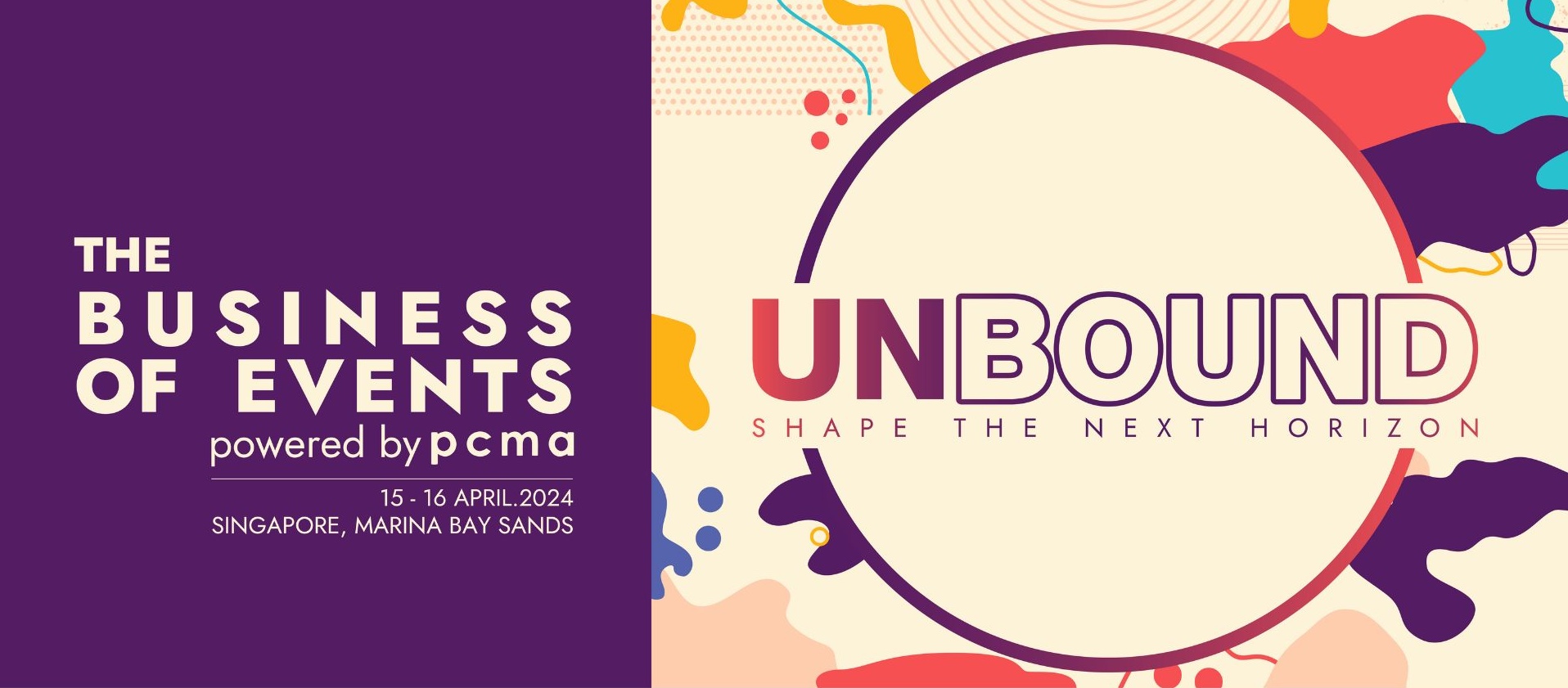 I'm speaking at PCMA Asia Pacific
I am speaking at The Business of Events powered by PCMA Asia Pacific, at Maina Bay Sands, Singapore on Monday 15th April 2024, where the day's theme will be UNLEARN.
My really excited to be speaking at this event and to be at Marina Bay Sands - it's such a beautiful venue.
My topic is The Future of Middle Managers
A Gallup study revealed that middle managers account for 70% of team engagement variance. These individuals, often considered as influencers and shapers of organisational culture, play a pivotal role in the evolving workforce. Known as the “doers” and reliable pillars in stressful times, their significance is undeniable. However, there’s a need to question if leaders fully grasp the challenges middle managers face. This session aims to shed light on tackling these pain points through unlearning and offer strategies to optimise middle management performance, thereby enhancing overall organisational effectiveness.
Check out the event here: https://www.pcma.org/apac/thebusinessofevents-programme-day-unlearn/
I absolutely love the idea of reframing our thinking, no matter what industry you're in.
What do you need to UNLEARN in order to be, think, do better?
In the lead up to this amazing event, I was interviewed by PCMA, I'm currently featured on their front page (tad excited about that), you can check out the interview here: https://www.pcma.org/great-leadership-starts-with-self-leadership-how-middle-managers-fit-events-industry/
Tags: Management
Location: Anywhere - Travel from Brisbane, Au Fees: $7,500
Service Type: Service Offered
Location: Anywhere - Travel from Brisbane, Au Fees: $7,500
Service Type: Service Offered
 The Five Key Ingredients (& Secret Sauce) of High Performing Middle Managers
Location: Anywhere - Travel from Brisbane, Au Fees: $7,500
Service Type: Service Offered

 Speaker ReelHave you ever lost it?Cadence over chaos: how rhythms build trust and speedMirror the Mission: Build a Team Scoreboard that Drives StrategyHow Fresh is Your LeadershipAfrican Safari and Elephant Leadership