Nov27
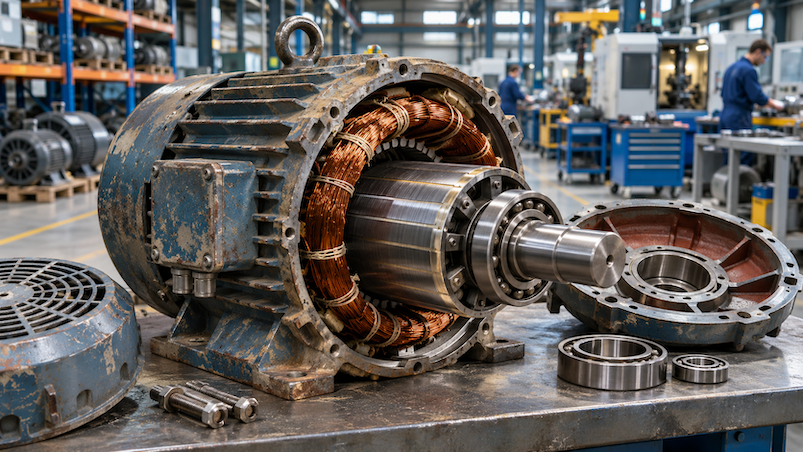
Imagine a manufacturer facing a copper shortage in 2035. Its procurement team is negotiating with suppliers, finance is modelling commodity price increases, and executives are concerned about geopolitical exposure.
Meanwhile, thousands of tonnes of copper the company previously purchased are sitting inside products it sold years earlier.
In buildings. In machinery. In vehicles. In electrical equipment.
Yet the company knows remarkably little about where those materials are, when they might become available again, or how it could recover them.
Businesses invest enormous sums improving visibility across their upstream supply chains. Perhaps it's time they devoted rather more attention to what happens downstream.
As competition for strategically important materials intensifies, today's customers could become tomorrow's suppliers. And the implications extend into industrial decarbonisation, product design, corporate finance, artificial intelligence and the economics of manufacturing itself.
Circular economy discussions have traditionally centred on waste reduction, recycling and environmental responsibility. All worthwhile objectives, but the commercial rationale is becoming considerably more compelling.
The International Energy Agency's Global Critical Minerals Outlook 2026 projects a potential 25% shortfall in primary copper supply in 2035, based on the current project pipeline.
We're electrifying transport, expanding electricity grids, deploying renewable energy infrastructure and building vast amounts of computing capacity. All require materials, and copper is particularly difficult to substitute in many electrical applications.
Meanwhile, UNEP's Global Resources Outlook 2024 estimates that global material extraction could increase by 60% between 2020 and 2060 without significant changes in resource management.
That exposes a strategic weakness in conventional manufacturing. We've built extraordinarily sophisticated systems for acquiring, transforming and distributing materials, yet comparatively rudimentary mechanisms for getting them back.
I explored this issue with Darren West, Global Head of Circular Economy at SAP, on a recent episode of my Climate Confident podcast.
Darren argues that circularity is increasingly being viewed through the lens of geopolitics, material scarcity and strategic resilience.
The IEA's research on critical minerals recycling suggests secondary copper supply, excluding scrap used directly, could meet nearly 40% of copper demand by 2050 in its Announced Pledges Scenario, compared with 17% at the report's baseline.
Recycling won't eliminate the need for new mines. Growing demand and long product lifetimes impose physical constraints on material recovery.
But circularity doesn't need to replace primary extraction entirely to become a significant source of competitive advantage. Diversifying material supply, reducing exposure to commodity markets and potentially cutting emissions are compelling objectives in themselves.
Conventional manufacturing rewards businesses for selling more products. Once a product leaves the factory, responsibility for it generally passes to the customer, along with the residual value of its materials.
That increasingly looks like a missed opportunity.
As Darren explained:
Once you sell something and you know who your customer is, then you can build a relationship, which means that you can get your materials back.
Established businesses are already demonstrating how this can work.
Caterpillar's remanufacturing and core-return programme incentivises customers to return used components when purchasing remanufactured replacements. Caterpillar gains access to components whose specifications it already knows, while customers can benefit from lower replacement costs.
A more familiar example is Apple's Trade In programme. Customers receive credit for eligible devices, while devices without remaining trade-in value can be recycled free of charge.
According to its 2026 Environmental Progress Report, Apple returned more than 15 million devices and accessories to circulation through its various reuse programmes in 2025. Its investments in specialised disassembly technologies, including the Daisy robot, also help recover valuable materials from end-of-life devices.
What's interesting is the alignment of commercial incentives. Apple encourages repeat business, customers recover some of their original investment, and products or materials re-enter the supply chain.
There is an environmental caveat: encouraging premature replacement of perfectly functional devices could erode some of the climate benefits. Keeping products in productive use for longer generally offers greater environmental value.
Nevertheless, both examples demonstrate how customer relationships can become channels for material recovery.
Product-as-a-service models take this considerably further.
When manufacturers retain ownership and generate revenue from an asset's performance or availability, durability becomes financially attractive. So do repairability, modularity and ease of disassembly.
The incentive shifts from maximising unit sales to maximising the economic value generated by each asset throughout its lifetime.
Electric vehicle batteries offer an interesting example. Where a battery retains useful capacity beyond the economic life of its original vehicle, retained ownership could facilitate refurbishment, redeployment or eventual material recovery.
Of course, service-based models bring financing costs, working capital requirements, residual value risks and repair infrastructure obligations. Customers may also prefer ownership over another subscription.
The objective isn't to convert every product into a service. It's to find commercially viable mechanisms for recovering value, whether through retained ownership, deposits, trade-ins, buybacks or specialist recovery partnerships.
Consider two steel beams recovered from buildings being dismantled.
One comes with reliable records of its composition, structural specifications, manufacturing history and previous use. The other has no documentation.
Despite their physical similarities, their commercial value could be substantially different.
The documented beam may be easier to assess for structural reuse. The undocumented beam could require additional testing, creating costs and uncertainty that make recycling it as scrap more commercially attractive.
The difference?
Information.
A 2026 study of structural steel reuse, published in the journal Buildings, examined several European construction projects. In one case, involving the relocation of a warehouse and attached office building in Romania, original design documentation and steel certificates enabled the structure's reuse without laboratory material testing.
Preserving information about physical assets can help preserve their economic value.
This is where digital product passports (DPPs) become particularly interesting.
The European Union's Ecodesign for Sustainable Products Regulation establishes a framework for introducing digital product passports across selected product categories. Depending on the applicable requirements, passports may include information about material composition, environmental performance, durability, repairability and recycling.
Requirements are being introduced progressively through product-specific rules. But businesses focusing exclusively on regulatory compliance risk overlooking a considerably larger opportunity.
Imagine product information remaining accessible throughout an asset's useful life, across changes of ownership, repairs, upgrades and eventual decommissioning.
Manufacturers could identify recoverable components. Repair businesses could source replacement parts more efficiently. Demolition contractors could assess the reuse potential of construction materials before dismantling buildings. Procurement teams could purchase recovered components with greater confidence.
Reliable documentation doesn't remove the need for inspection, testing, certification or engineering judgement. It can, however, reduce the information asymmetry that frequently inhibits markets for secondary materials.
Businesses treating digital product passports as compliance documents may satisfy regulators. Those using them to develop new services and markets for recovered materials could gain a significant competitive advantage.
What happens when purchasing decisions are increasingly delegated to artificial intelligence?
An AI procurement agent could evaluate hundreds of suppliers against criteria covering price, quality, availability, material composition, carbon intensity and regulatory compliance.
But it needs reliable data.
During our conversation, Darren described an SAP project involving an AI agent that gathers information for a fashion business from fragmented enterprise systems, purchasing records and laboratory test reports. It identifies missing information and can initiate workflows to obtain it.
It's a company-reported example rather than an independently evaluated outcome, but it illustrates how AI could reduce the considerable administrative effort involved in assembling usable product information.
I've written previously about why unreliable emissions data has become a supply chain risk. Agentic procurement could amplify that risk considerably.
Imagine two suppliers offering comparable products at similar prices. One provides verifiable, machine-readable information about materials, product carbon footprints and relevant certifications. The other offers a glossy sustainability brochure and incomplete spreadsheets.
If procurement agents are instructed to prioritise verified environmental performance, the second supplier could increasingly struggle to compete.
However, the purchasing criteria matter enormously. A well-documented high-carbon product is still a high-carbon product. An AI agent instructed to prioritise price above everything else will do precisely that.
AI offers the possibility of integrating environmental performance into procurement decisions at scale. Realising that opportunity depends on data quality, purchasing criteria, governance and commercial incentives.
Research from UNEP's International Resource Panel into remanufacturing, refurbishment, repair and direct reuse identifies substantial opportunities to reduce production-related environmental impacts across several industrial sectors.
Retaining a functioning component can avoid much of the energy and material consumption associated with manufacturing its replacement. Direct reuse can preserve value that would otherwise be lost through melting, shredding or chemical reprocessing.
But circularity metrics alone don't demonstrate emissions reductions.
Reducing packaging compliance costs, increasing recycled content or automating sustainability reporting can deliver commercial benefits. The climate outcome depends on what happens subsequently in the physical economy.
Does recovered material actually displace virgin production? How much energy is consumed in collection, transportation and reprocessing? Does extending a product's life avoid manufacturing emissions, or prolong the operation of inefficient equipment?
A lifecycle perspective is essential.
Recovery volumes also depend on product lifetimes, collection rates, material quality and the availability of economically viable processing infrastructure.
These are reasons to invest intelligently in circularity, rather than reasons to dismiss it.
If I were leading a manufacturing business today, I'd start with one strategically important material.
Bring procurement, product design, finance, manufacturing, sustainability and aftersales teams together and ask:
How much of this material do we purchase annually?
Where does it end up after we sell our products?
What proportion could realistically be recovered, and when?
What would recovery cost compared with continued primary material purchases?
What lifecycle emissions reductions and improvements in supply security could we achieve?
What changes to product design, customer relationships or commercial incentives would improve those outcomes?
That exercise could reveal opportunities invisible to procurement teams focused exclusively on upstream suppliers, sustainability departments operating in isolation, or finance functions concentrating on the next reporting period.
For decades, manufacturing strategy has concentrated on getting materials into factories and finished products out of them.
In a century increasingly characterised by competition for resources and the imperative to decarbonise industry, getting those materials back may become just as important.
The products you're selling today could form part of the supply chain your business depends on tomorrow.
How much do you know about them once they've left your factory?
For more on circular business models, digital product passports, emerging regulation and the role of AI in product information management, listen to my full conversation with Darren West, Global Head of Circular Economy at SAP, on Climate Confident. We also explore the practical economics of material recovery and why successful circularity requires coordinated decisions across multiple business functions.
By Tom Raftery
Keywords: Climate Change, Supply Chain, Sustainability
Your Next Supply Chain May Be the Products You've Already Sold Friday’s Leadership Reflection Quote – Saeculum Leadership: Leadership Builds Beyond Its Lifetime
 The Corix Partners Friday Reading List - November 27, 2026
 Lost without the technology: Are we outsourcing our ability to think?
 The VIP List: 30 Global Trends to Watch in 2027