Nov27
FLRQ226 | Leadership Learning: Are you building institutional architecture that others can inherit, steward and develop long after your leadership ends?
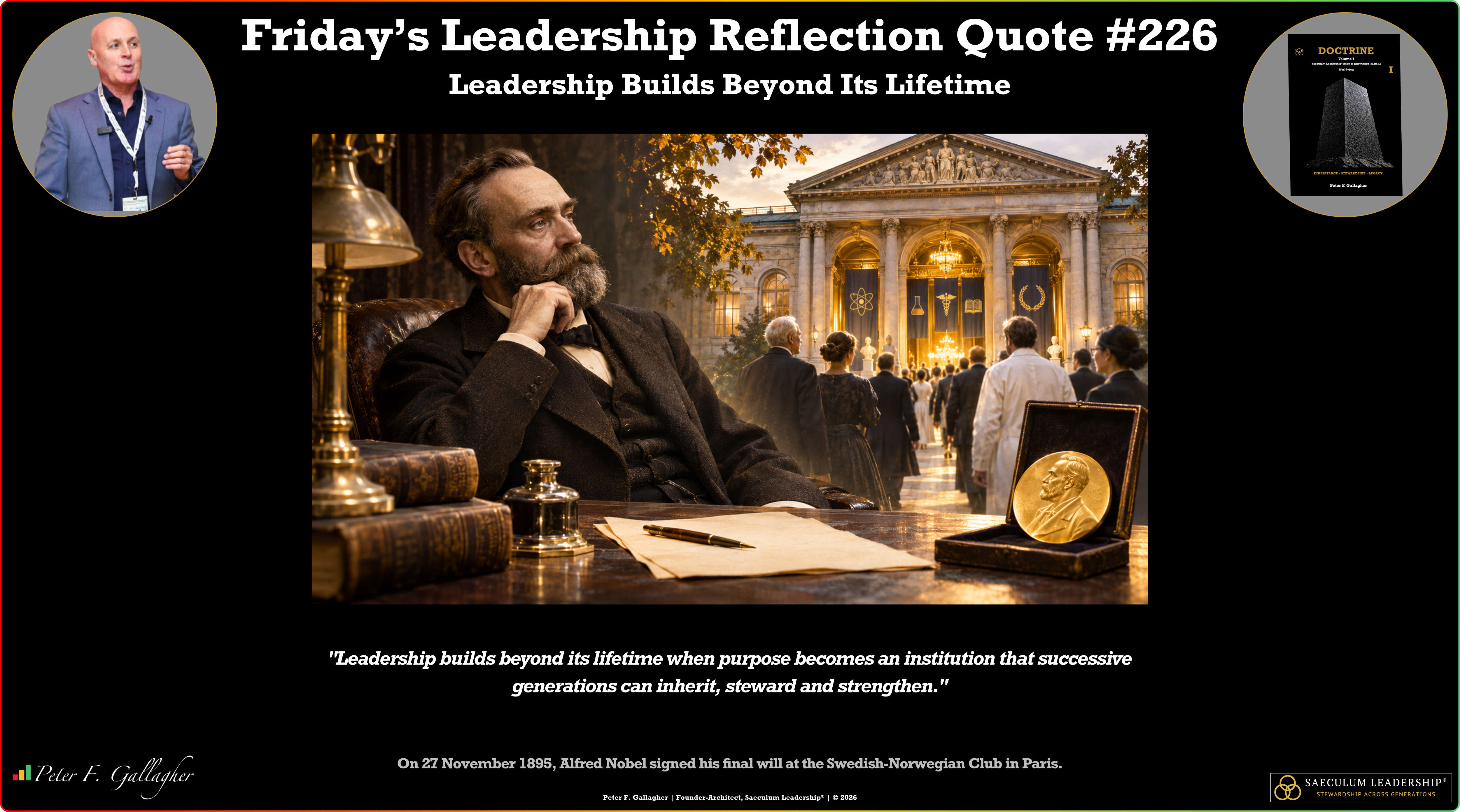
On 27 November 1895, Alfred Nobel signed his final will at the Swedish-Norwegian Club in Paris. He directed that most of his estate be invested in a fund to finance five annual prizes recognising achievement in physics, chemistry, physiology or medicine, literature and peace. Following his death in 1896, the Nobel Foundation was established in 1900, with the first prizes awarded in 1901. A decision made by one individual laid the foundations for an institution intended to serve successive generations.
Nobel’s inheritance extended beyond material wealth. He inherited a family tradition of engineering, invention and enterprise, shaped by his father Immanuel’s achievements and setbacks. Following his father’s bankruptcy in Sweden, the family eventually benefited from his commercial success in St Petersburg. Alfred grew up in an environment of technical experimentation, commercial risk and international enterprise. Privately educated, he developed proficiency in five languages and pursued chemistry and engineering. He subsequently built international industrial enterprises supported by inventions, patents and commercial partnerships. His achievements were enabled by inherited knowledge, capability and opportunity, but were not predetermined by them.
During his lifetime, Nobel accumulated substantial financial resources, intellectual property, commercial interests and scientific standing. His fortune was connected to industries that enabled construction and mining but also contributed to warfare and destruction. His final will redirected much of that accumulated wealth towards the recognition of work intended to benefit humanity, irrespective of the nationality of those undertaking it. Realising that vision subsequently required his executors, Ragnar Sohlman and Rudolf Lilljequist, to overcome legal, financial and family challenges. Nobel had articulated the purpose; others inherited the responsibility for making it endure.
The deeper significance lies in the distinction between possession and stewardship. Nobel transformed accumulated resources into the foundations of a generational inheritance. His enduring legacy depended not on wealth alone, but on institutional arrangements and successive stewardship capable of carrying his purpose beyond his lifetime.
Within Saeculum Leadership®, this is primarily an Institutional Legacy Signal, with a secondary Knowledge Architecture Signal: accumulated resources were directed towards the continuing recognition of human achievement. The primary Leadership Responsibility is Vision, demonstrated through Nobel’s articulation of a purpose intended to serve generations he would never meet. Model and Intervene became relevant to those subsequently responsible for translating that purpose into practice. The historical turning point illustrates that legacy is not secured at the moment of decision; it depends on the institutional architecture and successive stewardship that make an intention durable across generations.
Saeculum Leadership® Lessons: Saeculum leaders diagnose what they have inherited, recognising the capabilities, resources, institutional foundations and responsibilities entrusted to their stewardship. They establish evidence of what must be preserved, strengthened or transformed to create enduring value beyond their tenure. Saeculum leaders mobilise people, knowledge and resources around a clearly articulated purpose that transcends individual interests and immediate objectives. They execute decisions by establishing the governance, structures and responsibilities through which others can sustain that purpose. Saeculum leaders steward what they build, ensuring that succeeding generations inherit not only the benefits of their decisions, but also the capability to preserve, strengthen and develop them. Leadership Builds Beyond Its Lifetime.
“Leadership builds beyond its lifetime when purpose becomes an institution that successive generations can inherit, steward and strengthen.”
From the Canon — Practice 5 — System Stewardship: System Stewardship is the discipline through which leaders establish, strengthen and preserve the institutional architectures that future generations inherit.
Alfred Nobel’s final will of 27 November 1895 illustrates this principle. He articulated a purpose and entrusted others with the responsibility for realising it. The subsequent creation of the Nobel Foundation demonstrates that an enduring legacy requires both the vision of its originator and the stewardship of succeeding generations.
System Stewardship begins with recognising that purpose alone does not endure. Aspirations, values and intentions achieve institutional continuity when they are translated into structures, responsibilities and governing arrangements capable of surviving changes in leadership, circumstance and time.
This requires leaders to look beyond immediate outcomes towards institutional continuity. Knowledge must be preserved, responsibilities clearly assigned and mechanisms established through which purpose can be sustained and renewed. Effective stewards recognise that institutions rarely endure through preservation alone; they endure because successive generations are able to adapt and strengthen them without losing sight of their founding purpose.
This is the Saeculum Continuum in practice: responsibility passes between generations, together with the knowledge, capability, institutional architecture and consequences of preceding stewardship.
The ultimate measure of System Stewardship extends beyond the success achieved during a leader’s tenure. It is whether leaders leave their successors stronger institutions, clearer purpose and greater capability than they themselves inherited.
The Stewardship Reflection Lens:
What are we inheriting? What resources, knowledge, capabilities and responsibilities have been entrusted to our stewardship?
How should we steward it? What must we preserve, strengthen or transform to ensure that institutional purpose and capability endure beyond our tenure?
What legacy are we creating? Will others inherit stronger institutions and greater capability because of our stewardship?
INHERITANCE • STEWARDSHIP • LEGACY
Further Reading: Saeculum Leadership® Body of Knowledge (SLBoK); Saeculum Leadership®: Doctrine — Volume I.
For further insights into Saeculum Leadership®, institutional stewardship and leadership across generations, please contact Peter F. Gallagher at Peter.gallagher@a2B.consulting.
For further insights please visit our websites: https://www.a2b.consulting https://www.peterfgallagher.com Amazon.com: Peter F Gallagher: Books, Biography, Blog, Audiobooks, Kindle
Saeculum Leadership® Body of Knowledge (SLBoK): Volumes 1-10.A-E & 0, I-VI
~ Saeculum Leadership®: Doctrine — Volume I
~ Leadership of Change® Volume 1 - Change Management Fables
~ Leadership of Change® Volume 2 - Change Management Pocket Guide
~ Leadership of Change® Volume 3 - Change Management Handbook
~ Leadership of Change® Volume 4 - Change Management Leadership
~ Leadership of Change® Volume 5 - Change Management Adoption
~ Leadership of Change® Volume 6 - Change Management Behaviour
~ Leadership of Change® Volume 7 - Change Management Sponsorship
~ Leadership of Change® Volume 8 - Change Management Charade
~ Leadership of Change® Volume 9 - Change Management Insanity
~ Leadership of Change® Volume 10 - Change Management Dilenttante
~ Leadership of Change® Volume A - Change Management Gamification - Leadership
~ Leadership of Change® Volume B - Change Management Gamification - Adoption
Keywords: Business Strategy, Change Management, Leadership
Friday’s Leadership Reflection Quote – Saeculum Leadership: Leadership Builds Beyond Its Lifetime The Corix Partners Friday Reading List - November 27, 2026
 Lost without the technology: Are we outsourcing our ability to think?
 The VIP List: 30 Global Trends to Watch in 2027
 The Empty Chair at Thanksgiving: Remembering the Employees Who Are No Longer at the Table