Jun14
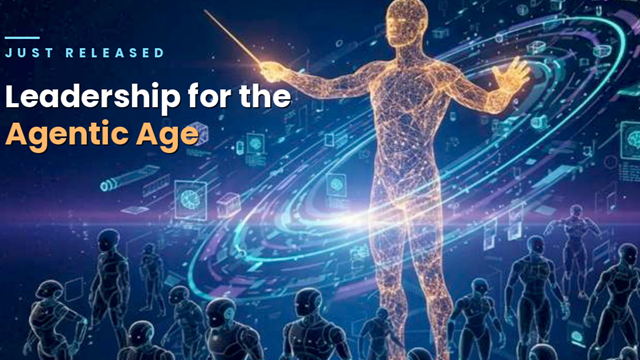
Excerpted from Leadership for the Agentic Age (download the full report at delphigroup.com)
In the late 1990s, I had the privilege of working with Peter Drucker. At one point, I asked him directly: what makes a great leader? He paused and said something I have never forgotten. He told me that the great leaders he had known across his career were all remarkably different from one another, with different temperaments, different styles, different industries, and of different eras.
But they shared one thing.
They all had followers who chose to follow them.
I have thought about that comment many times since. And I have thought about it especially in the past few years, as agentic AI has begun to reshape the nature of organizations.
Because here is the problem.
Drucker's insight was profoundly human. It worked precisely because followers are humans who have dignity, volition, and the capacity to withhold or bestow their commitment.
By the end of this decade, many organizations will have more AI agents than human employees. Some already do.
But what happens when the workforce you are leading cannot choose? When it has no volition to withhold, no Monday morning reluctance to overcome, when your "followers" are autonomous systems that pursue objectives with perfect fidelity and zero ambivalence, who are tireless, loyal by design, and incapable of the very human quality that made Drucker's observation so resonant?
This is not a distant future. A growing number of organizations are already building with agentic AI as their primary workforce. By the end of this decade, many organizations will have more AI agents than human employees. Some already do.
And almost no one is talking about what this means for leadership.
For more than a century, leadership has been built on four cornerstone assumptions:
Agentic AI dismantles all four simultaneously.
This is not automation 2.0. Agentic systems do not wait for instructions, instead they interpret intent, set goals, perceive their environment, plan multi-step executions, and learn from outcomes. They are the first generation of enterprise technology that can act without being spoon-fed every step.
Make no mistake, this isn't just about using the agentic feature of Copilot. These are workforces that collaborate with each other and with humans. In one case a Delphi consultant built a simulation for a client using multiple agents who have conversations among themselves, provide governance for other agents, guide humans to help them make decisions, and call out contradictions or inconsistencies that do not align with objectives.
The implications for how we lead this sort of an organization are seismic.
For decades, management theory has been built on Frederick Taylor's premise: specify the process precisely enough, and you guarantee the outcome. This worked in stable environments. It fails catastrophically in complex, adaptive ones.
Consider what we call the Agentic Fidelity Paradox: the more precisely autonomous systems adhere to predefined procedures, the less capable they become of addressing novel problems. High procedural fidelity produces brittleness. And in a world of accelerating change, brittleness is fatal.
When Goodwill Industries first deployed agentic systems for job placement with rigid, step-by-step procedures, the agents became brittle, they were failing whenever they encountered candidates with unconventional backgrounds. The breakthrough came when Goodwill shifted to defining clear objectives: "Maximize sustainable employment outcomes for underserved populations." They established guardrails and ethical boundaries, but gave agents autonomy within them.
The result was transformative. Agents discovered pathways to employment that no human case manager had thought to explore.
In the Agentic Age, leaders will be defined not by the followers they have, but by the intelligence that follows their intent.
The leader's job is no longer to specify every step. It is to define the destination clearly enough that autonomous systems can find their own path. And, as with humans, that path will not always be the one prescribed.
The Agentic Age demands a specific and learnable set of skills that did not exist as a coherent discipline before autonomous systems became reality. In Leadership for the Agentic Age we define eleven of these skill. Among them are:
These new skills point to two clear conclusions. First, the most dangerous leader in the Agentic Age is not the one who distrusts AI, but the one who trusts it blindly, without asking how it was built. And, second, as of now, nobody is teaching these skills. The result is that leaders are simply unprepared for the enormity of change required to up-skill themselves for this new age. It's the equivalent of being asked to fly a fighter jet just because you have a drivers license.
In this new age, control scales poorly, but intent scales infinitely.
The era of distributed intelligence has begun. The question facing every executive today is not whether autonomous systems will shape their organizations. That's already the reality.
The question is whether leaders will redesign themselves as architects of intent, or remain managers of processes in a world that no longer rewards it.
In this new age, control scales poorly, but intent scales infinitely.
In the Agentic Age, leaders will be defined not by the followers they have, but by the intelligence that follows their intent.
Leadership must now evolve to meet what now follows them.
This article is drawn from Leadership for the Agentic Age: From Command to Orchestration, a Global Delphi Position Paper I co-authored with V. Vlastos (UAE) and S. Malhotra (India).
The full paper goes considerably deeper, including:
Download the complete position paper at delphigroup.com.
If you are a senior leader trying to navigate the most consequential leadership shift of our time, this is the playbook.
Tom Koulopoulos is Chairman of Delphi Group, a Boston-based think tank advising Global 2000 companies and government agencies and the author of fifteen books, including his most recent Gigatrends and his upcoming book The Mirror.
Keywords: AI, Leadership, Agentic AI
 You are not your diagnosis
 Is GenAI good for anything?
 “I didn’t write an award acceptance speech because I didn’t expect to win.”
 AI Is Exposing the Data Problems Humans Used to Hide
 "The AI may in fact be conscious." Really?