Aug20

Every procurement and contract management professional has experienced it: a disruption happens somewhere in the world, and within days the phone starts ringing. Suppliers cannot deliver. Lead times double. Prices spike. Clauses that once seemed irrelevant suddenly become the most important sentences in your portfolio.
The Strait of Hormuz is one of the most illustrative examples of this phenomenon. Roughly 20 percent of the world's oil and an enormous share of liquefied natural gas passes through this narrow body of water between Iran and Oman. When geopolitical tension rises in the region, energy markets react within hours. Within weeks, freight rates change, production costs shift, and the assumptions built into multiyear contracts begin to erode. Any organisation that depends on energy-intensive manufacturing, petrochemical inputs, or global freight is exposed, whether they know it or not.
The uncomfortable truth is that most organisations discover their exposure only after the disruption has already materialised. The question this article addresses is why that keeps happening, and how the intelligent use of AI in scenario modelling can fundamentally change that pattern. More importantly, it will become clear that artificial intelligence alone cannot solve the problem. A superior AI in supply chain risk requires a superior contract management process to sit underneath it. Without that foundation, the intelligence has nowhere to land.
Scenario modelling is not about predicting the future. It is about preparing for a range of plausible futures by mapping out cause-and-effect chains across a system. In supply chain terms, this means understanding how a specific event in one part of the world propagates through supplier networks, logistics routes, commodity markets, regulatory environments, and contractual obligations.
Traditional scenario modelling was largely manual, slow, and narrow. Analysts would build spreadsheet models based on historical data, expert judgment, and a limited number of variables. These models were useful but had significant limitations. They could not process real-time data at scale. They could not simultaneously evaluate hundreds of interdependencies. And they required weeks of work to update when circumstances changed.
AI changes this equation substantially. Modern AI systems can ingest vast quantities of structured and unstructured data simultaneously: shipping manifests, geopolitical news feeds, commodity price indices, port congestion reports, supplier financial data, weather patterns, and more. They can identify non-obvious correlations between variables that human analysts would never connect. And they can run thousands of scenario variations in minutes rather than weeks.
This is not a theoretical capability. It is being deployed now by leading organisations in energy, aerospace, automotive, and defence. The gap between those who are using it and those who are not is growing rapidly.
The Hormuz situation is an excellent training case for AI-driven supply chain scenario modelling, and understanding why reveals something important about how this technology works.
A well-designed AI model for supply chain risk is not trained in the traditional machine learning sense of simply feeding it historical data and hoping it generalises. The most effective approach combines historical pattern recognition with structured causal modelling. The Hormuz situation illustrates why both dimensions matter.
Historically, the strait has seen several periods of heightened tension: the tanker wars of the 1980s, the 2019 attacks on oil tankers, and recurring threats of closure in recent years. Each of these events generated a specific pattern of consequences: immediate freight rate increases on certain routes, substitution flows through alternative corridors such as the Cape of Good Hope, reactive inventory building by downstream buyers, and delayed effects in energy-intensive production sectors. An AI system trained on these patterns learns the typical propagation speed and magnitude of Hormuz-related disruptions.
But historical patterns alone are insufficient. The current situation has characteristics that differ from prior episodes, including different geopolitical actors, different energy market structures, different LNG contract configurations, and different inventory levels across the supply chain. This is where causal modelling comes in.
A sophisticated AI system models the causal logic of the supply chain ecosystem: if throughput at Hormuz falls by 30 percent for 60 days, what does that do to spot LNG prices in Europe? What does that do to energy costs for aluminium smelters in the Netherlands? What does that do to the delivery timelines of suppliers who depend on those smelters? What clauses in those supplier contracts are triggered?
This causal chain approach allows the AI to generate scenario variants that go beyond historical precedent. It can model outcomes the world has never seen before, based on a coherent logic of how the system works. That is qualitatively different from extrapolating from the past.
The practical implication for procurement and contract management teams is significant. With this kind of AI in place, an organisation does not need to wait for a disruption to discover its exposure. It can run a Hormuz stress test on its entire supplier portfolio today, identify which contracts carry the most risk under various disruption scenarios, and take pre-emptive action.
Here is where many organisations hit a wall. The AI produces valuable output. The scenario models identify real risks. But when the procurement team looks at their contract portfolio to understand what they can actually do, they find a collection of documents that was never designed to be machine-readable, never structured for systematic risk analysis, and never maintained with the kind of discipline that would make rapid action possible.
This is the critical connection between AI-driven supply chain intelligence and contract management. The two are not separate domains. They are fundamentally interdependent.
Consider what a contract management process needs to deliver in order to be useful to an AI-driven supply chain risk system. First, contracts need to be structured and tagged in a way that allows the AI to extract relevant clauses systematically: force majeure provisions, price adjustment mechanisms, delivery obligation tolerances, termination rights, and escalation procedures. Second, contract data needs to be current and accurate. An AI scenario model is only as good as the underlying data about what your obligations and rights actually are. Third, the contract management process needs to support rapid decision-making. When a scenario model identifies that a specific supplier contract will become a liability within 90 days if disruption continues, the organisation needs to be able to act on that insight before the window closes.
None of this is possible with a passive, document-centric approach to contract management. It requires an active, structured, and data-disciplined process. It requires people who understand contracts not just as legal documents but as operational instruments in a dynamic business environment.
There is a principle that becomes increasingly important as AI becomes more central to business operations: the quality of your AI is bounded by the quality of your underlying processes and data. In the supply chain risk domain, this principle is particularly acute.
An organisation can invest heavily in the most sophisticated AI scenario modelling platform available. It can build excellent data pipelines from commodity markets and geopolitical intelligence sources. It can run precise scenario analyses of Hormuz disruptions and their second and third-order effects. But if the contract management data that feeds into that analysis is incomplete, outdated, inconsistently structured, or simply unavailable in machine-readable form, the AI's output will be systematically misleading.
Worse, it will be misleadingly precise. The model will produce confident-looking outputs based on flawed contract data. Decision-makers who trust those outputs will make well-informed-seeming decisions based on a distorted picture of their actual risk exposure. This is arguably more dangerous than having no AI at all.
The implication is counterintuitive but important: organisations that want to benefit from AI in supply chain risk management need to invest in contract management capability first. Not because contract management is more important than AI, but because it is the enabling condition for AI to work correctly.
This means building contract management processes that are structured, consistent, and continuously maintained. It means developing competencies in contract data management, not just contract drafting and negotiation. It means treating contracts as live operational instruments rather than static legal archives. And it means aligning the contract management function closely with procurement, supply chain, finance, and risk management, so that insights flow both ways.
One final dimension deserves attention. Supply chain scenario modelling is not just about bilateral relationships between a buyer and its direct suppliers. It is about ecosystems. The Hormuz situation affects not only your tier-one suppliers but also their suppliers, the logistics providers they use, the energy sources they depend on, and the financial conditions under which they operate.
AI is particularly powerful in modelling these multi-tier ecosystem effects, which are largely invisible to traditional supply chain analysis. But capturing these effects requires data that extends beyond direct contractual relationships. It requires visibility into supplier networks, sub-supplier dependencies, and shared infrastructure vulnerabilities.
This is where the future of contract management is heading. Forward-looking organisations are already moving toward supply chain transparency frameworks that require suppliers to share structured data about their own supply chains as a condition of doing business. The contractual obligation to provide this data, and the governance framework that enforces it, is a contract management responsibility.
The organisations that will benefit most from AI-driven supply chain scenario modelling in the next decade are those that are building this capability now, systematically, with contract management as the structural backbone.
The Strait of Hormuz is more than a geographical bottleneck. It is a test case for organisational intelligence. An organisation that can model its exposure to a Hormuz disruption, understand the contractual implications in near real time, and act decisively before the disruption fully materialises has a profound competitive and operational advantage over one that reacts after the fact.
AI makes that kind of intelligence possible. But only if it is built on a foundation of disciplined, structured, and continuously maintained contract management. The lesson is clear: do not wait for the strait to narrow (again or still) before you build that foundation.
Keywords: AI, Ecosystems, Supply Chain
 2027 Predictions for Cybersecurity: The Agent Is the New Insider
 FROM THE AISLE Field Notes on AI Implementation
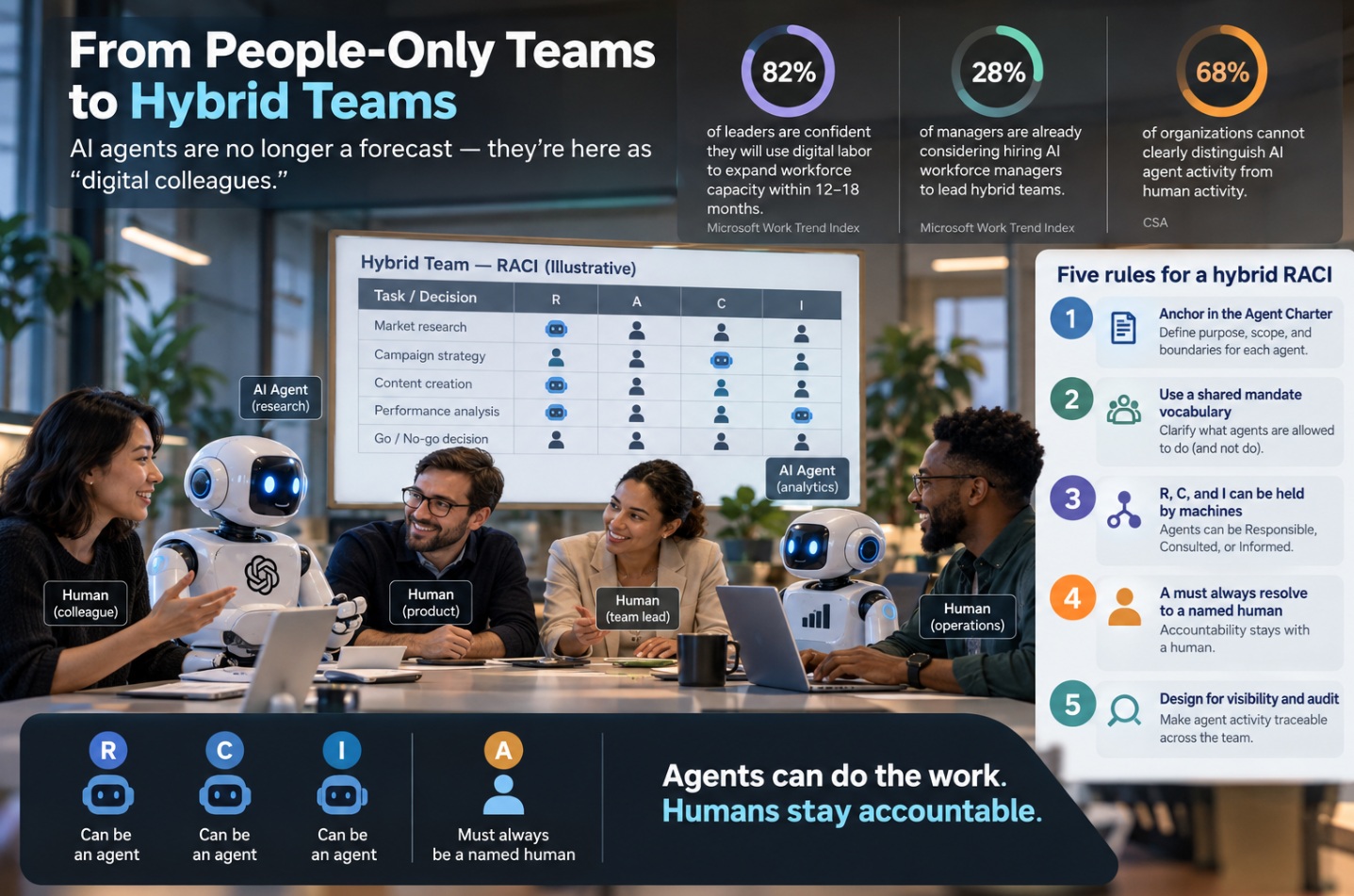 The Hybrid Team: Rethinking RACI When Some of Your Team Members Are Machines
 Two Clocks, One Truck: The Army's Need for Speed Meets New Defense Sourcing Rules
 Sustainable Transformation: The Elephant and The Mouse In The Room