Oct09
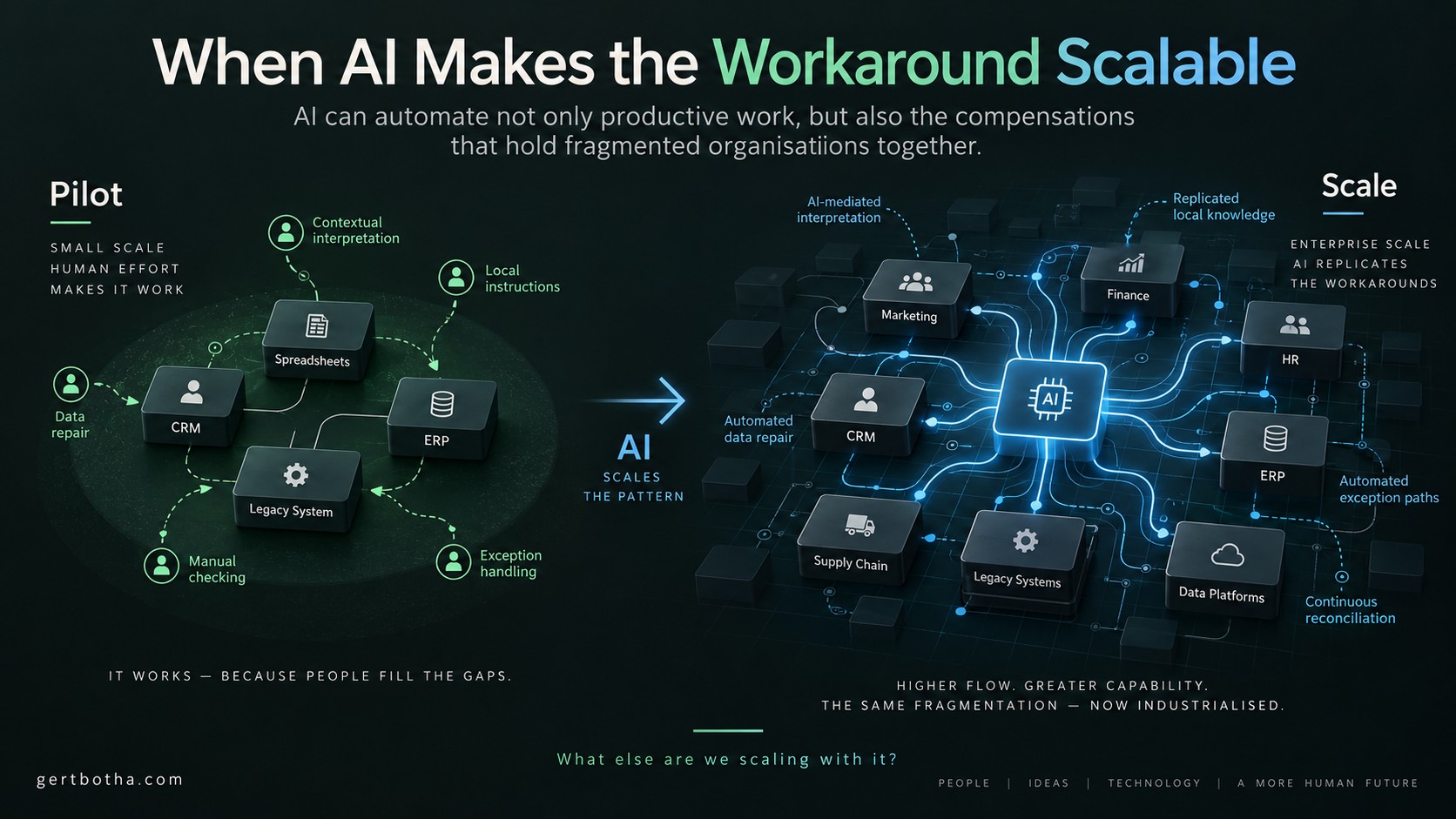
AI can automate not only productive work but also the compensation that holds fragmented organisations together. That can create real value — and make unresolved problems much easier to institutionalise.
POSITIONING FRAME
What is changing: AI can increasingly perform the contextual interpretation, reconciliation, repair and exception handling that people have historically used to bridge imperfections in organisational processes and systems.
Why it matters: This changes the economics of organisational complexity. A workaround that was too expensive to reproduce manually may become inexpensive enough to scale with AI.
Where the tension lies: The same capability that makes an operating model more effective can also make an unresolved condition less visible. Organisations may industrialise the compensation rather than decide whether the underlying problem should still exist.
The practical implication is that organisations should not simply replicate a successful AI pilot. Before scaling, organisations need to understand what made the pilot work and deliberately decide which parts belong in the future operating model.
One of AI's more interesting effects may have very little to do with replacing human work.
AI is making workarounds scalable.
Organisations have always contained more activity than their formal process maps suggest. People reconcile data between systems that were never properly integrated. They know that two departments use the same term differently. They repair incomplete information before it reaches the next process. They interpret local instructions that were never incorporated into the formal design. They know which exceptions matter and which they can safely ignore.
Much of this work is rational. Organisations are rarely designed from scratch, and replacing every inherited system, process and interface would often be economically absurd. But these compensations matter when we start introducing AI.
An AI pilot can replicate more than the capability we think we are testing. It can also depend on the human checking, contextual interpretation, manual data repair, local instructions and exception handling that make the capability appear dependable.
At small scale, people easily miss those contributions. Knowledgeable people remain close to the pilot. They fix things because fixing them takes a few minutes. They explain an unusual case to the project team. They correct an input because they know it is wrong. They recognise that the apparent exception is actually normal for this particular customer or site.
The pilot works. Then we scale it. And everything that made the pilot work becomes a candidate operating function.
This is where AI introduces a genuinely new dynamic.
Historically, some organisational imperfections were constrained by the cost of compensating for them. If two systems could not communicate cleanly, people had to reconcile the difference. If definitions varied across business units, someone had to translate them. If incoming information was unreliable, somebody had to repair it. If a process produced too many exceptions, people had to investigate them.
At sufficient scale, those costs created pressure to address the underlying condition. AI can weaken that pressure. An agent may reconcile two incompatible systems in seconds. Another can interpret inconsistent product descriptions. A model can identify likely data errors and repair them. An AI-enabled workflow can manage thousands of exceptions that previously required teams.
That can be an excellent use of AI. No principle says every inconsistency must be eliminated or every legacy system replaced. Intelligent mediation may be substantially cheaper, faster and less disruptive than rebuilding the underlying architecture. In some situations, the AI workaround may genuinely be the best enduring design.
But that raises a harder management question. Has AI produced a better operating model? Or has it simply made an unresolved problem inexpensive enough to tolerate? Those two outcomes can look remarkably similar from the outside. Both can reduce cost. Both can increase throughput. Both can remove manual effort. Both can make a process appear smoother.
The difference becomes visible later, when the organisation has to change something.
Imagine a financial-services organisation piloting an AI-enabled customer operation.
The agent performs well. It understands requests, retrieves relevant information and resolves a growing proportion of cases without human intervention. But another layer of work sits around the formal process.
Experienced employees know that customer information is represented differently across several inherited systems. Product definitions vary slightly between parts of the business. Some records are incomplete. Certain exceptions require knowledge that was never included in the written policy.
During the pilot, people quietly bridge those gaps.
The organisation now wants to scale.
One option is to redesign the underlying systems, standardise definitions, improve the data and resolve every process ambiguity. That could take years.
Another option is increasingly available: use AI to bridge the gaps. An agent reconciles customer records. Another translates between product definitions. Others reconstruct missing context, interpret local rules or route unusual circumstances. The result may be dramatically better than the old process.
But something important has happened. The organisation has not necessarily removed its fragmentation. It has made the fragmentation easier to live with. That may be the correct decision. Replacing several functioning core systems may cost far more than an intelligent mediation layer.
But it should be a decision. If the organisation copies the same compensation across products, regions, and functions simply because the pilot worked, it may quietly turn a local workaround into enterprise architecture.
AI has industrialised it.
That is why I think organisations will increasingly need to separate two questions often treated as one.
The first is:
Did the AI capability work?
The second is:
Should we scale the complete operating arrangement that made it work?
Those are not the same questions. A pilot may demonstrate genuine capability while relying on conditions that are perfectly reasonable at small scale but undesirable at enterprise scale.
Some of what surrounds the pilot should absolutely be replicated. Some may reflect legitimate differences between customers, sites, products or jurisdictions that the organisation should preserve rather than eliminate. Some controls may be sensible temporary protections while confidence develops.
Some activity may exist only because an unresolved condition has carried forward.
Before scale, those differences need to become visible.
This is not a request for perfection. Organisations should not delay using AI until they've solved every data problem, harmonised every process, and retired every legacy system. That would be another form of poor decision-making.
The point is almost the opposite.
AI gives organisations more design options.
It can allow them to tolerate complexity that previously had to be removed. It can mediate between technologies that would otherwise require expensive integration. It can preserve valuable local variation without forcing everything into one standardised process.
But greater flexibility makes architectural judgement more important, not less. The question is no longer simply whether a workaround exists.
The question is whether the workaround deserves to become part of the future organisation.
There is a further risk. Human compensation eventually becomes visible because somebody has to do the work. A team grows. A queue gets longer. Overtime increases. People complain. The manual reconciliation becomes expensive enough to attract management attention.AI compensation can be much quieter.
An agent works continuously. The marginal cost of another reconciliation may be tiny. The exception queue disappears. Nobody has to maintain a spreadsheet. The service-level metric improves.
Operationally, this may be excellent. From a management perspective, however, the underlying dependency can become harder to see. The organisation may gradually lose sight of a particular AI service because two parts of the business disagree on what customer status means, because one system still produces unreliable information, or because a temporary implementation compromise was never revisited.
The unresolved condition has not disappeared. Its cost has changed. That matters because today's inexpensive compensation can become tomorrow's constraint.
A new product has to pass through it. A regulatory change affects it. Another agent begins depending on its output. A future transformation must understand an increasingly dense layer of intelligent mediation before it can change anything underneath.
What looked like simplification at the interface can therefore create additional dependency behind it.
Again, that does not automatically make the design wrong. But it does make the design consequential.
This connects to a wider organisational pattern. Organisations rarely carry only the visible consequences of earlier decisions. They also carry the arrangements created to make those decisions workable: additional approvals, extra reconciliation, informal expert intervention, duplicate information, exception routes and protective controls.
Sometimes those arrangements remain necessary. Sometimes the original constraint disappears while the arrangement remains. AI can help remove that burden. But AI can also make carrying it much cheaper.
That distinction matters. If an agent eliminates hours of manual reconciliation caused by two systems that can't be replaced economically, AI may be removing a genuine operating burden.
If an agent performs the same reconciliation because nobody wants to resolve an avoidable inconsistency between two teams, AI may make the burden easier to carry rather than remove it.
The technology can look identical. The management judgement is not.
Before an AI pilot scales, the organisation needs to understand the full capabilities that make it dependable.
Not merely the model. Not merely the agent. The whole arrangement.
What did people correct? What context did they contribute? Which exceptions did they interpret? Which local differences mattered? What protection existed because the technology was new? Which problems were temporarily tolerated because the pilot was small?
The objective is then to distinguish four very different things.
This is not a checklist to complete after the pilot. That's why you should treat scale as a new decision.
Volume changes economics. Diversity introduces conditions the pilot may never have encountered. Wider deployment exposes local assumptions. Greater authority increases consequence.
What was negligible in a contained environment may become structural at scale. And AI itself may make that structural burden surprisingly cheap.
The usual scaling question is straightforward:
Can this capability work across the enterprise?
I think organisations will increasingly need another one:
What else are we scaling with it?
Most likely, the answer is some combination of all four.
The quality of the enterprise design depends on whether we understand that combination before we multiply it.
This matters because the AI era may not simply eliminate organisational complexity. In some cases, it will make complexity much easier to sustain. That can be an enormous advantage. Organisations may preserve valuable diversity, extend the life of expensive systems and connect capabilities that would otherwise remain isolated. But the same economics can preserve arrangements that no longer deserve to exist.
Leaders therefore need to distinguish between intelligent mediation and automated avoidance.
One is an architectural choice. The other is a problem that has become cheaper to ignore.
AI is making organisational workarounds scalable.
That is not inherently a problem. In many cases, AI-mediated reconciliation, interpretation and exception handling may be substantially better than removing the underlying complexity.
But cheap compensation changes management incentives. Problems that once became visible because they consumed people and money can increasingly disappear inside intelligent operating layers.
The next challenge, therefore, is not simply to scale AI successfully.
It is to know what the organisation is scaling with it. A successful pilot demonstrates that something can work. It does not establish that every condition surrounding that success belongs in the future operating model.
The better question before scaling is: Has AI created the best enduring design — or has it simply made an unresolved problem inexpensive enough to tolerate?
By Gert Botha
Keywords: AI, Digital Transformation, AI Governance
When AI Makes the Workaround Scalable The Age of Continuous Shocks: Why the coming downturn will be decided in your supply chain
 Friday’s Leader Reflection Quote – Saeculum Leadership Leaders Accept Decisions Create Responsibilities
 The Corix Partners Friday Reading List - October 9, 2026
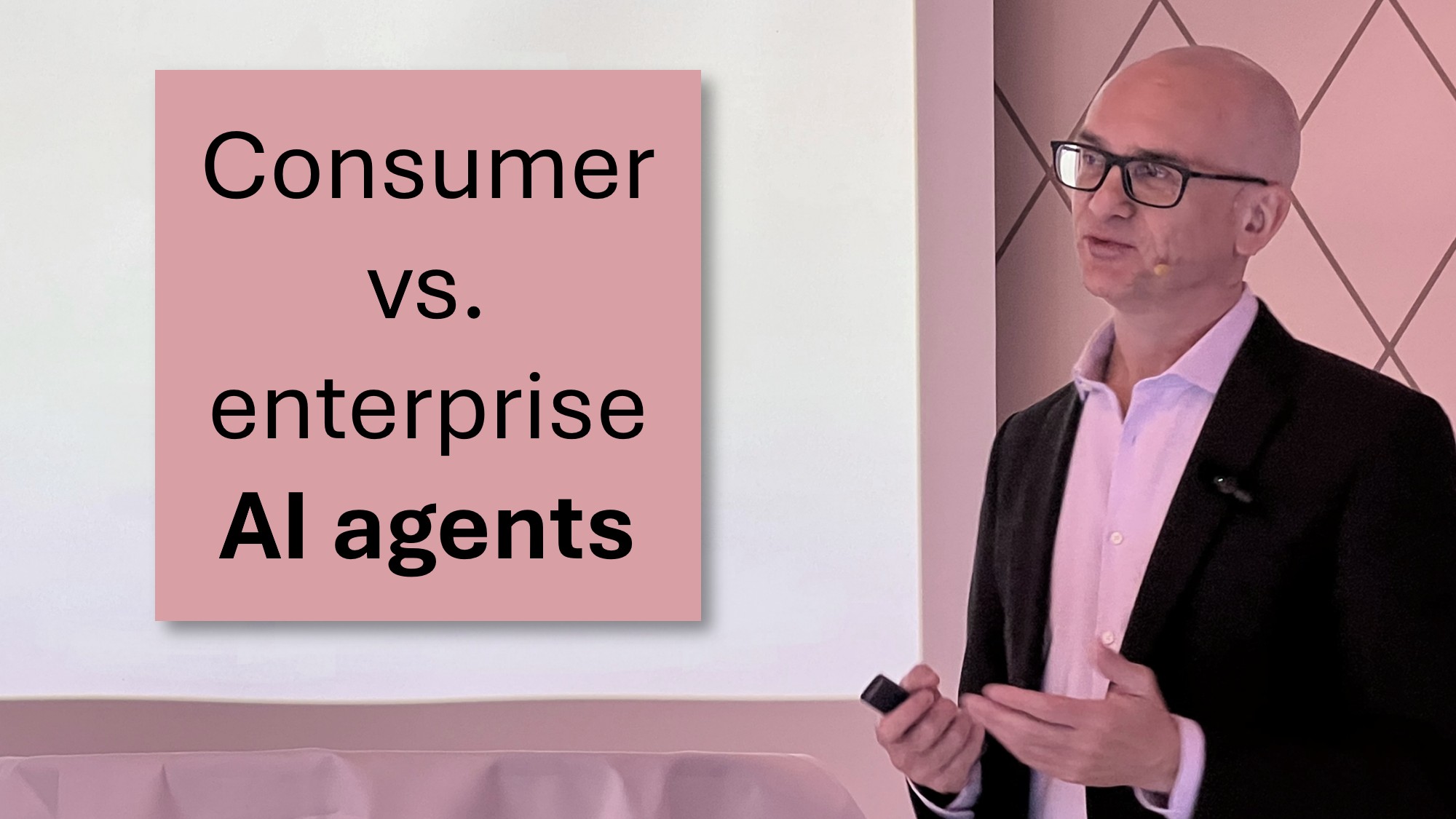 Consumer vs. enterprise AI agents