
Sep21
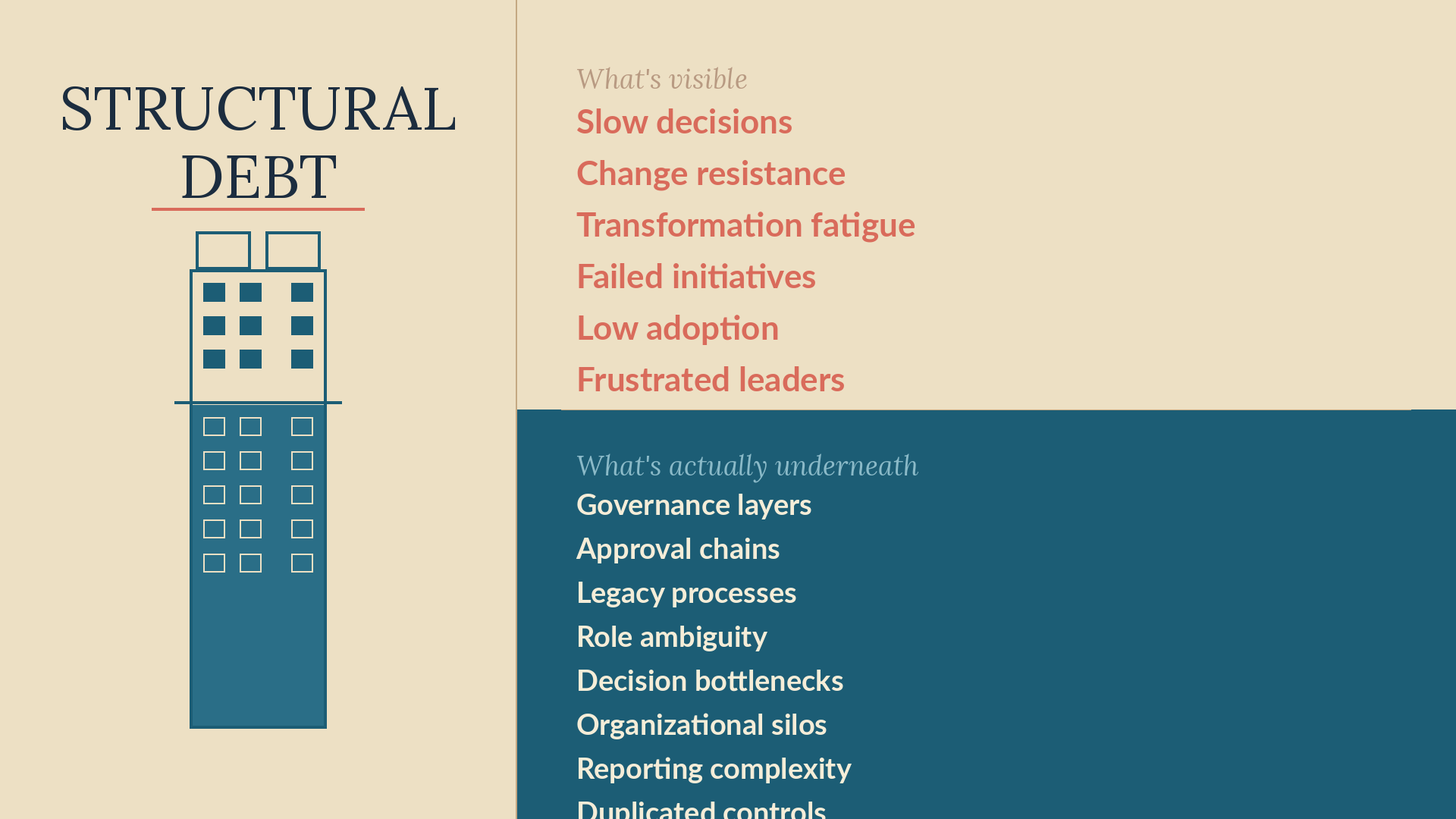
Every organization keeps a balance sheet, a risk register, and an org chart. None of the three will show where the organization has taken on debt nobody is assigned to pay off.
Financial debt gets found because someone external demands to see it and there is usually a due date when it must be paid in full. A lender wants to see how much debt is on the books before extending additional credit. An auditor wants the reconciliation. A board wants the ratio explained before the next raise. Technical debt gets found for a similar reason: a security review, a platform migration, a new engineering leader who inherits a codebase and has to justify slowing down to fix it. Both kinds of debt survive for a while, but eventually something outside the system that created them forces a closer look.
Structural debt stays hidden because it has no equivalent. Nobody outside the organization has a reason to demand a review of its decision rights, its approval chains, or the reporting lines that made sense under a structure that no longer exists. There is no due date for someone to pay attention to. So it accumulates without a forcing resolution, and it is usually discovered the same way: a new leader arrives, tries to move something simple, and cannot work out who actually has the authority to say yes.
McKinsey's 2020 survey of fifty CIOs at large financial-services and technology firms found that ten to twenty percent of the budget earmarked for new technology work was instead absorbed by resolving existing technical debt, and that technical debt amounted to twenty to forty percent of the value of the entire technology estate. That figure is specific to technology spending, not to organizational structure as a whole, and it is six years old as of this writing. But the mechanism it measures, capacity that should be building the future instead being consumed by decisions made in the past, is the same mechanism at work when a CEO cannot explain why a routine approval takes four signatures instead of one. Nobody has measured that number for structural debt the way McKinsey measured it for technology. The absence of a number is not evidence the cost is small. It is evidence nobody has been forced to look.
That is the actual problem: not that structural debt is hard to see, but that nothing in a normal operating rhythm asks anyone to look for it. It has to be found on purpose. There are three places are worth checking first.
Decision rights inherited from a structure that no longer exists. Every approval step was created to solve a specific problem for a specific structure. When the structure changes, the approval step usually does not, because removing a control is a harder decision than adding one, and nobody wants to be the person who takes away a safeguard right before it turns out to have mattered. The test is simple: for any approval, ask what would go wrong if it were removed today. If the answer identifies a live risk, the approval belongs. If the answer takes longer than fifteen seconds, or reaches for who used to need it rather than who needs it now, the approval is inherited, not necessary.
Standing commitments that outlived their trigger. Recurring meetings, reports, and sign-off chains are almost always created for a reason: a project, a crisis, a specific person who needed visibility. The commitment is easy to create and, unlike a budget line, has no natural expiration built in. It survives the reason for its own existence by default, because ending a standing meeting requires someone to notice it, question it, and take the small social risk of saying it is no longer needed, while continuing it requires nothing from anyone. Ask any recurring commitment why it exists. If the honest answer names a project that ended or a person who has moved on, it has outlived its trigger.
Role definitions that changed on paper but not in practice. This is the least visible of the three, and the most expensive. A title changes, a job posting is rewritten, an org chart is redrawn, but the incentives, the reporting line, and the actual work someone is measured on stay exactly as they were. The organization now runs two systems at once: the one on paper and the one people are actually rewarded for. Compare what a role's job description says against what its last month of actual work and performance conversations rewarded. Where they diverge, the structure changed in name only, and the person in the role is left doing both jobs to protect themselves in both systems.
None of these three is hard to find once someone is looking for them. The harder problem is that nobody is assigned to look, because structural debt has no natural owner the way financial debt has a CFO and technical debt increasingly has a CTO with a mandate to manage it. Some organizations build that assessment in deliberately: an outside diagnostic that treats governance and decision rights as something to be reviewed on a cycle, the way a balance sheet or a codebase is reviewed, rather than something reviewed only after it has already become someone's crisis. That kind of review does not produce a single number the way a debt-to-equity ratio does. It produces something closer to a maturity profile: where authority, incentives, and structure still match, and where they have drifted apart without anyone deciding they should.
The organizations that treat that review as routine catch the drift while it is still cheap to fix. The ones that wait find out the same way they always do: a new leader tries to move something simple, and discovers that no one can say who actually has the authority to let them.
Keywords: Agile, Change Management, Transformation
 “I didn’t write an award acceptance speech because I didn’t expect to win.”
 AI Is Exposing the Data Problems Humans Used to Hide
 "The AI may in fact be conscious." Really?
 When AI Makes the Workaround Scalable
 The Age of Continuous Shocks: Why the coming downturn will be decided in your supply chain