
Sep28
Smart Cities have become increasingly capable of sensing and describing what is happening.
Traffic networks generate continuous operational data. Environmental systems monitor local conditions. Connected infrastructure reports status and failure. Citizens provide information through digital channels. AI can combine those sources, identify patterns, and generate assessments much faster than a person could by inspecting them individually.
That capability is valuable, but it exposes a second problem.
Knowing more does not automatically make a city better at acting.
A city can know that a road is flooding without the responsible operator receiving usable evidence. An AI model can recommend an intervention without having authority to initiate it. A workflow can report that it sent an instruction without establishing that anything changed on the ground. A response can be completed while related services continue working from the previous state.
The missing layer is what I would call decision architecture: the connections through which evidence becomes a decision, the Decision becomes legitimate action, the action is verified, and the resulting consequence can change what happens next.
It is not another dashboard. Nor does it imply that every city decision should pass through one central platform. The purpose is to make the consequential path visible across the people, organisations and systems that already participate in it.
A useful Smart City operating loop can be expressed:
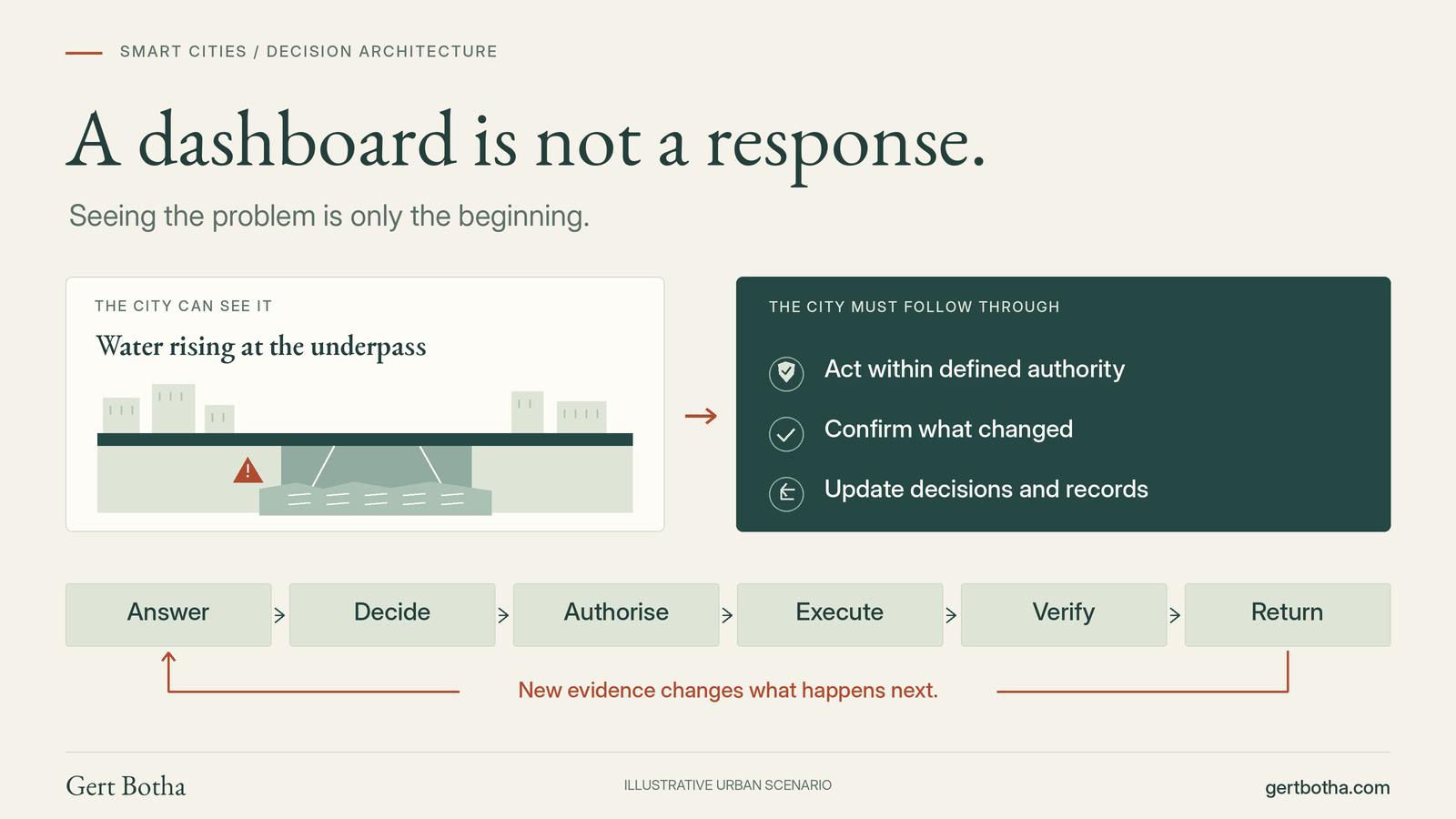
Answer → Decide → Authorise → Execute → Verify → Return
The Answer is the assessment supported by the available evidence.
The Decision establishes what the responsible institution intends to do.
Authorise determines who or what may legitimately carry out that intention and within what limits.
Execute changes the relevant service, resource, record or physical condition.
Verify establishes what actually happened and what followed.
Return brings the resulting evidence back to whatever must now change.
These stages may occur across several organisations. They may involve conventional systems, AI, people or a mixture. The point is not to introduce more bureaucracy. It is to distinguish things that can otherwise be collapsed into phrases such as "the city responded" or "the AI handled it".
That distinction becomes increasingly important as AI makes interpretation and coordination faster.
Imagine a city dashboard showing water rising at an underpass.
A weather service forecasts further rain. A maintenance system shows recent drainage work. Traffic data indicates vehicles slowing or turning around, while residents begin reporting standing water.
The city has a rich picture of the situation. The immediate operating question remains unresolved: what response is appropriate, who should initiate it, and how will the city know whether the action occurred?
The example is deliberately simple because it shows why data and response are different capabilities.
The available evidence may support several actions. A team may need to investigate a questionable sensor reading, restrict access, send a crew, divert transport services or later decide whether the road can reopen.
Those decisions do not require identical evidence, nor do they necessarily belong to the same institution.
A useful design therefore starts with the Decision and its consequence rather than the number of data feeds available.
A district rainfall estimate may help anticipate pressure on drainage infrastructure. It cannot, by itself, establish the condition of a particular road.
A maintenance record showing that drainage work was completed last week may be useful history. It does not prove that the system is functioning now.
A resident's report may contradict the dashboard without establishing that either source is correct. The contradiction itself can nevertheless be valuable because it tells the organisation that the current representation may be insufficient for the next action.
The question is not whether the city has enough data in general. It is whether the available evidence preserves the distinction the next consequential decision needs.
For a precautionary investigation, a broad warning may be sufficient. Closing a road may require stronger evidence or an established rule for acting under uncertainty. Reopening it may require something different again.
This is why more data and better decision evidence are not the same thing.
Suppose an AI model combines the evidence and concludes that the underpass may be unsafe.
That assessment can be valuable.
It is still an assessment.
The ability to generate it does not determine who may close a road, divert public transport or instruct a contractor. Those permissions already sit inside legal, organisational and operational arrangements.
AI can participate in those arrangements without erasing them.
A deployed agent might compile the evidence, prepare the incident record, notify the responsible operator or initiate an action through an authorised business system. Whether it may go further depends on the authority that has actually been delegated.
This becomes especially important where responsibilities cross institutional boundaries.
A road operator may control access while a transport authority manages bus routes. A contractor may maintain drainage infrastructure without having authority over traffic. A city platform may share information with all three while controlling none of their operational decisions.
Connectivity does not resolve those distinctions.
Decision architecture needs to preserve them while still allowing coordinated action.
Suppose the responsible road operator decides to restrict access and the workflow records that the instruction was sent.
The city now has evidence of communication.
It does not yet have evidence that the road condition has changed.
The barrier may not have been placed. The digital sign may not have updated. A transport operator may still be routing vehicles through the area. A navigation feed may continue reporting the road as open.
This distinction becomes increasingly important in automated environments because systems often report successful completion of their own step.
An API confirms that it accepted a request. A workflow records that it delivered a notification. A task changes status.
Each may be correct.
None automatically proves that the intended consequence occurred.
Verification therefore has to follow the action that matters, not merely the software process that requested it.
In our example, that may mean confirming the road restriction, establishing that dependent transport services have received the updated condition and monitoring whether the response is producing new problems elsewhere.
The city does not need one giant control room to achieve that. It does need a way to identify which consequences still matter and who is responsible for seeing them.
The water begins to fall.
It is tempting to treat reopening the underpass as the reverse of closing it.
Operationally, it is a new decision.
The evidence required to justify a precautionary restriction may differ from the evidence required to declare the road usable again. A falling water level may be encouraging while debris, damage or a drainage fault remains.
This illustrates why decision architecture cannot stop at execution.
Temporary arrangements create dependencies.
A diversion may remain active after the road is safe. One system may show the restriction as withdrawn while another continues using the earlier status. A maintenance task may be complete even though the operational service has not returned to normal.
The recovery path therefore needs its own evidence, authority and verification.
Otherwise the city can complete the original response while leaving the service partially unresolved.
Suppose the later investigation finds that recent maintenance altered the drainage route but the operating record used by the relevant teams was never updated.
The immediate incident may now be resolved.
The organisation has also learnt something about the process by which changes to infrastructure become usable operational information.
If nothing changes beyond the individual case, the same underlying condition remains available to produce another failure.
Learning therefore needs an accepting destination.
The city might correct the asset record, change the handover requirement for completed works, review similar locations or alter the evidence used by the monitoring system. It might change an AI model, but that is only one possible response.
The important question is what object, Decision, permission, or working arrangement should change because this incident occurred.
That is the purpose of Return.
Cities already have incident procedures, control rooms, emergency authorities and experienced operators. Decision architecture should not rename functioning practice to make an AI-era framework appear novel.
Its value is in revealing missing connections.
If existing arrangements already provide an authorised operator with sufficient evidence to execute the response reliably, verify the result, and correct the underlying cause, they should be retained.
AI may contribute only where it improves that capability.
In another setting, the problem may sit between organisations. Each team may do its work competently while nobody owns the complete service outcome. There, the intervention is less about replacing systems and more about making dependencies visible.
The same principle applies to human oversight. A person cannot meaningfully challenge an AI assessment without enough evidence, understanding, time and authority. Adding a human approval step can slow a process without making it safer.
The goal is usable capability, not ceremonial control.
The next phase of Smart Cities will continue to depend on sensors, networks, digital twins, analytics and data platforms.
Those technologies remain important.
But as cities become better at interpreting conditions and coordinating action, the management problem increasingly shifts to the connections around the Decision.
What evidence supports the assessment?
Which institution forms the intention?
Who or what is authorised to act?
What actually changed?
How does the city establish the consequence?
What new evidence should change the original arrangement?
A city may answer those questions with AI, conventional software, established human procedures or some combination of them. The right architecture depends on the service and consequence, not on the desire to maximise automation.
This is why I think the Smart City conversation needs to expand beyond data architecture.
Data makes the city more observable.
Decision architecture helps make that observation consequential.
The flooded-underpass dashboard is valuable because it makes the problem visible. Its public value grows when the right people and systems can use that evidence, act within legitimate authority, establish what followed, and change the conditions that need correction.
A Smart City's intelligence is not demonstrated only by what it can see.
It is also demonstrated by what its institutions can responsibly do next.
By Gert Botha
Keywords: AI, AI Governance, Smart Cities
 Two Clocks, One Truck: The Army's Need for Speed Meets New Defense Sourcing Rules
 Sustainable Transformation: The Elephant and The Mouse In The Room
 The Price of Standing Alone: Strategic Autonomy in a World Where Nobody Can Do It Alone
 The Potter’s Hands: Why Great Leaders Shape Environments, Not People
 The Corix Partners Friday Reading List - October 16, 2026