Aug01

“We were aligned. Until the meeting started.”
Every transformation leader has had that moment.
The private green light. The public hesitation.
The plan that made sense - until the room filled up.
I used to assume that alignment in one-on-ones meant support in public. That a nod in private was a firm “yes” I could build on.
I was wrong.
What I’ve seen over time is this:
Many people don’t say “yes” to the change.
They say “yes” to avoid discomfort.
To avoid being the lone voice.
To protect their image.
That’s not alignment.
That’s survival.
And when we mistake the two, transformation quietly derails.
Because the cost of false alignment isn’t just an awkward meeting.
It’s lost credibility.
It’s a confused team.
It’s change initiatives that stall without warning.
In my work leading transformation across organizations, I’ve learned to listen between the words.
To look for what’s not being said.
And to ask a simple question before moving forward:
“Can I bring this to the wider group as our collective decision?”
If there’s hesitation, the answer was never really “yes.”
This matters because transformation doesn’t just depend on vision.
It depends on clarity of commitment.
Not posturing. Not passive agreement.
But clear, confident, public support, especially when stakes are high.
We talk a lot about resistance to change.
But often, the bigger risk isn’t resistance.
It’s pretend agreement.
And if we don’t address that signal gap early, we end up leading alone.
Not because the strategy was wrong -
But because the support wasn’t real.
Keywords: Leadership, Culture, Transformation
 AI Is Exposing the Data Problems Humans Used to Hide
 "The AI may in fact be conscious." Really?
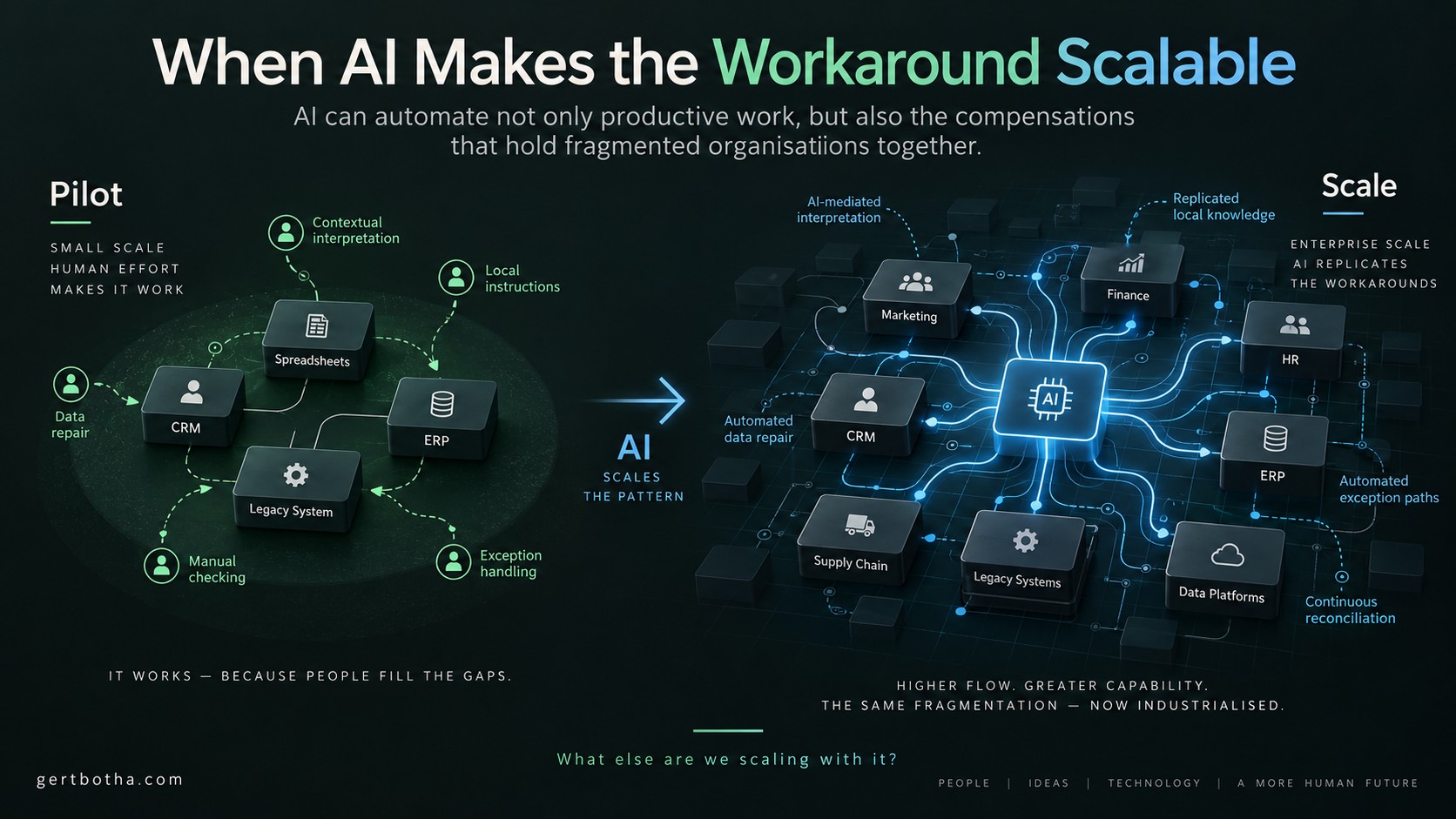 When AI Makes the Workaround Scalable
 The Age of Continuous Shocks: Why the coming downturn will be decided in your supply chain
 Friday’s Leader Reflection Quote – Saeculum Leadership Leaders Accept Decisions Create Responsibilities