


DeepTech entrepreneur, applied mathematician, technology architect and R&D leader with 25 years of applied research and product innovation.
I love to work where Technology Strategy, Product/R&D Direction, Architecture and Applied Mathematics/Algorithms meet - from defining technology vision to hands-on applied R&D, prototyping and validation. I engage through advisory, consulting, project-based or senior hands-on roles - from Principal R&D Engineer and AI Solutions Architect to Head of R&D or CTO-level advisory. The common denominator is direct technology ownership: shaping what should be built, why, and how to turn it into a defensible capability.
I studied Applied Mathematics & Mathematical Engineering when tensor calculus and graph theory were still considered "pure theory", then moved through research in multi-agent systems, distributed knowledge management, semantic matching and search in heterogeneous systems - areas now re-emerging as agents, hybrid reasoning and knowledge-centric AI.
That long arc is why I am strict about turning probabilistic AI into reliable systems through explicit contracts, algorithmic control, evaluation frameworks, benchmarking, validation, auditability and measurable KPIs, built around Ontologies, Knowledge Graphs, Context Graphs and Semantic Layers.
Current focus:
• Hybrid AI / augmented intelligence: LLMs with structured knowledge, rules, multi-stage RAG, Graph RAG, advanced retrieval and deterministic verification.
• AI evaluation frameworks and benchmarking: qualitative and quantitative assessment, systematic model/system evaluation and experimental validation.
• AI/LLM/agent architectures for regulated or high-risk domains: AI Governance, Responsible AI, deterministic guardrails, schema validation, tool contracts and audit trails.
• Ontologies, semantic modeling, knowledge graphs and semantic layers for enterprise workflows.
• Digital twins, physical and mathematical simulation, advanced data science, data-driven design and engineering automation.
• Fast feasibility studies and applied R&D - from mathematical formulation and experimental design to PoC and MVP.
Background: Founder/Co-founder, Head of R&D, CTO, CEO, Product Manager, Strategy Consultant and hands-on technical lead across enterprise AI, industrial systems, InsurTech, Smart Transportation, virtual retail, 3D commerce, cloud manufacturing and design automation.
• 20+ patents.
• Speaker at 100+ conferences; TOP-100 Retail Tech Influencer.
• IBM Champion.
• International network across major technology and industrial partners.
Available For: Consulting, Influencing, Speaking
Travels From: Milan
Speaking Topics: Artificial Intelligence, Digital Transformation, Technology Innovation, Luxury Fashion, Footwear
| Andrey Golub | Points |
|---|---|
| Academic | 5 |
| Author | 127 |
| Influencer | 356 |
| Speaker | 12 |
| Entrepreneur | 180 |
| Analyst | 0 |
| Total | 680 |
Points based upon Thinkers360 patented algorithm.

 Expert @ Fashion Tech cluster, The Russian Association for Electronic Communications (RAEC)
Tags: Digital Disruption, Digital Transformation, Supply Chain
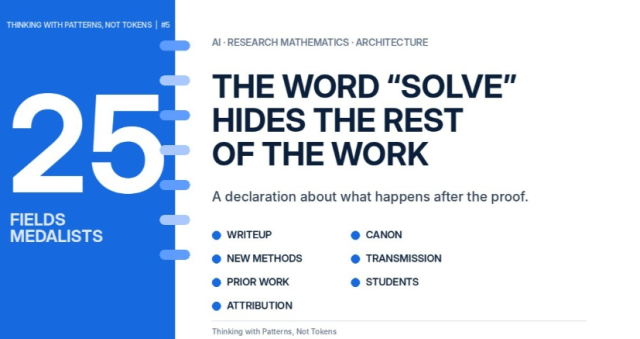 Twenty-Five Fields Medalists Just Described My Problem
Tags: AI, Digital Disruption, Digital Transformation

Tags: AI, Digital Transformation, Innovation
 AFRICAN CREATIVE INDUSTRY TECH – WEBINAR SERIES 2021
Tags: AI, Digital Transformation, Innovation
 Natural Leather – A recycled product with a unique ecological value!
Tags: Customer Experience, Sustainability, Supply Chain
 Strategy Innovation Forum (SIF2020)- 4 settembre 2020, Venezia: Gli impatti di IA sul Consumo- con ELSE Corp!
Tags: Customer Experience, Digital Transformation, Innovation
 Highlights from conversion of Industrial IoT with e-commerce platforms
Tags: Digital Transformation, IoT, Supply Chain
Tags: Supply Chain
Tags: Robotics
 High Tech solutions from ICOL Group on Arsutoria Digital
Tags: AI, Innovation
 ICOL Factory 4.0 solutions for leather cutting- International Leather Maker (ILM)
Tags: AI, Digital Twins, Robotics
 Milano Digital Fashion Week – July Issue, dal 14 al 17 luglio
Tags: Retail
 APLF Webinar-GFES: How can AI, Digitalised Supply Chains and Smart Factories become strategies?
Tags: Digital Transformation, Supply Chain, AI

Tags: Digital Transformation

Tags: Sustainability, Leadership, Supply Chain
 ToJoy CEO speaks about ELSE Corp and Virtual Retail at Nightly Talk- China
Tags: AI, AR/VR, Digital Transformation
 Look – no hands, ICOL Group. World Footwear 02/2020
Tags: Digital Transformation

Tags: Digital Transformation, Ecosystems

Tags: Sustainability

Tags: Customer Experience, Retail, COVID19
 Assocalzaturifici talks about Covid-19 impact in Italy
Tags: Retail
 Pelli, pellicce, piume: limiti normativi per una Moda sostenibile- Fashion Law
Tags: Retail
 ICOL Group fa debuttare la sua filiale italiana e due soluzioni industriali – FASHION Net Italia
Tags: Digital Transformation
 Veg-tan leather and the vegans: COTANCE clarifies confusion
Tags: Customer Experience
 New Dates of APLF 2020 Confirmed: 1st – 3rd June 2020
Tags: Digital Transformation, COVID19
Tags: AI, Digital Transformation, Emerging Technology
 "Artificial Intelligence for Fashion" (original title in RUSSIAN: "Искусственный интеллект для моды"
Tags: AI, Digital Disruption, Retail
Tags: AI, Big Data

Tags: Digital Disruption, Digital Transformation, Supply Chain
Tags: Customer Experience, Design Thinking, Digital Transformation
Tags: Digital Disruption, Supply Chain, Sustainability
Tags: AI, Digital Disruption, Emerging Technology
Tags: AI, Customer Experience, Digital Disruption
 WAKE UP CONFERENCE - Interview with Andrey Golub for FCG Media
Tags: AI, Digital Transformation, Retail

Tags: Digital Transformation, Retail, Startups
Tags: Digital Disruption, Digital Transformation, Supply Chain

Tags: AI, Digital Transformation, Supply Chain
 Personalized Digital Last (a Women’s Example)—The Tool Required to Enable Mass Customization
Tags: Customer Experience, Digital Transformation, Supply Chain
 IEEE Industry Connections (IEEE-IC)3D Body Processing (3DBP) Initiative
Tags: Digital Disruption, Digital Transformation, Emerging Technology


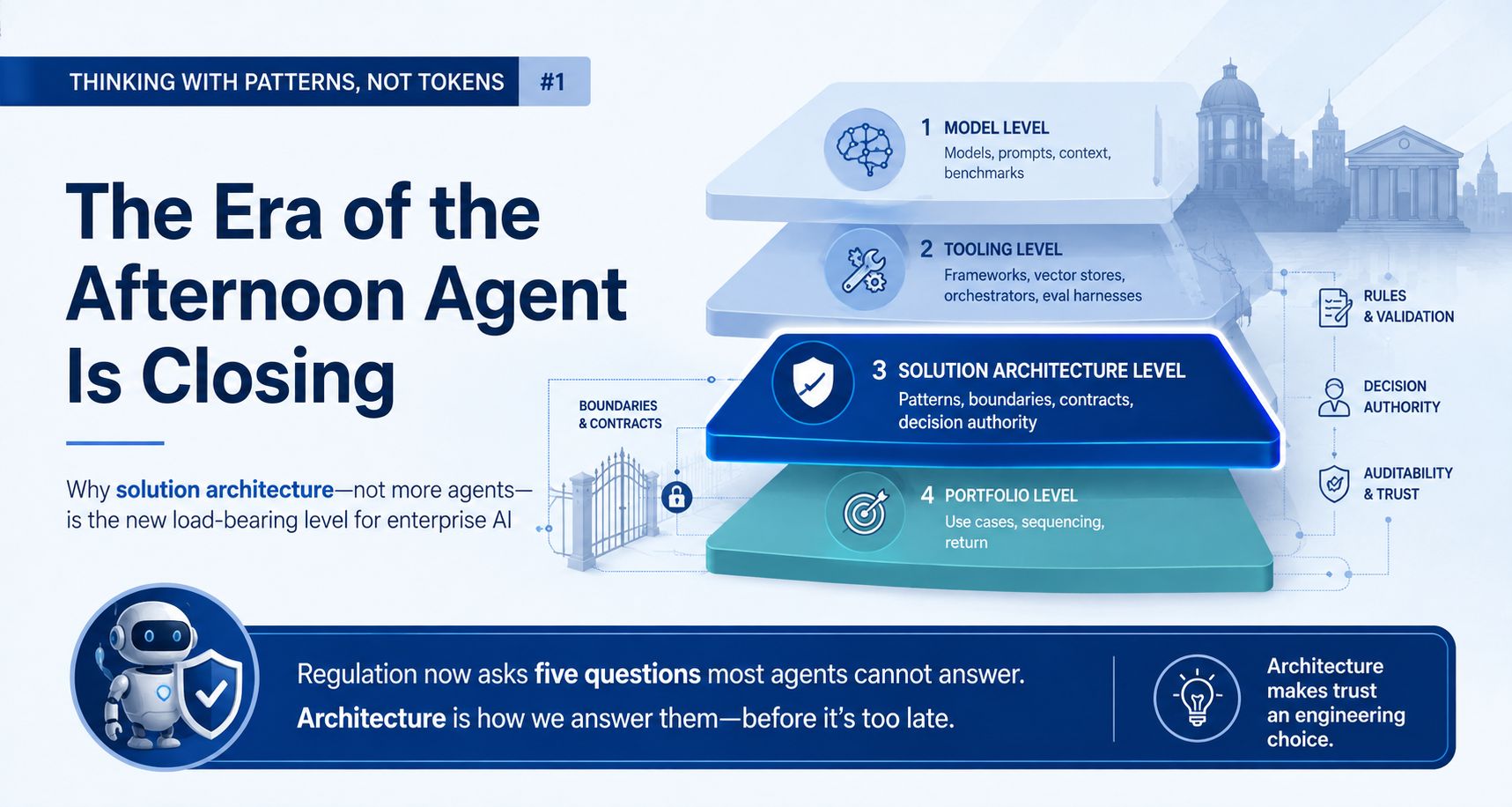 The Era of the Afternoon Agent Is Closing
The classification instinct.
By education I am a mathematician- tensor calculus and graph theory back when neither had a market value. By career I am an AI architect and R&D leader with twenty-five years, twenty-plus patents, and a standing practice of being brought into initiatives where probabilistic AI must meet symbolic backbones, contracts, and auditability. The industry is now rediscovering my research territory as if it were new. I write these notes to show that the instinct to classify first and build second still produces better systems than the instinct to generate first and explain never.
The Era of the Afternoon Agent Is Closing.
The level nobody is selling…
Decisions about enterprise AI are made at four levels.
The industry has extraordinary depth at levels one, two and four: benchmarks, leaderboards, framework comparisons, maturity models, ROI calculators, a whole consulting economy built on sequencing use cases.
Level three is thin to the point of absence. Not because it is difficult. Because it does not sell. Nobody ships a boundary. Nobody demos a contract. There is no launch event for a well-placed validation gate, and no analyst quadrant for knowing where authority sits. A boundary is invisible when it works, which is exactly what makes it valuable and exactly what makes it unmarketable.
And that is where the failures land.
Read the post-mortems of the last two years and the stated causes are almost always level one or level two. The model hallucinated. The framework was immature. The retrieval was poor. Those are real observations, and almost never the actual failure. The actual failure is that nobody named where the authority sat the decision, so when the output was wrong there was no boundary at which to catch it and no artifact to inspect afterwards. A system without named internal structure cannot fail in a diagnosable way. It can only disappoint.
Solution architecture is the discipline of putting that structure in before it is needed- deciding what the model may determine and what it may only propose. In classical enterprise IT this level is well staffed. In AI it has been treated as an implementation detail to sort out after the demo lands.
What changed?
I assumed for a long time that this would correct itself: that the wrapper phase would end on its own, that bounded systems with the model as a component rather than the brain would win because they simply work better, and that the market would arrive at the right architectures by ordinary evolutionary pressure.
It did not happen. Volume won. An assistant assembled in an afternoon kept being sold as a business function and bought as one. So the correction is arriving from regulation instead- not a sentence I write with any enthusiasm.
An AI system that interacts with people in Europe must now be able to say what it is and on whose behalf, it is acting. That reads like a disclosure requirement. It is not. Read structurally, it decomposes into five capabilities that must exist before any label can be attached: the system must be a nameable thing with declared purpose and limits; it must disclose the principal it acts for, which presupposes a real delegation chain, not authority implied by a prompt; it must have named moments where notice is due, which presupposes gates, not a trajectory; it must carry that obligation across handoffs, making disclosure a protocol property, not an interface string; and it must mark its output as synthetic at production time, making provenance a construction property, not a label applied afterwards.
None of these five are compliance features. They are the ordinary properties of a governable system: declared scope, explicit authority, materialized decision boundaries, traceable handoffs, provenance by construction. The regulation is not asking for a banner. It is asking whether the system has internal structure that can be pointed at. You cannot label what you cannot locate.
This is why the era of the afternoon agent is closing- not because the industry grew wiser or the demos stopped being impressive, but because the difference between a system with named internal structure and one without has stopped being a question of quality and become a question of admissibility.
I came through the last three years without becoming a generator of LLM automations, and it was closer than I would like. Several capable architects I respect did not: they spent two years shipping wrappers and are now rediscovering, with some irritation, that they knew how to do this properly all along. They are about to be useful again, which is the most encouraging development in this field in some years.
What a pattern actually is?
If level three is the missing level, the natural question is what it is made of. The answer is patterns- a word that has been used so loosely it barely means anything. Four different objects are routinely called patterns, and none of them is one.
The template is a structure with blanks in it. It tells you what to fill in and never why this shape rather than another; it has no alternative, which is the tell. The best practice is a recommendation with survivorship bias attached: it tells you what worked somewhere, not which conditions made it work, so it cannot tell you whether your conditions match. The reference architecture is a complete stack presented as neutral, every box a decision already made with the decision itself deleted from the drawing. The vendor blueprint is a reference architecture with particular products in the boxes, rendered in the visual language of a law of nature.
What these four share is the interesting part. None of them contains a question. They contain answers with the question removed.
A pattern is three things at once. It is a named recurring structure: something observed more than once, in more than one context, carrying a name that survives outside the room where it was coined. It carries a discriminating question: the one whose answer tells you whether you are inside this pattern or the one next to it. And it states a trade-off: what you give up by choosing it. A pattern with no cost is not a pattern, it is an advertisement.
The discriminating question is the load-bearing element. Remove it and the whole thing collapses into one of the four impostors above. Keep it and the pattern stops being a thing you adopt and becomes a thing you can test yourself against.
Take hybrid search. The market definition is keyword plus vector, fused- a template, and it is why so many teams implement it and then cannot explain why their retrieval is still wrong. The discriminating question is different: what kind of evidence is being combined, and at which stage? Ask it and the single label separates into distinct retrieval patterns- lexical and vector fusion is only the first- each combining a different class of evidence for a different reason, with different failure modes. A team that knows which one it is building can debug it. A team that has implemented "hybrid search" can only tune it.
Take the AI agent. The market treats it as one category with a maturity spectrum inside. The discriminating question is where decision authority sits. Ask it and the category separates into distinct classes, and the three critiques of agentic AI now circulating- that anthropomorphic framing degrades human oversight, that the return on autonomous agents does not materialize, that outsourcing execution to a frontier model transfers control to its owner- turn out to be three symptoms of one root. All three follow from the model, owning the decision. None follows from using a model. Which gives the shortest, useful diagnostic I know remove the model, and ask whether the process still exists. If yes, the model is a component and the system is governable. If no, the model is the system, and every critique above applies to you.
Patterns, not tokens!
Which brings me to the name of this series, and the distinction underneath it. Tokens are generated. Patterns are identified.
Generation produces something plausible from a distribution over what has been written before. It is an extraordinary capability and I use it daily. Identification produces a commitment: this is the case, that is not, and these consequences hold. Different operations- and the failure mode of the past three years has been using generation where identification was required. A model can generate a fluent account of why a system failed. It cannot tell you which question was never asked, because that question was never in the training distribution- it was never asked by anyone.
This is not an argument against models. It is an argument about placement: hybrid AI, where probabilistic components sit inside structures that are not probabilistic, bounded by contracts, validated against symbolic backbones, auditable after the fact. Ontologies, knowledge graphs, context graphs, semantic layers- the unglamorous machinery that makes the glamorous part safe to deploy.
Classifying first and building second is not pedantry. It is the only reliable way to know what you are building. A mathematician learns early that most problems dissolve once you have the right decomposition, and that no amount of computation rescues the wrong one.
Why do I write these?
I do not write these for reach; the number attached to a piece of writing has no relationship to whether the writing was right. I write because classification is how I think, and because writing forces classification to be honest in a way thinking alone does not.
What follows is one overloaded term at a time, taken apart and put back together with the precision it deserves. Knowledge layers, semantic architecture, retrieval and evidence, reasoning as a distributed capability, where authority sits in agentic systems, what can be proven after the fact. Each has the same shape: a term the market treats as one thing, a question that separates from it, and the consequences of knowing which one you are in.
An afternoon is enough to assemble an agent.
It is not enough to name a boundary.
Regulation has just made that difference load bearing.
#AI #EnterpriseAI #AIArchitecture #AIGovernance #AIAct #HybridAI #AIAgents #SolutionArchitecture
Tags: AI, Generative AI, Agentic AI
 Twenty-Five Fields Medalists Just Described My ProblemThe Era of the Afternoon Agent Is Closing