Unlock access to Thinkers360 AI to fast-track your search for analysts and influencers.
This feature is available for Enterprise Lite and Enterprise Members Only.
You have been temporarily restricted. Please be more thoughtful when adding content for your portfolio. Your portfolio and digital media kit and should be reflective of the professional image you wish to convey. Accounts may be temporarily restricted if we receive reports of spamming or if the system detects excessive entries.
Membership
Publish your original ideas on the Thinkers360 platform!
This feature is available for Pro and Pro-Plus Members Only.
Speaker Bureau functionality whereby individuals can be featured speakers within our Speaker Bureau service and enterprises can find and work with speakers.
This feature is available for Pro, Pro-Plus, Premium and Enterprise Members Only.
Highlight your featured products and services within our company directory for enhanced visibility to active B2B buyers worldwide.
This feature is available for Pro, Pro Plus, Premium and Enterprise Members Only.
Publish on the Web’s #1 Thought Leadership Blog.Join the elite. Ranked the top thought leadership blog by Feedspot (2021–2025), Thinkers360 offers you more than just a platform - it offers authority. Share your insights with our community and tap into a combined network of over 100M followers through our peer-to-peer marketplace.
You’ve reached your daily limit for entering quotes. Please only add personally-authored content which is reflective of your digital media kit and thought leadership portfolio.
Thinkers360 Content Library
For full access to the Thinkers360 content library, please join ourContent Planor become a contributor by posting your own personally-authored content into the system viaAdd PublicationorImport Publication.
Dashboard
Unlock your personalized dashboard including metrics for your member blogs and press releases as well as all the features and benefits of our member plans!
Interested in getting your own thought leader profile? Get Started Today.
Jon Ward
Director at Beneficial Consulting Limited
London, United Kingdom
I've spent thirty years working where enterprise change actually happens: not in the boardroom, but in the corridors and meeting rooms where strategy either survives contact with reality or doesn't. I built and sold my own consultancy before applying that same approach at JPMorgan, the London Stock Exchange Group, BT Group, and Experian.
My central belief is simple. Enterprise Agility is the rapid adaptation of an organisation's value creation model. It is a business goal, not an IT one, and changing how a software team works does not, by itself, create it. I contributed to the PMI's Manifesto for Enterprise Agility because too many transformations still confuse activity with outcome.
Most of my current work sits at the intersection of Enterprise Agility and Agentic AI. I build Digital Twins of software engineering functions, using live delivery data to surface exactly where a transformation is stalling. The harder problem is never the model. It's governance: who is accountable when a system acts on your behalf faster than any committee can review it. My whitepaper for the Agile Business Consortium, where I serve as a Business Agility Ambassador, tackles that question directly.
I write and speak from what I've actually done, not from theory. If an idea can't survive contact with a real board, or my local craft brewery in Suffolk, I don't publish it.
Available For: Advising, Authoring, Consulting, Speaking Travels From: Devon, UK
Speaking Fee
$2,000 (In-Person), $1,200 (Virtual)
Jon Ward
Points
Academic
0
Author
157
Influencer
35
Speaker
19
Entrepreneur
0
Analyst
0
Total
211
Points based upon Thinkers360 patent-pending algorithm.
The truth about AI and Transformation
Beneficial Consulting
September 25, 2026
This paper identifies that there is no such thing as an “AI transformation”, only business transformation in which AI is one tool among many, anchored in strategy. Most AI initiatives fail through weak governance and no link to business outcomes, not through technology. Organisations should start with a Strategy Map rather than a use-case list, and name an owner for every AI-informed decision.
The white paper argues that AI earns its place when AI is defined through four artefacts: a business case, a harm-based risk assessment, controls that grant autonomy only on evidence, and tested stop-use mechanisms. It also stresses that governance continues after go-live, feeding lessons back into strategy. This continuous loop is what makes it Enterprise Agility rather than a project plan.
Tags: Agentic AI, Business Strategy, Transformation
Strategy Mapping: Using AI to Do the Legwork
Beneficial Consulting
September 16, 2026
A white paper on the high-level steps to build a strategy map faster and sharper. AI does the research and pressure-testing. It never gets to author the strategy itself.
A strategy map gives organisational direction
Linkedin
September 14, 2026
Everyone's piloting AI right now. Almost nobody can tell you, six months in, whether the pilot actually worked. Based on some recent research in the UAE, my contact said that 80% of his organisation's AI initiatives were stuck in the pilot stage.
AI adoption is accelerating
Linkedln
April 28, 2026
The conversations we had confirmed what we already suspected: that AI adoption is accelerating, but the questions organisations are asking have matured considerably. It is no longer about whether to adopt AI. The summit was full of people wrestling with harder problems: where to start, how to prove the value, and how to stay in control as things move fast.
Tags: Agile, Behavioral Science, Business Strategy
Rethinking Finance for Enterprise Agility
Linkedln
July 29, 2025
Enterprise agility is no longer a luxury—it’s a necessity. Yet one of the biggest blockers to agility is hiding in plain sight: traditional financial planning and budgetary control. It's that time of year when firms are starting their neolithic strategic planning process, ready for 2026!
Tags: Agile, Behavioral Science, Business Strategy
Enterprise Agility - Competitive Advantage in a volitile world
Linkedln
July 10, 2025
Enterprise Agility is more than a buzzword—it's the capability of an organisation to rapidly adapt to changing market conditions, seize opportunities, and neutralise threats. The result? A resilient, customer-centric organisation that thrives even in uncertainty.
Tags: Agile, Behavioral Science, Business Strategy
Hybrid Portfolio Reporting. Dissect, don't roll up!
Linkedln
May 12, 2025
The revised Lean-Agile PMO course content introduces techniques that enable PMOs to manage a hybrid portfolio, a mix of traditional and agile activities. Key topics are hybrid portfolio planning and reporting, Agile Risk Management, Agile practice maturity, and Agile Governance.
Tags: Agile, Behavioral Science, Business Strategy
What’s all this Product Mentality BS?
Linkedln
April 08, 2025
There seems to be an Agile mantra about products that everything an Agile squad touches is a product. Why are we agilists letting this happen? It’s as if having seen a monkey, all mammals seen thereafter are also monkeys.
Tags: Agile, Behavioral Science, Business Strategy
Spontaneous Squads – A Tool for Transformational Change
LinkedIn
March 18, 2025
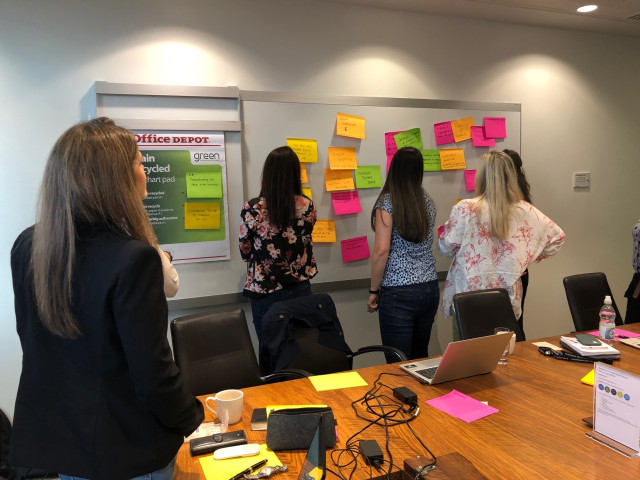
"Spontaneous Squads" describes a volunteer mobilisation model Jon developed at a client after a 2020 call for transformation volunteers drew 228 responses against an expected 20, which initially overwhelmed the programme's structure. The paper is the retrospective on how they fixed that.
The framework draws on Kotter's fourth step, "Enlist a Volunteer Army," but adapts it into something more concrete: volunteers self-select which theme to join at a "crewing call" during quarterly and monthly planning, then form purpose-built "spontaneous squads" that run lightweight Scrum-adjacent ceremonies (stand-ups two or three times a week, Kanban boards, timeboxes, flow-based pull rather than estimation) until their goal is met, sometimes over six months. Senior leaders and frontline staff volunteer on equal footing, a deliberate flattening that Jon credits with improving both engagement and buy-in. Stand-ups double as a mechanism for surfacing "regression," his term for change reverting once attention moves elsewhere, which he treats as a normal, trackable part of culture change rather than a failure. Quarterly planning uses a World Café format to reprioritise, let volunteers rotate or stand down, and recruit fresh contributors, so the operating model evolves rather than being fixed upfront.
Tags: Business Strategy, Change Management, Digital Transformation
Operating Models for Enterprise Agility
LinkedIn
March 04, 2025
This paper contrasts traditional, functionally aligned operating models with agile ones, and argues for designing organisations around customer value streams rather than departments.
Traditional models are described as hierarchical, centralised, and optimised for functional efficiency and career paths within silos, at the cost of speed and responsiveness to changing customer or market conditions. Agile operating models, by contrast, are flatter, organised around value streams rather than functions, and built to evolve continuously rather than being fixed once and left alone.
The core design method is customer journey mapping: tracing every touchpoint from initial contact through post-purchase support to find friction and redesign around it (illustrated with a telecoms example where ordering broadband took roughly four times longer than competitors). Customer satisfaction metrics, gathered through surveys, analytics, and AI-assisted monitoring, function as the ongoing design benchmark rather than a one-off measure.
Design itself is treated as iterative, borrowing the analysis-ideation-modelling cycle from agile software practice and applying it to organisational structure rather than code, with value stream maps used to model and refine target operating models over successive rounds. This is explicitly contrasted with Lewin's Unfreeze-Change-Refreeze model, a linear, one-time change approach, positioned as the traditional counterpart to agile's continuous iteration. One caveat raised: frequent structural change can unsettle employees, so iteration needs measured pacing and clearly communicated goals rather than constant, disorienting churn.
How HR facilitates Enterprise Agility
LinkedIn
February 25, 2025
This paper outlines that HR functions need a fundamental overhaul to support Enterprise Agility, rather than treating agility as purely an IT or operating-model concern. The central complaint is that most HR goal-setting still runs on century-old scientific management theory, individual OKRs, annual appraisal cycles, departmental targets, and that this actively works against agility by encouraging employees to optimise their own metrics over cross-functional collaboration, and by locking organisations into annual planning cycles when markets move faster than that.
The prescription has three parts. Goal-setting needs to shift from individuals to teams, with more frequent, data-driven feedback (it floats AI systems pulling from sales, ERP, project management, and financial data to monitor progress continuously rather than annually). Talent management needs to move from fixed job roles to fluid ones, with executives shifting from managing-by-reporting to leadership-by-data, giving teams the information to make autonomous decisions rather than waiting to be directed. And new job families and career paths need to emerge to formalise the roles agile ways of working actually require, rather than forcing them into legacy structures.
The cultural-change section leans on Edgar Schein's three-layer model (artefacts, espoused values, underlying assumptions), with the practical angle being that HR can move fastest by changing visible artefacts first, the example given being swapping annual individual appraisals for quarterly team reviews as a deliberate signal that teamwork now outranks individual performance.
Coaching continual improvement
Linkedln
May 30, 2024
Let's start from the beginning! In my role as transformation lead, I am often asked what is Agile. It is a difficult question for me to answer. I use the following headline statement: "Agile is a different and constantly evolving way of working, using organisational constructs of collective intelligence with devolved authority and decision-making." I then need to explain the nuances of my statement and illustrate Agile practices using examples. I also explain that Agile, although originating with software development, now has a much broader application.
Tags: Agile, Behavioral Science, Business Strategy
When ignorance breeds confidence!
Linkedin
May 30, 2024
Agile Coaching - when people get the "wrong end of the stick."
Ever come across someone who seems to know nothing about a topic yet is completely convinced they're an expert? That's the Dunning-Kruger effect in full force.
Attention all Agile Coaches!
Linkedin
May 28, 2024
Let's get candid—Agile coaching is never easy! It's a craft, not something you can simply learn by passing certifications. True mastery comes from real-world experience and adapting to diverse circumstances and challenges.
Vicious and virtuous transformational circles
Linkedin
May 21, 2024
Picture the situation in which a senior manager feels a team is not working hard enough. They want data about performance and land on story points as an indicator. There are conversations with the team, which regularly delivers what is planned, about 60 story points per sprint. Pressure is put on the team, and they resist and feel aggrieved. Next Sprint, the Squad plans the same number of stories, totalling 300 story points this time. Seeing the more significant number but smelling the coffee, the senior manager still needs to be convinced and demands more pressure! The Squad I was coaching in Buenos Aires was in a vicious circle created mainly by distrust from the London-based senior manager.
The complete guide to your bespoke agile framework or How to disrupt the agile certification gravy train.
Linkedin
December 06, 2022
What is an Agile Framework?
I believe an Agile framework should be designed to help you create a more efficient and simplified process for delivering software. However, this is not the case! The key Agile frameworks are designed to enable candidates to pass certificates rather than refine the delivery capabilities of your organisation. What’s the alternative? Now agile is more mainstream, create your approach, a bespoke agile playbook designed for your organisation that meets your specific business needs fulfills your brand promise to your customers and employees, and supports your culture.
Is Deming the father of Agile?
Linkedin
August 07, 2021
In this digital era, organisations are transforming how they work using agile principles, values and practices to create enterprise agility. Agile seeks to create a learning organisation where continuous improvement is the norm, customer-centric, combined with the ability to change direction rapidly.
Is Scrum the only way for Agile Teams?
Linkedin
August 07, 2021
I am often asked what is Agile? It is a difficult question to answer. I use the following headline statement: Agile is a different and constantly evolving way of working, using organizational constructs of collective intelligence, with devolved authority and decision making. I then need to explain the nuances of my statement and illustrate Agile practices using examples. I also explain that Agile, although originating with software development, has a much broader application.
Let's end fluffy Agile Coaching
Linkedin
August 02, 2021
I find many coaches think that continuous improvement is unimportant. They struggle with facilitating the retrospective, and the improvement element is forgotten or not taken seriously. Some think that continuous improvement applies to their teams but not to themselves! Some coaches think that Robert Greenleaf only wrote about the servant aspect of servant leadership. I find so many coaches operating without a coaching plan. In my mind, Agile Coaching can be all too fluffy.
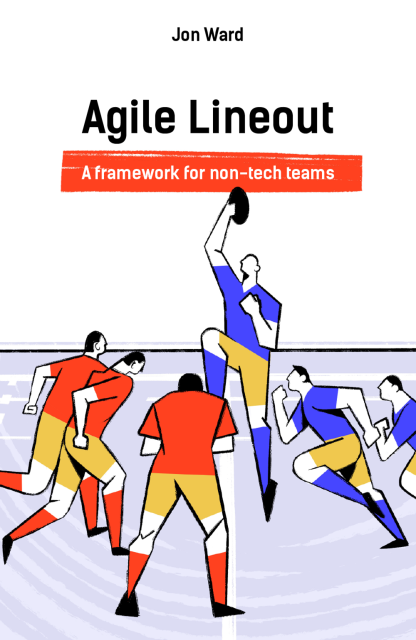
Agile Lineout - an Agile Framework designed for non-software teams
Linkedin
July 18, 2021
Business Teams managing transformations, mergers or acquisitions, marketing initiatives or corporate change have tried to adapt agile frameworks designed for software teams. Now agile has a framework specifically designed for non-software development activities - Agile Lineout.
Since the publication of the manifesto, agile has been treated by some as if it is merely a process. It seems as if there is a widely held belief that once people are trained or certified, suddenly, they are agile! Why is it then that once trained, and agile is simple in context, that people struggle and organisations fail, to realise the anticipated benefits of an agile culture? Why is it so hard? What’s missing?
Agile coaching for agile coaches
Linkedln
July 01, 2020
Many times, in an interview after a game or event, a sports coach indicates that their team needs to improve a specific aspect of their performance. The sports coach then develops an improvement plan for their team based on the game just finished. The same is true of agile teams. An effective agile coach does the same, analyses team performance and decides what the team needs to do to improve their game. The coach prepares a plan to discuss with the agile team to reach an agreement regarding improvement goals.
Tags: Agile, Behavioral Science, Business Strategy
Do you need an agile catalyst?
Linkedln
October 30, 2019
Without a doubt, the role of an Agile Coach is complex and looking at job advertisements recently, the Agile coaching role seems to embrace everything from working with a single scrum team to working with a sizable enterprise.
Tags: Agile, Behavioral Science, Business Strategy
Estimation errors - can we blame the PMO?
Linkedln
August 20, 2017
Sadly the historical case for estimation errors in business and software projects is well established; but who’s to blame? This paper suggests that it is a fundamental role of the PMO to add organisational value through improving project estimation. By using proven techniques which have been available for more than a decade, the PMO can radically improve project estimation performance.
Tags: Agile, Behavioral Science, Business Strategy
Smarter QA - Agile Quality Techniques
Linkedln
July 12, 2016
In this age of faster time to market, competitive and regulatory pressures, transformational change, constant product evolution, testing and solution quality can often become an afterthought. However, when solutions fail; significant regulatory penalties can be applied, customers have the ability to seek alternative providers of services or products, the resultant commercial and reputational damage from poor quality is self-evident. It is, therefore, essential that the Quality Assurance profession adapts or evolves new techniques and approaches to provide an appropriate “safety net” for faster agile delivered solutions.
Agile Lineout is Jonathan Ward's alternative to Scrum, built to fill the gaps novice teams hit when Scrum's deliberate minimalism leaves them unsupported. It organizes agile delivery around two aligned "lines" — a product line, which ensures the team is building the right outcome, and a delivery line, which ensures the team is building it efficiently — with team behaviour running between them. Each iteration opens with a context assessment across all three, uses a mid-iteration Enhancement Workshop for course correction, and draws on Deming's system of profound knowledge, systems thinking, and team-behaviour research (Hackman, Gersick, Edmondson, Alderfer) rather than prescribing practices by rote. It's designed to scale to big teams and to apply equally to software and non-software change initiatives, and — per the update we just made — it now positions itself as a practical implementation of the Manifesto for Enterprise Agility rather than only a critique of Scrum.
Agile Coach's Cookbook
Austin Macauley Publishers
May 28, 2021
With this coachs cookbook, Jon has managed to create a thing of both great simplicity and immense value. A must read for the coaching community, this is an easily referenceable guide to coaching excellence, full of handy hints, tips, tools and techniques. As a coach, no matter your experience, expertise and specialism, this is a resource you will all want in your back pocket. Gustav Bjorkeroth, CEO at Radtac There are so many self\-proclaimed\-and\-promoting agile experts, and best\-selling agile authors. Its challenging to decipher whos right, who to engage with, or who to follow. Then theres Jon Ward of Beneficial Consulting. Jons pragmatic and catalytic approach nullifies these challenges. Within the world of agile transformation, transitioning from waterfall to agile, Jon stands up and out providing practical advice based on successful recent experience. This book provides an essential read for agile coaches who wish to make a difference. Alan Gedye, Head: People Change Management and Enablement, Absa Johannesburg
Transitioning the reluctant organisation
Srum Alliance Tbilisi Georgia
June 19, 2026
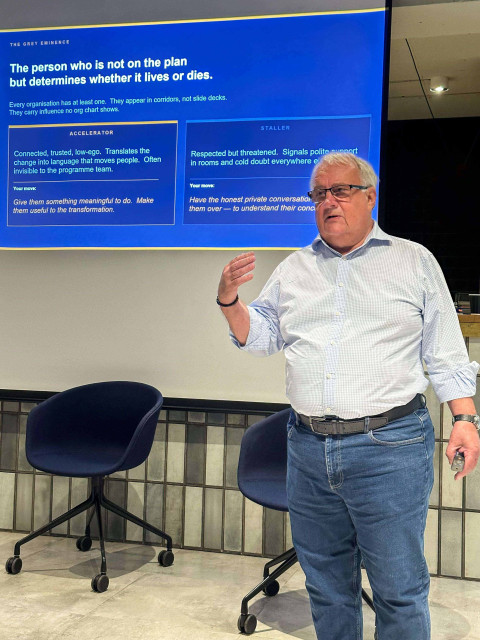
Transitioning the Reluctant Organisation — making agile happen when the organisation doesn't want to.
Sixty minutes. Four parts. One practical output.
→ Why every reluctant organisation has a "grey eminence" — the person not on the plan who decides whether it lives or dies
→ Seven archetypes of resistance — and the specific move each one demands
→ Three levers that actually move reluctant organisations: narrative, coalition, early wins
You'll leave with a live influence map of a change you're trying to land right now, a named grey eminence, and one honest conversation to have this week.
If you're selling agile transformation into a reluctant enterprise — or trying to make it happen inside one — come and find me in Tbilisi.
Tags: Business Strategy, Leadership, Transformation
1 Post
Change Doesn't Happen Because of a Plan
Beneficial Consulting Limited
August 18, 2026
Project Managers are taught to treat Stakeholders as a hurdle. People to be "managed" or communicated with. This paper looks at stakeholders as a means to strategic change. It argues that by enlisting stakeholders' participation, commitment, and energy, change happens.
Designing the Agile Enterprise
Global Technology Weekend Tbilisi 2026
June 20, 2026
Designing the Agentive Enterprise — value streams when AI is on the team
Most companies are bolting AI onto an operating model designed in the 1920s — and wondering why it doesn't deliver. In this 40-minute hands-on session, Jon Ward — author of A New Look at Strategic Adaptation — guides you to map a real value stream from your own business and redesign it with AI agents as teammates, not tools. You leave with a redrawn value stream you can take straight back to your team on Monday.
AI Leadership and Strategy for Business Transformation
Informa Connect Acadamy
July 27, 2026
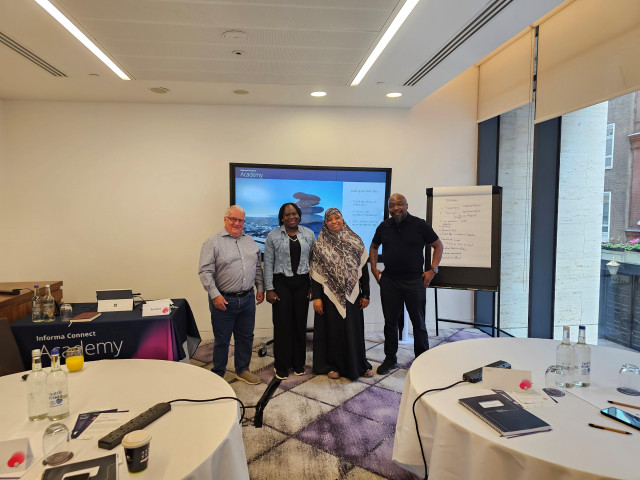
The AI Leadership and Strategy for Business Transformation course equips senior leaders and change agents with the mindset, frameworks, and practical tools needed to turn AI from a technical capability into a source of real business agility. It focuses on how leadership choices, governance, and operating models shape the effective use of AI. Thus enabling organisations to sense change faster, adapt with confidence, and continuously improve how value is created. Rather than concentrating on technology alone, the course emphasises strategic intent, responsible leadership, and adaptive ways of working that allow AI to amplify human judgement and drive lasting transformation.
Tags: Agentic AI, AI Governance, Business Strategy
Lean Agile PMO
House of PMO
June 29, 2026
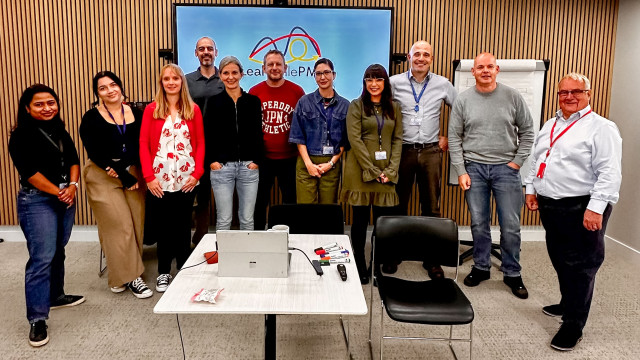
Transform Your PMO with Agile! This course is tailored to enable PMOs and senior change stakeholders to guide your organisation through the transition to agile working methods. We will dive deep into key agile frameworks, agile metrics, and essential governance changes to ensure a smooth and effective transformation.
Why your AI roadmap should start with a strategy map not a use case list
Beneficial Consulting Limited
September 04, 2026
This white paper argues that most organisations build their AI roadmaps backwards. They start from a generic list of sector use cases rather than from their own strategy. As a result, they have no way to judge whether a given AI capability actually helps or quietly undermines how the organisation wins.
The whitepaper proposes reversing the sequence: start from the strategy map the organisation already has (or build one). Then walk the map to surface AI opportunities that sense signals earlier or optimise existing decisions, tie each one to a named metric, and filter it through that boundary.
This approach produces a six-step method for turning a strategy map into a governed AI roadmap, illustrated with three sector examples (a regulated insurer, a luxury goods house, and a heavy equipment manufacturer), and the paper's core claim is that a roadmap built this way survives board scrutiny because it's inseparable from the strategy itself, rather than a technology plan with governance bolted on afterward.
Join Thinkers360 for free! Are you a Reader/Writer, Thought Leader/Influencer (looking to increase your earnings), or an Enterprise User (looking to work with experts)?




 The truth about AI and Transformation
 Strategy Mapping: Using AI to Do the Legwork
 A strategy map gives organisational direction
 AI adoption is accelerating
 Rethinking Finance for Enterprise Agility
 Enterprise Agility - Competitive Advantage in a volitile world
 Hybrid Portfolio Reporting. Dissect, don't roll up!
 What’s all this Product Mentality BS?
 Spontaneous Squads – A Tool for Transformational Change
 Operating Models for Enterprise Agility
 How HR facilitates Enterprise Agility
 When ignorance breeds confidence!
 Attention all Agile Coaches!
 Vicious and virtuous transformational circles
 The complete guide to your bespoke agile framework or How to disrupt the agile certification gravy train.
 Is Deming the father of Agile?
 Let's end fluffy Agile Coaching
 Agile Lineout - an Agile Framework designed for non-software teams
 Agile Coach's Cookbook
 Agile coaching for agile coaches
 Do you need an agile catalyst?
 Estimation errors - can we blame the PMO?
 Smarter QA - Agile Quality Techniques
 Agile Lineout
 Transitioning the reluctant organisation
 Designing the Agile Enterprise
 AI Leadership and Strategy for Business Transformation
 Lean Agile PMO