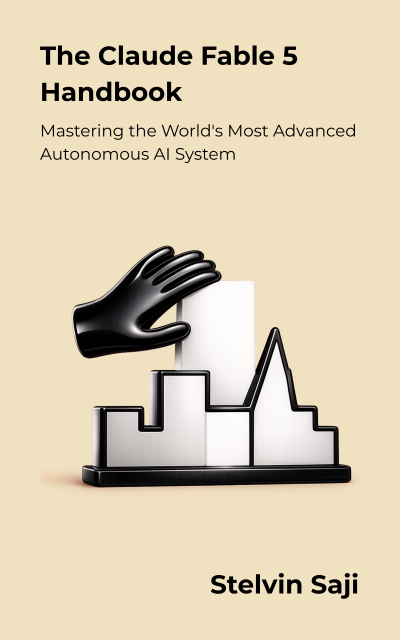
 The Claude Fable 5 Handbook: Mastering the World's Most Advanced Autonomous AI System
Stelvin Saji
August 20, 2026
The tools didn't change everything. The people who mastered them did.
"The best investment you can make is in yourself," Warren Buffett once said. In an age where AI does the compounding for you, the real question isn't whether you'll use it; it's whether you'll use it well.
Most people are still prompting AI like it's 2023: one question, one answer, repeat. Meanwhile, a small number of builders, founders, and operators have quietly figured out how to hand an entire job to an AI system and walk away with finished work. That gap isn't closing. It's widening. This book exists to put you on the right side of it.
The Claude Fable 5 Handbook is a complete operating manual for the world's most autonomous AI system built for people who don't just want to chat with AI, but want to deploy it like a team.
Inside, you'll learn:
1. The 5 upgrades that actually matter: long-horizon autonomy, first-shot correctness, vision-as-infrastructure, compounding memory, and parallel self-validating subagents explained without the marketing fluff.
2. Why the safety systems exist: and how understanding them makes you a more effective operator, not a frustrated one.
3. 10 battle-tested mega-prompts: from "The Overnight Operator" to "The Honest Before/After," designed to extract senior-level output on the first try.
4. A 100-framework prompt vault: a working library covering full-stack architecture, product launches, financial recovery plans, investigative journalism, career transitions, ad optimization, course design, and dozens of other real-world jobs you can hand off starting today.
This isn't a book of AI hype or hypothetical futures. It's a field manual the kind you keep open in a second tab while you work, not the kind you read once and shelve. Compounding doesn't announce itself. It just quietly changes the outcome, year after year. The people who master this system early aren't smarter; they just started sooner.
Stop prompting. Start delegating. Get the edge.
See publication
Tags: AI Ethics, AI Infrastructure, Generative AI
 The Claude Finance Playbook: Structured Prompts for Investment Banking, Valuation & Deal Strategy
Stelvin Saji
April 21, 2026
The financial world doesn’t reward effort, it rewards precision, clarity, and speed.
For decades, institutional-grade financial analysis lived behind elite firms, expensive advisors, and high-cost terminals. That barrier is gone.
The Claude Finance Playbook is a practitioner’s system for turning AI into a true financial engine, built for serious operators, not casual users. It delivers structured, high-performance frameworks that replicate the work of investment bankers, consultants, and top-tier analysts in minutes.
Inside are 60+ precision-built frameworks across six core domains:
1. Investment Banking & Valuation: DCF, LBOs, M&A analysis, and full-scale deal narratives.
2. Market Research & Strategy: TAM-SAM-SOM, positioning, pricing, and go-to-market execution.
3. Buffett-Style Stock Analysis: Moats, financial diagnostics, risk, and long-term value assessment.
4. Legal Document Architecture: High-quality agreements and legal frameworks without the premium fees.
5. The $2,000 Terminal Killer: Deep research, technical signals, and macro intelligence at minimal cost.
6. The Sovereign Builder: A complete system for building and scaling a one-person enterprise.
This is not about AI theory. It’s about output, leverage, and execution. The advantage compounds for those who move first.
Also included as part of the Prompt Engineer’s Bible Series.
See publication
Tags: Business Strategy, Finance, Generative AI
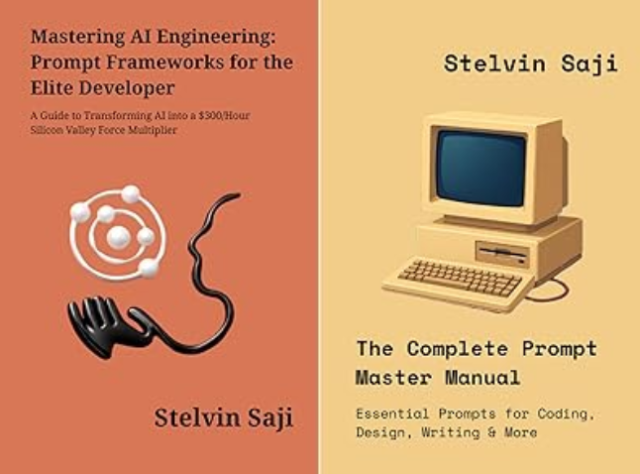 The Prompt Engineer's Bible
Stelvin Saji
March 12, 2026
Most people are whispering to AI. This series teaches you to command it.
The Prompt Engineer's Bible is the only collection built for those who want to operate at a level most users don't even know exists. Three volumes. Zero fluff. Pure, precision-engineered frameworks that turn AI into the most powerful tool you've ever touched.
This is the series that separates the professionals from the prompt-and-pray crowd.
Whether you're coding at speed, designing without limits, writing content that converts, or positioning yourself as the $300/hour force multiplier every team is desperately hunting for the frameworks inside these pages don't just improve your workflow. They rebuild it from the ground up.
Silicon Valley's best-kept secret isn't talent. It's leverage. Prompt engineering, done at this level, is the purest form of leverage available to anyone with a keyboard and a vision.
The Prompt Engineer's Bible isn't a reading experience. It's an upgrade.
Three books. One mission. Make you dangerous.
See publication
Tags: AI Infrastructure, Careers, DevOps
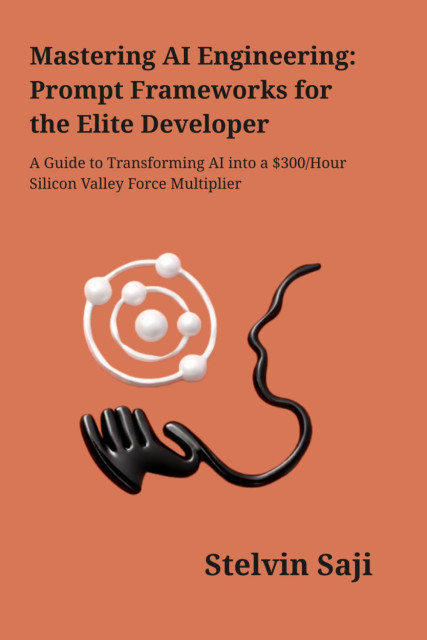 Mastering AI Engineering: Prompt Frameworks for the Elite Developer: A Guide to Transforming AI into a $300/Hour Silicon Valley Force Multiplier
Stelvin Saji
March 03, 2026
Some developers prompt AI. And some engineers architect with it. This book was built for the second group, the ones who want to operate at 10x output, ship with confidence, and permanently separate themselves from the 95% still typing one-line prompts into a chat box.
See publication
Tags: AI Infrastructure, Generative AI, Startups
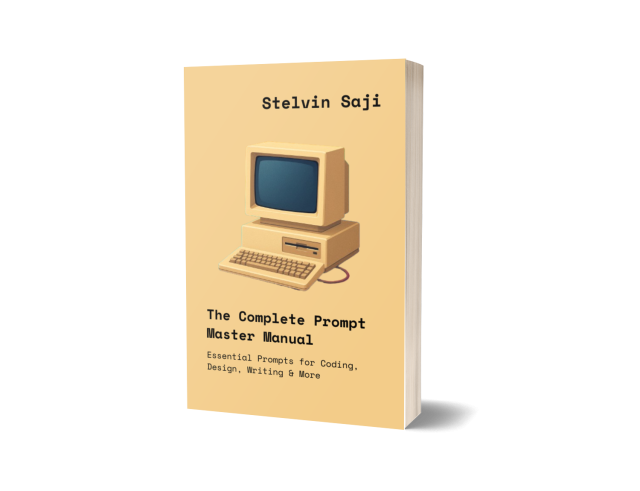 Complete Prompt Master Manual: Essential Prompts for Coding, Design, Writing & More
Stelvin Saji
December 09, 2025
Master the art of AI prompting with 500+ high-value prompts for coding, design, writing, productivity, and more.
The Complete Prompt Master Manual is the all-in-one reference built for professionals, creators, and beginners who want to get consistently powerful results from AI tools like ChatGPT, Gemini, Claude, and Llama. Instead of guessing what to type, you get a proven collection of battle-tested prompts designed to improve accuracy, speed, and creativity across all major fields.
See publication
Tags: AI Infrastructure, AI Orchestration, Open Source
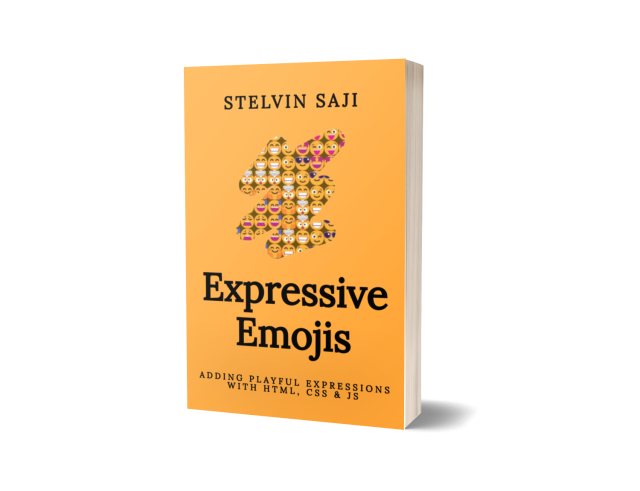 Expressive Emojis: Adding Playful Expressions with HTML, CSS & JS
Stelvin Saji
July 23, 2024
See publication
Tags: Design, Design Thinking, DevOps
Face Morphing in Images: A Novel Approach Using Aligned Facial Landmarks (v1.5)
Stelvin Saji
March 31, 2026
Face morphing in real-time browser environments demands more than visual fidelity; it requires stability under motion, interpretability of neural outputs, and performance that scales reliably across consumer hardware. This work presents MorphAI v1.5, a production-grade upgrade to the animated face-swapping framework introduced in v1, extending its capabilities with a significantly optimized WebGL rendering pipeline, a re-engineered multi-subject tracking architecture, and a comprehensive suite of diagnostic overlays designed to make facial computation fully observable and verifiable.
The system sustains 60 frames per second on modern mobile hardware through deliberate low-level optimizations, including reduced draw calls, efficient buffer management, and intelligent frame synchronization that eliminates jitter and temporal artifacts. Multi-subject detection is handled by a redesigned bounding box system that maintains stable alignment across dynamic scenes involving rapid movement, scale variation, and orientation shifts, ensuring that every morph operation remains spatially coherent and distortion-free.
To advance interpretability, MorphAI v1.5 introduces three diagnostic overlays: a high-density Face Mesh that maps a polygonal topology directly onto detected faces for sub-millimeter tracking precision; a 68-point Landmark system that anchors expression mapping and feature alignment to consistent anatomical reference nodes; and a Heatmap overlay that renders temporal velocity gradients across facial regions, surfacing micro-expressions and motion dynamics imperceptible to the human eye. A Split View Engine further enables side-by-side comparison between source input and neural output, transforming the pipeline from an opaque black-box system into a fully auditable visual environment.
The framework additionally supports seamless export of morphed outputs beyond the live canvas and integrates a keyboard shortcut system for streamlined control in power-user workflows. MorphAI v1.5 is implemented as a browser-native system optimized for consumer-grade hardware and is publicly deployed on Hugging Face. These advancements collectively establish a robust foundation for interactive media, creative visual tooling, and research applications demanding uncompromising performance, precision, and transparency.
See publication
Tags: AI, Privacy, Startups
Investigating Human Silhouettes: A Study of Live Human Pin Art Installations
Stelvin Saji
January 27, 2026
Pin art has progressed from an early mechanical experiment to a recognized form of large-scale participatory visual expression. Its conceptual foundations originate in mid-twentieth-century research on pinscreen animation, a technique that employed dense arrays of movable pins to produce highly detailed, shadow-based imagery through direct physical manipulation. This principle was subsequently realized in an interactive, sculptural format during the 1970s through the work of artist Ward Fleming, who developed the boxed pin art object, a structured grid of displaceable metal pins capable of recording transient three-dimensional impressions of hands, faces, and everyday objects. Following its presentation in experimental exhibitions and later patenting and commercialization, pin art achieved widespread recognition as a tactile and pedagogical medium, becoming a familiar presence in offices, educational institutions, and science museums. Despite variations in scale, materials, and fabrication, its fundamental mechanism has remained consistent: the translation of physical contact into a visible spatial imprint.
More recently, pin art has experienced renewed cultural visibility through its circulation within digital and social media environments. Short-form visual demonstrations, typically characterized by the sudden emergence of a three-dimensional form from an ostensibly flat surface, correspond closely with contemporary modes of algorithmically mediated content consumption. The immediacy of this transformation, together with the perceptual illusion of depth generated through physical displacement, renders pin art particularly effective within short-form video contexts, facilitating broad dissemination and sustained audience engagement across digital platforms.
This study investigates contemporary computational strategies for simulating and extending pin art within digital environments, employing a practice-based research methodology that integrates interactive systems and visualization techniques. By situating pin art within computational frameworks, the research reconceptualizes it as an interdisciplinary practice operating at the intersection of embodied interaction, interactive art, and technological mediation. Within this framework, pin art is examined not as a static artifact, but as an adaptive system capable of supporting collective participation and experiential interpretation
See publication
Tags: Digital Transformation, Education, Innovation
Face Morphing in Images: A Novel Approach Using Aligned Facial Landmarks
Stelvin Saji
November 25, 2025
Face swapping, the process of replacing one individual’s facial identity with another while preserving visual realism, has attracted increasing attention across digital entertainment, augmented reality, creative media, and digital forensics. This work presents an animated face-swapping system for static images that enables continuous and seamless cycling of facial identities among multiple individuals detected within a single frame.
The proposed method employs precise facial landmark detection to compute tightly aligned, rotation-aware bounding boxes that isolate only the inner facial oval, intentionally excluding hair, background regions, and other non-facial artifacts. To achieve visually coherent integration across identities, the pipeline combines color normalization, lighting transfer via homomorphic filtering, and unsharp masking, followed by seamless cloning using OpenCV. Facial transitions are animated through easing functions and temporal interpolation, producing smooth morphing effects rather than abrupt identity replacements.
The system is implemented as a high-performance, React-based web component optimized for execution on consumer-grade hardware. Experimental observations demonstrate improved facial alignment, smoother temporal transitions, and enhanced perceptual realism when compared with baseline static face-swapping techniques. These characteristics make the system suitable for interactive media applications, creative visual tools, and privacy-preserving identity transformation workflows.
See publication
Tags: AI, Privacy, Startups
 Serenity - Mental Health Companion
Stelvin Saji
July 03, 2026
Serenity is an AI-powered mental wellness companion that helps individuals cultivate self-awareness through thoughtful conversations, intelligent journaling, mood tracking, and meaningful insights into progress. Designed with a calm, distraction-free experience at its core, Serenity transforms everyday reflection into a simple, intentional practice, helping users build healthier habits, gain emotional clarity, and foster lasting personal growth.
See publication
Tags: Generative AI, Health and Wellness, Mental Health
 MorphAI (AI Face Morphing Platform)
Stelvin Saji
September 03, 2024
MorphAI develops advanced facial transformation systems that enable seamless identity exchange in static imagery while preserving structural integrity and visual realism. The technology supports continuous, multi-person face cycling within a single frame, creating fluid and coherent identity transitions. Designed at the intersection of computer vision, procedural rendering, and expressive interaction, MorphAI redefines how facial data can be transformed, visualized, and experienced across digital media environments.
See publication
Tags: AI Orchestration, Generative AI, Innovation
Top 50 Global Thought Leaders and Influencers on Generative AI 2026
Thinkers360
July 19, 2026
I'm honored to be recognized by Thinkers360 as one of the Top 50 Global Thought Leaders and Influencers on Generative AI 2026.
To me, Generative AI has never been just about models or automation. It's about creating tools and experiences that amplify human creativity, simplify complex problems, and make technology more accessible. That belief has shaped the products I've built, the ideas I've shared, and the conversations I've been fortunate to have with people around the world. This recognition reflects the value of collaboration and continuous learning. Every thoughtful discussion, shared idea, and piece of feedback has challenged me to think differently and keep improving.
As AI continues to evolve, I'm excited to explore what's next, not just building smarter systems, but creating experiences that are meaningful, responsible, and genuinely useful.
Grateful for this recognition, and even more excited for the journey ahead.
See publication
Tags: AI, Entrepreneurship, Generative AI
Top 50 Global Thought Leaders in Design Thinking 2026
Thinkers360
April 06, 2026
Still taking a moment to reflect on this…
Honored to be named among the Top 50 Global Thought Leaders and Influencers on Design Thinking 2026
Moments like these remind me how powerful the combination of technology, creativity, and human-centered thinking can be. What started as curiosity, experimenting, building, and sharing has grown into something far more meaningful. One of the most rewarding parts of this journey has been the opportunity to collaborate with incredible people across the world. Working with diverse, international minds has not only broadened my perspective but has also taught me lessons that go far beyond code and design.
Through my work, including projects like MorphAI, I’ve always aimed to go beyond functionality and create experiences that truly connect with people. Grateful for everyone who has been part of this journey through support, conversations, and continuous learning.
This recognition is not a finish line, but a reminder to keep pushing boundaries. More to come
See publication
Tags: AI, Design Thinking, Innovation
 Olipasto
Stelvin Saji
May 25, 2026
Transform your images into refined oil pastel artwork infused with rich, expressive colors and timeless artistic depth.
See publication
Tags: Creativity, Design, Transformation
 Dither Studios
Stelvin Saji
May 11, 2026
Transform any image into visually striking, high-quality dither art with a fast, precision-driven rendering engine designed for creators who value both speed and detail. Seamlessly upload your images, fine-tune dithering styles and visual depth with complete control, and export beautifully crafted pixel-based artwork in seconds. From subtle retro textures to bold monochrome compositions, every output is optimized for clarity, artistic accuracy, and a refined digital aesthetic.
See publication
Tags: Creativity, Design, Digital Transformation
 Motion Trace: Capturing Movement as Living Memory
Stelvin Saji
April 28, 2026
Motion Trace reimagines how we experience movement, transforming fleeting actions into lasting visual narratives. Through elegant trails and soft echoes, it captures not just where something moved, but how it felt in motion. It blends technology and artistry to reveal patterns, emotion, and rhythm hidden within motion itself.
See publication
Tags: Digital Transformation, Emerging Technology, Generative AI
The Hidden Potential of Face Morphing - Presentation
Stelvin Saji
April 16, 2026
I took the stage at Nerdearla 2026, Santiago, as a speaker. My talk, “The Hidden Potential of Face Morphing", dived into the evolving landscape of AI-powered visual systems and how they’re shaping the future of immersive, dynamic user experiences.
See publication
Tags: AI, Cybersecurity, Privacy
 The Hidden Potential of Face Morphing - Slides
Stelvin Saji
April 16, 2026
I took the stage at Nerdearla 2026, Santiago, as a speaker. My talk, “The Hidden Potential of Face Morphing", dived into the evolving landscape of AI-powered visual systems and how they’re shaping the future of immersive, dynamic user experiences.
See publication
Tags: AI, Cybersecurity, Privacy
 The Hidden Potential of Face Morphing
Nerdearla Chilie
April 16, 2026
Face morphing is usually treated as a visual gimmick, but its underlying mechanics reveal something more important: it is one of the few technologies that merges geometry, perception, and real-time computation to model how humans interpret identity. This talk breaks down the core innovations powering modern morphing systems, landmark alignment, mesh interpolation, temporal blending, and model-driven feature extraction, and explains how these techniques allow transformations that feel natural to the human eye.
Building on this foundation, the session explores an emerging frontier: using morphing to create adaptive interfaces, emotion-aware systems, and dynamic digital characters that respond to users in real time. These applications reshape entertainment, learning, accessibility, and AR experiences. The talk concludes with a practical ethical framework addressing consent, transparency, and identity integrity, key considerations for any technology that manipulates human faces.
See publication
Tags: Digital Transformation, Privacy, Security


 Particle Studio: Product Hunt Launch Recognition
 Featured on Valentina Roberto’s Field Notes Podcast: Community Building & Onboarding


















 The Hidden Potential of Face Morphing