Unlock access to Thinkers360 AI to fast-track your search for analysts and influencers.
This feature is available for Enterprise Lite and Enterprise Members Only.
You have been temporarily restricted. Please be more thoughtful when adding content for your portfolio. Your portfolio and digital media kit and should be reflective of the professional image you wish to convey. Accounts may be temporarily restricted if we receive reports of spamming or if the system detects excessive entries.
Membership
Publish your original ideas on the Thinkers360 platform!
This feature is available for Pro and Pro-Plus Members Only.
Speaker Bureau functionality whereby individuals can be featured speakers within our Speaker Bureau service and enterprises can find and work with speakers.
This feature is available for Pro, Pro-Plus, Premium and Enterprise Members Only.
Highlight your featured products and services within our company directory for enhanced visibility to active B2B buyers worldwide.
This feature is available for Pro, Pro Plus, Premium and Enterprise Members Only.
Publish on the Web’s #1 Thought Leadership Blog.Join the elite. Ranked the top thought leadership blog by Feedspot (2021–2025), Thinkers360 offers you more than just a platform - it offers authority. Share your insights with our community and tap into a combined network of over 100M followers through our peer-to-peer marketplace.
You’ve reached your daily limit for entering quotes. Please only add personally-authored content which is reflective of your digital media kit and thought leadership portfolio.
Thinkers360 Content Library
For full access to the Thinkers360 content library, please join ourContent Planor become a contributor by posting your own personally-authored content into the system viaAdd PublicationorImport Publication.
Dashboard
Unlock your personalized dashboard including metrics for your member blogs and press releases as well as all the features and benefits of our member plans!
With 20+ years leading project controls, PMO, and predictive scheduling across complex CAPEX portfolios in life sciences, energy, infrastructure, nuclear, and offshore industries, I help organisations transform how they plan, govern, and deliver major projects.
Founder of PROPRISM, I advise project leaders, engineering directors, and PMO heads on turning project controls into a strategic advantage — integrating schedule, cost, risk, change, and contracts into true decision intelligence.
My work sits at the intersection of data, behaviour, and strategy: building systems where visibility drives trust, trust drives predictability, and predictability accelerates CAPEX delivery.
I’ve supported multinational organisations (GSK, UCB, Takeda, MSD, Jan De Nul, Sweco, DPS Group…) and mentored PMO leaders globally. I teach Project Management at Université Paris-Saclay, speak on schedule-risk integration and high-maturity controls, and publish daily insights to 20,000+ project professionals on LinkedIn.
Creator of the Strategic Controls Framework™, I specialise in:
• Predictive & AI-enabled scheduling
• Portfolio governance & decision velocity
• Schedule–cost convergence
• Integrated risk & Monte Carlo analysis
• Controlled change & scope governance
• PMO design for large CAPEX environments
My mission: help 100 million managers build reliable, confident, data-driven projects, and reduce the €2T lost every year due to poor project controls.
Areas of Influence: Project Management, Project Controls, PMO, Portfolio Governance, Predictive Analytics, AI in Projects, Schedule Risk Analysis, Project Leadership, Planning & Scheduling, CAPEX Strategy.
DEcision Debt Congestion Curve
LinkedIn
July 23, 2026
Executives spend almost 40% of their time making decisions.
Yet they believe most of that time is poorly used.
The most expensive problem may not be the decisions they get wrong.
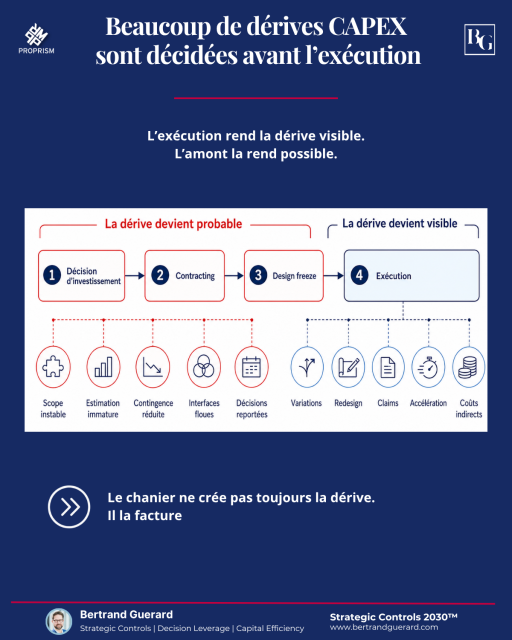
Beaucoup de dérives CAPEX sont décidées avant l'exécution
LinkedIn
July 20, 2026
Le chantier n’a pas créé la dérive CAPEX.
Il l’a simplement facturée.
Dans beaucoup de projets, une partie du dépassement est rendue probable avant même le premier jour d’exécution.
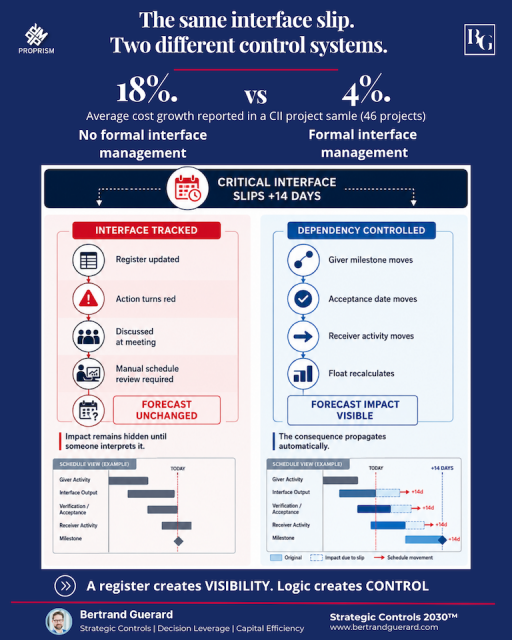
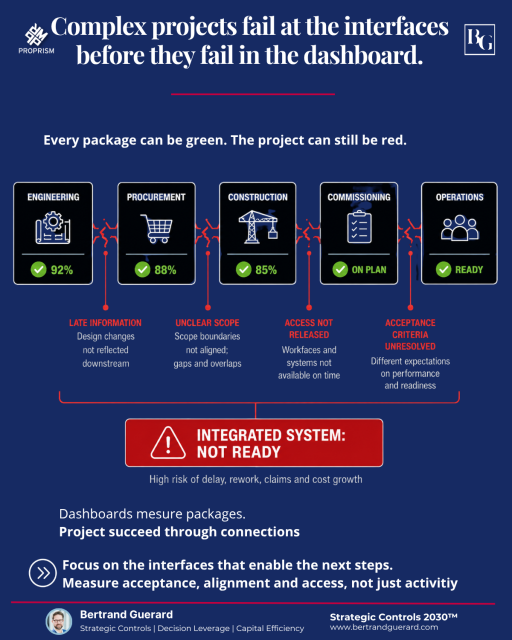
Complex projects fail at the interfaces before they fail in the dashboard
LinkedIn
July 20, 2026
£16 billion had been spent.
The bulk of Crossrail’s construction was complete.
Yet only 27% of the pre-commissioning and partial-acceptance certificates across its central-section stations had been completed.
The assets existed.
The integrated railway was not yet ready.
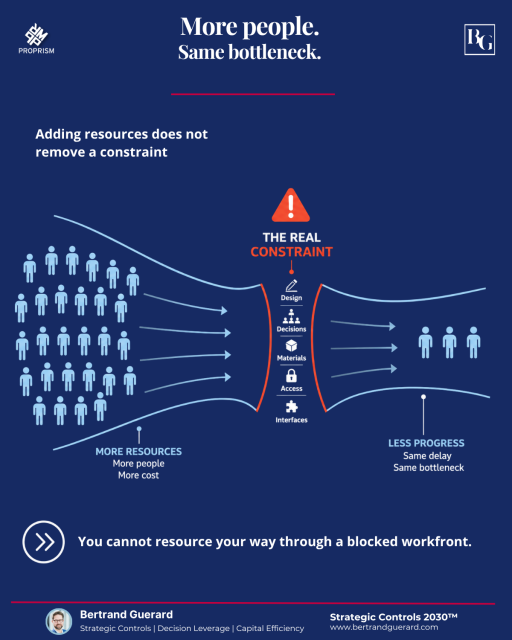
When Resource Loading Exceeds Real Capacity
LinkedIn
July 19, 2026
A resource-loaded schedule can be mathematically complete and operationally impossible.
In one schedule assessment, the US Government Accountability Office described a programme requiring 70 software engineers when only 40 could realistically be staffed.
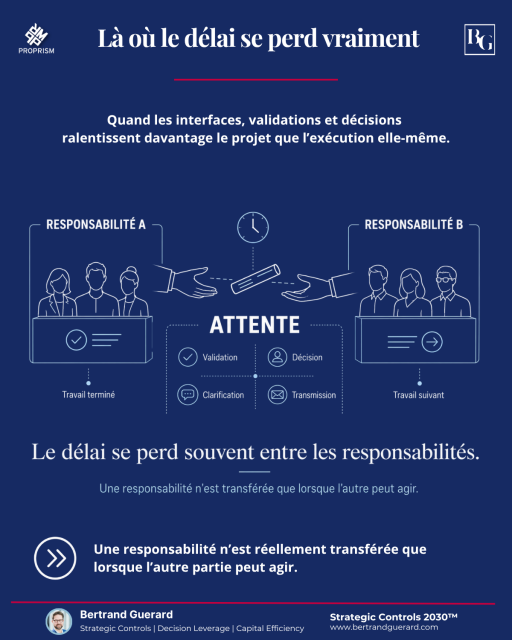
Là où le délai se perd vraiment
LinkedIn
July 19, 2026
Un projet peut prendre du retard alors que personne n’est réellement lent.
Parce que le délai ne se perd pas toujours dans l’exécution.
Il se perd souvent entre les responsabilités.
The claim is rarely the beginning
LinkedIn
July 16, 2026
Commercial risk does not begin with the claim.
It begins when people stop being honest about the project.
When the schedule still shows green, but nobody believes the date.
When work continues without an agreed instruction.
When scope gaps are discussed informally but never resolved.
When meeting minutes become more careful than the conversations.
When emails are written to protect a future position rather than solve today’s problem.
Un planning n'est fiable que si son avancement reflète le terrain
LinkedIn
July 10, 2026
e me souviens d’un projet dont le planning semblait presque parfait.
Puis je suis allé sur le terrain avec ce planning.
Et toute l’histoire a changé.
Le planning était détaillé.
La logique était bien construite.
Les ressources étaient chargées.
Les achats étaient intégrés.
Les risques et les contraintes étaient documentés.
- Reporting classique vs Système de décision
LinkedIn
July 08, 2026
La plupart des projets ne manquent pas de reporting.
Ils ont des dashboards.
Des KPI.
Des comités.
Des statuts hebdomadaires.
Des slides mensuelles.
Des codes couleur.
Des tableaux d’actions.
Des commentaires d’avancement.
Et pourtant, les décisions arrivent encore trop tard.
A Clean Estimate Can Still Hire Risk
LinkedIn
July 02, 2026
I have sat in gate reviews where the estimate looked approved before the uncertainty was even discussed.
That is where projects become dangerous.
Not when the estimate is uncertain.
Every estimate is uncertain.
The danger starts when uncertainty is hidden behind a clean number.
AACE shows why this matters.
A Class 5 estimate can carry a high-side range up to +100%.
GAO gives an even sharper example.
A $2.47B point estimate had only about 15% probability of being sufficient.
At 80% confidence, the number became $2.79B.
Contingency Is Risk Capital
LinkedIn
June 29, 2026
I often see contingency treated as spare money.
Money that can be reduced.
Money that can be released.
Money that can be used to make the business case look better.
But contingency is not spare money.
It is risk capital.
That distinction matters.
Because once contingency is seen as “extra,” the conversation changes.
Interfaces Are Where Optimism Becomes Exposure
Linkedln
July 21, 2026
The reporting may be accurate. The civil team may genuinely be progressing to plan. The equipment vendor may be meeting its manufacturing dates. Engineering may have issued the required information. The commissioning team may still believe the handover window is achievable.
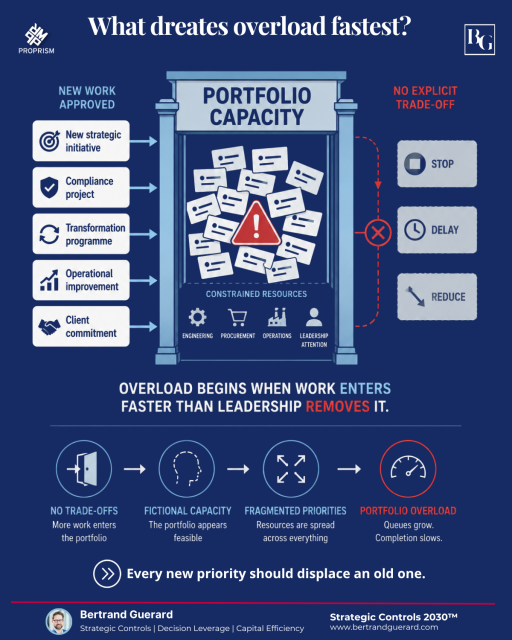
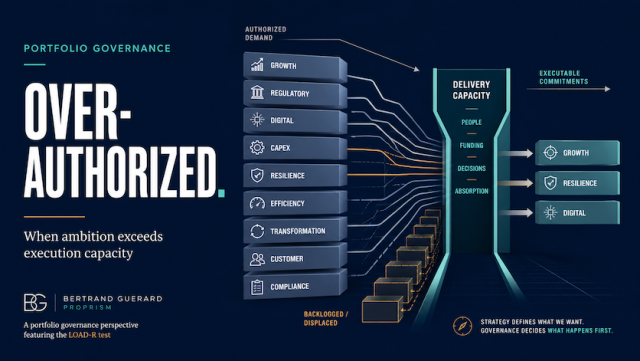
Portfolio Overload Is a Governance Failure Disguised as Ambition
LinkedIn
July 16, 2026
73% of organizations are already near, at, or beyond change saturation.
Yet many leadership teams continue approving more projects.
Another transformation.
Another CAPEX initiative.
Another digital programme.
Another “strategic priority.”
Each project may have a valid business case.
Each may have a sponsor.
Each may appear valuable in isolation.
But that does not mean the portfolio is deliverable as a whole.
This is the distinction many governance systems miss:
Project selection asks whether an initiative is valuable.
Portfolio governance asks whether the organization can deliver it alongside everything else already authorized.
And then comes the question most approval committees avoid:
What must be delayed, reduced, resequenced, or stopped if this project is approved?
When leadership refuses to answer that question, prioritization does not disappear.
It is transferred to:
scarcity,
political influence,
resource conflicts,
escalation,
and firefighting.
The result is often described as a resource problem.
But in many cases, it is an authorization problem.
In my new article, I explore why portfolio overload is often a governance failure disguised as ambition, and introduce the LOAD-R executive test:
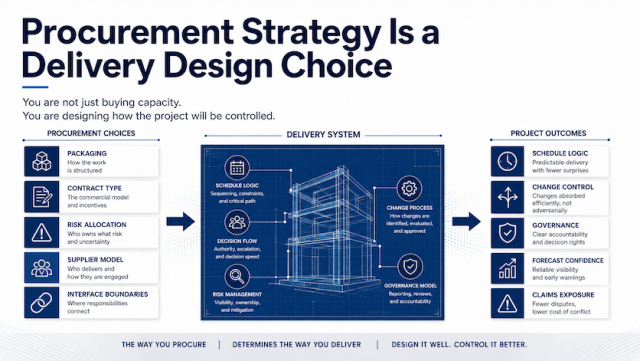
Procurement Strategy Is a Delivery Design Code
LinkedIn
July 07, 2026
Most projects do not discover their delivery problems during execution.
They inherit them.
From the way the work was packaged.
From the way risk was allocated.
From the way suppliers were selected.
From the way interfaces were drawn.
From the way contract incentives were designed.
Procurement is often treated as a commercial step:
Define the scope.
Go to market.
Compare bids.
Negotiate.
Award.
Execute.
But in complex projects, procurement is not just buying capacity.
It is designing the delivery system.
The procurement strategy determines who controls the work, where interfaces sit, how risks are transferred or retained, how change will be absorbed, how decisions will flow, and whether the project can actually be governed.
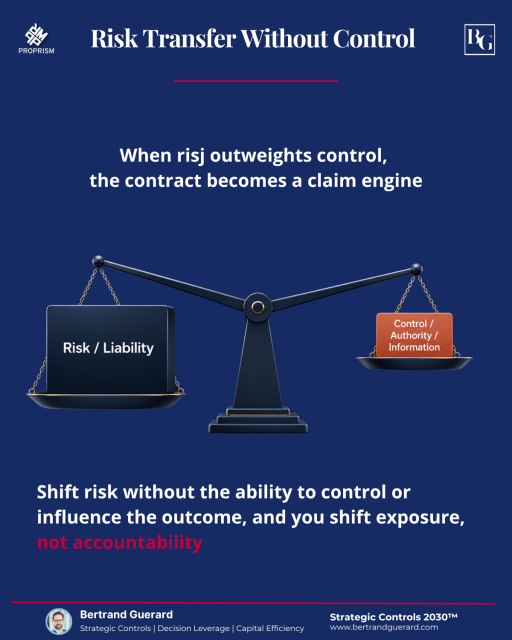
A contract can transfer liability.
It does not automatically transfer control.
A supplier can own a scope.
Only the client can own the delivery system.
In this article, I explore why procurement strategy should be treated as an upstream delivery design choice, not just a purchasing or legal process.
I also share a practical lens: the Procurement-to-Delivery Fit Test.
Before approving a procurement strategy, leaders should ask:
Can this delivery model be governed?
Are the interfaces visible?
Is risk aligned with control?
Will the contract type create the right behavior under pressure?
Can project controls still see reality early enough?
Because once complexity is embedded upstream, no dashboard, steering committee, or recovery plan can fully compensate for it later.
Procurement strategy is a delivery design choice.
Treat it that way before execution makes the lesson expensive.
What do you see most often: procurement reducing delivery risk, or relocating it?
--
Follow Bertrand GUERARD for daily insights to strengthen project control leaders, because better-led projects mean less waste, stronger organizations, and more predictable outcomes.
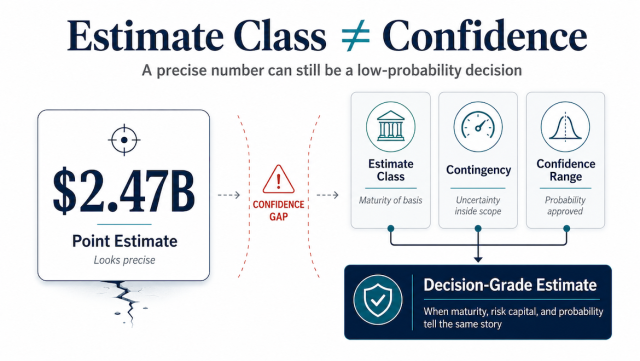
Estimate Class Is Not Confidence: The Cost Governance Gap Behind CAPEX Overruns
LinkedIn
July 01, 2026
A project estimate can look precise and still be unsafe.
That is one of the biggest traps in CAPEX governance.
A number may be clean.
The decimals may look professional.
The approval pack may look mature.
The contingency line may appear reassuring.
But the real question is not:
“Do we have an estimate?”
The real question is:
“What confidence does this estimate deserve?”
This is where three concepts are often confused:
1 - Estimate Class
How mature is the basis?
2 - Contingency
What uncertainty remains inside the defined scope?
3 - Confidence Range
What probability is leadership actually approving?
A Class 3 estimate is not automatically a high-confidence estimate.
Contingency is not spare money.
And a point estimate is not a decision-grade number unless leadership understands the probability behind it.
In one GAO cost-estimating example, a $2.47B point estimate had only approximately a 15% likelihood of being achieved once risk and uncertainty were considered. The P50 and P80 values were materially higher.
That is the real governance issue.
The problem is not the number itself.
The problem is approving the number without naming the confidence level behind it.
I have written a technical article on this:
Estimate Class Is Not Confidence: The Cost Governance Gap Behind CAPEX Overruns
It explores how estimate class, contingency, and confidence ranges should work together before a CAPEX number becomes a baseline.
Because a decision-grade estimate is not the one with the most precise number.
It is the one where maturity, risk capital, and probability tell the same story.
Before your next approval gate, one question may change the conversation:
Are we approving a cost estimate, or are we approving a probability of overrun?
--
Follow Bertrand GUERARD for daily insights to strengthen project control leaders, because better-led projects mean less waste, stronger organizations, and more predictable outcomes.
The Estimation Is Not the Decision. The Confidence Level Is.
LinkedIn
June 30, 2026
️ €2.47B -- behind that number may sit immature scope, weak assumptions, incomplete risk analysis, fragile schedule logic, and contingency that cannot defend its own purpose
The most dangerous estimate is not the one with a wide range.
It is the one with a precise number leadership wants to believe.
A project estimate can look professional:
Clean dashboard.
Green status.
Visible contingency.
Approval pack ready.
But behind that number may sit immature scope, weak assumptions, incomplete risk analysis, fragile schedule logic, and contingency that cannot defend its own purpose.
That is where capital decisions become exposed.
In one GAO example, a $2.47B point estimate had only about a 15% likelihood of being met once risk and uncertainty were considered.
The P50 value was $2.61B.
The P80 value was $2.79B.
Same project.
Different confidence level.
Very different capital decision.
This is why estimate confidence matters more than estimate precision.
Leaders often ask:
“Can we reduce the estimate?”
“Can we make the number sharper?”
“Is the contingency too high?”
“Can we approve this budget?”
But stronger governance asks different questions:
“Which assumptions are driving the range?”
“What maturity is missing before this number becomes decision-grade?”
“What risks is contingency designed to protect?”
“What confidence level are we approving?”
A project estimate is not credible because it contains more decimals.
It is credible when its logic can survive challenge.
That is the shift I explore in my new article:
Why Estimate Confidence Matters More Than Estimate Precision
Because in capital projects, the estimate is not the decision.
The confidence level is.
Before your next approval gate, don’t only challenge the estimate value.
Challenge the confidence level your organization is about to underwrite.
Before your next approval gate, ask one uncomfortable question:
Are we approving a number, or underwriting a confidence level we have not properly tested?
Read the article and let me know how your organization handles this.
--
Follow Bertrand GUERARD for daily insights to strengthen project control leaders, because better-led projects mean less waste, stronger organizations, and more predictable outcomes.
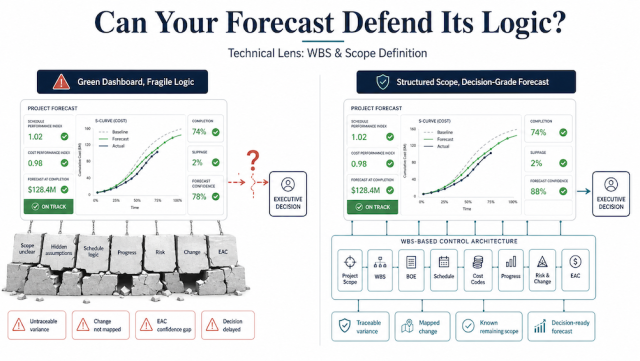
Without that structure, project controls spends too much energy reconciling systems and defending reports.
With that structure, the forecast becomes traceable, challengeable, and decision-ready.
That is why WBS and scope definition are not administrative details.
They are part of capital control.
In my latest article, I explore why forecast credibility starts long before the forecasting meeting.
It starts when the project decides how scope will be defined, structured, coded, measured, changed, and governed.
Because in the end:
You cannot control what you cannot structure.
What do you usually see breaking first: scope definition, schedule logic, cost structure, progress measurement, or change control?
--
Follow Bertrand GUERARD for daily insights to strengthen project control leaders, because better-led projects mean less waste, stronger organizations, and more predictable outcomes.
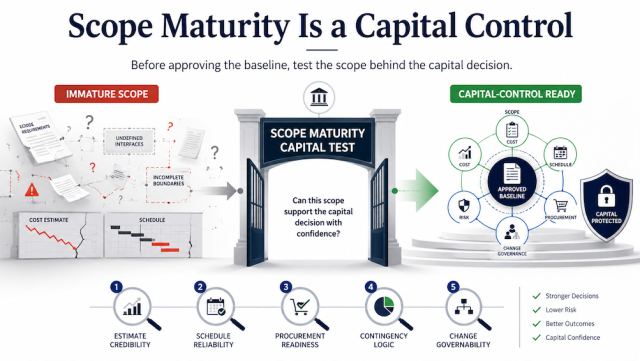
By the time it appears in the change log, the issue is already late.
By the time it appears in the forecast, the capital impact has already started.
And by the time it reaches the steering committee, the organization is no longer debating scope maturity.
It is debating cost growth.
That is why I believe scope maturity should be treated as a capital-control discipline, not a technical detail.
A mature scope does not mean a perfect scope.
It means the scope is explicit, traceable, challenged, risk-adjusted, and governable.
In my latest article, I share the “Scope Maturity Capital Test”, a practical leadership lens to assess whether a baseline deserves confidence before capital is committed.
Because approval without maturity is not control.
It is exposure with a signature.
Before approving your next baseline, ask yourself:
Is the scope mature enough to protect the capital behind it?
--
Follow Bertrand GUERARD for daily insights to strengthen project control leaders, because better-led projects mean less waste, stronger organizations, and more predictable outcomes.
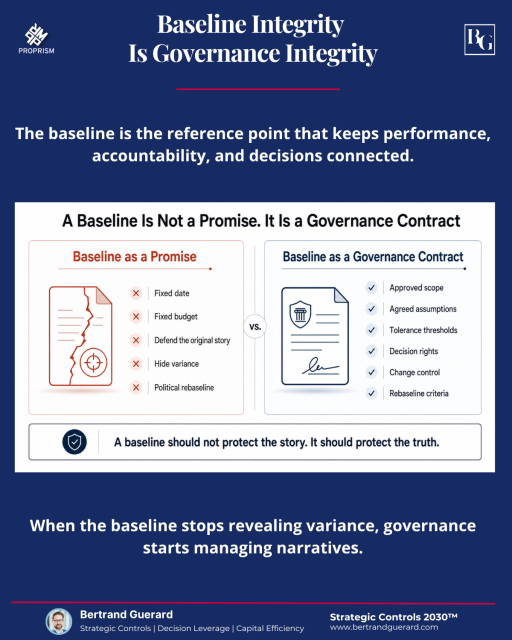
When the Baseline Becomes Political, the Forecast Becomes Useless
LinkedIn
June 16, 2026
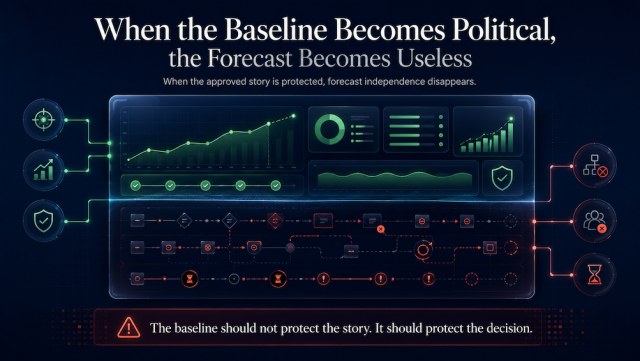
Every project baseline has two lives.
One is technical.
It lives in the schedule, the cost system, the change log, the earned value model, and the steering pack.
The other is political.
It lives in the commitment made to the board.
The date communicated to the sponsor.
The budget approved by the investment committee.
The promise made to secure funding.
Project control starts to fail when the second life takes control of the first.
Because when the baseline becomes a story to protect, the forecast loses its independence.
It stops asking:
“Where are we really going?”
And starts asking:
“How close can we stay to the story we already approved?”
That is where many projects lose decision quality.
Not because teams cannot calculate dates or costs.
But because the gap between commitment and reality becomes too uncomfortable to show.
In my latest article, I explore why baseline management is not only a planning discipline.
It is a governance discipline.
And why mature project controls should protect four views:
→ the baseline
→ the current plan
→ the forecast
→ the decision gap
Because the real question is not:
“Can we still say we are on baseline?”
The real question is:
“What is the baseline telling us about the decisions we now need to make?”
The baseline should not protect the story.
It should protect the decision.
Curious to hear your view:
Can your current forecast move away from the approved baseline without being treated as failure?
Decision Architecture: The Missing Layer Between Project Visibility and Control
LinkedIn
June 09, 2026
Most project governance systems are designed to move information upward.
Dashboards show variance.
Reports explain trends.
Steering committees create visibility.
Stage gates formalise control points.
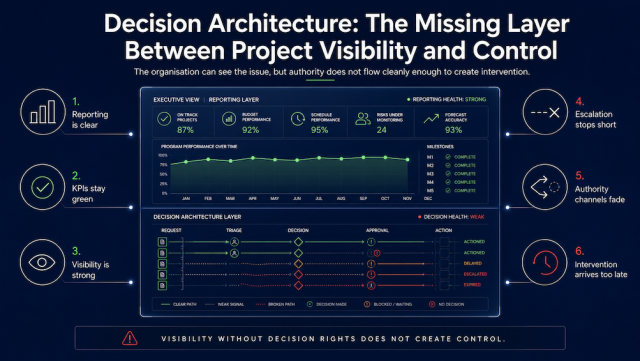
But visibility is not control.
A project becomes controllable only when the right people can make the right decisions before the project loses optionality.
That is where many governance systems quietly fail.
Not in reporting.
In authority.
I see this pattern often in major project environments:
The project controls team identifies the issue.
The dashboard shows the trend.
The risk is escalated.
The mitigation options are prepared.
The steering committee discusses the problem.
But the decision does not happen.
No one is fully sure who can release contingency.
No one wants to approve acceleration too early.
No one owns the trade-off between cost, time, scope, and risk.
No one knows exactly when the decision loses value.
So the organization asks for more analysis.
And while governance is discussing, the project is losing options.
This is why I believe decision architecture is one of the missing layers in project governance.
Decision architecture is the designed pathway through which project facts become authorised intervention before options expire.
It defines:
Who can decide.
What they can decide.
When they must decide.
What evidence they need.
What trade-offs they can make.
What happens if no decision is made.
Because project controls can reveal variance.
Governance can create forums.
But only clear decision rights convert project facts into action.
In my new article, I explore why decision architecture matters for sponsors, Heads of PMO, project directors, project controls leaders, and CAPEX organizations.
The central idea is simple:
A project is only as controllable as its decision architecture.
Where do you see the biggest decision-rights gap in project governance today?
--
Follow Bertrand GUERARD for daily insights to strengthen project control leaders, because better-led projects mean less waste, stronger organizations, and more predictable outcomes.
Predictability Is Not a Project Metric. It Is a Leadership Advantage.
LinkedIn
May 26, 2026
By the time a project becomes unpredictable, it has usually been predictable for a long time.
Not in the dashboard.
Not in the official narrative.
But in the weak signals experienced teams can already feel:
Assumptions becoming fragile.
Float quietly disappearing.
Procurement dates losing credibility.
Interfaces becoming harder to control.
Forecasts being defended more than challenged.
This is where many organizations confuse visibility with control.
They have dashboards.
They have reports.
They have governance meetings.
They have traffic lights.
But the real question is not whether leadership can see the project status.
The real question is whether the organization can detect what is emerging, decide before certainty arrives, and intervene before optionality disappears.
That is why I believe predictability is not a project metric.
It is a leadership advantage.
And AI will make this even more important.
Not because AI will magically fix weak project controls.
It will not.
AI will expose the difference between organizations with reporting maturity and organizations with real control maturity.
In my new LinkedIn article, I explore:
→ why predictability is becoming a capital delivery advantage
→ why schedule predictability is financial predictability
→ why AI will amplify the control system already in place
→ why decision time may become one of the most important executive variables in complex projects
→ and why I believe the next maturity frontier is predictive governance for capital delivery
The article is titled:
Predictability Is Not a Project Metric. It Is a Leadership Advantage.
Because in the next era of project controls, the winners will not be the organizations with the most dashboards.
They will be the ones that turn intelligence into action while there is still time.
What is your view?
Are most organizations truly becoming more predictable — or simply better at reporting uncertainty?
Bertrand GUERARD.
Follow for more on Strategic Controls in CAPEX & portfolio leadership.
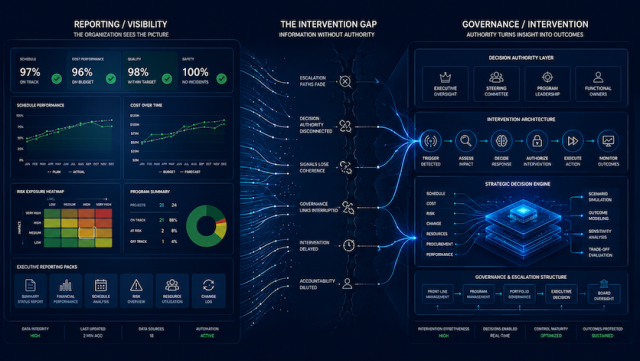
But many projects still drift long before the dashboard turns red.
Why?
Because visibility is not control.
And reporting does not create intervention.
Over the last few years, I have repeatedly observed the same hidden failure pattern across complex delivery environments:
The organisation could see deterioration.
But it could not convert signals into timely decisions.
Float erosion was visible.
Procurement pressure was known.
Forecast confidence was weakening.
Risks were documented.
Yet intervention remained delayed, fragmented, politically difficult, or structurally unclear.
The project was being observed in high definition.
But it was not being controlled.
In my latest article, I explore:
- Why reporting maturity is often mistaken for control maturity
- Why governance fails when authority to intervene is unclear
- The hidden cost of “decision debt”
- Why AI will expose weak governance faster than it fixes it
- The Intervention Control Chain: a framework for turning signals into action
One of the core ideas behind the article is simple:
Project control is not the ability to see variance.
It is the authority to act on consequence.
I would genuinely be interested in hearing where control tends to break inside your organisation:
At visibility?
At escalation?
Or at intervention authority?
---
Follow Bertrand GUERARD for daily insights to strengthen project control leaders, because better-led projects mean less waste, stronger organizations, and more predictable outcomes.
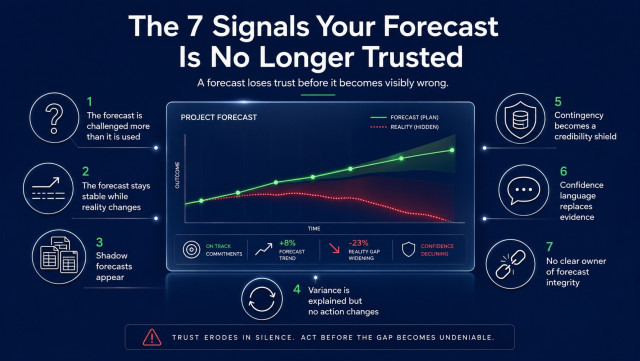
The 7 Signals Your Forecast is No Longer Trusted
LinkedIn
May 19, 2026
This article explores why project forecasts often lose trust before they become visibly wrong.
It introduces the Forecast Trust Chain:
Signal → Interpretation → Ownership → Decision → Intervention
And explains the seven warning signs that a forecast is no longer used as a decision signal.
A practical perspective for PMOs, sponsors, project controls leaders, and CAPEX executives who want to improve forecast integrity, governance quality, and delivery confidence.
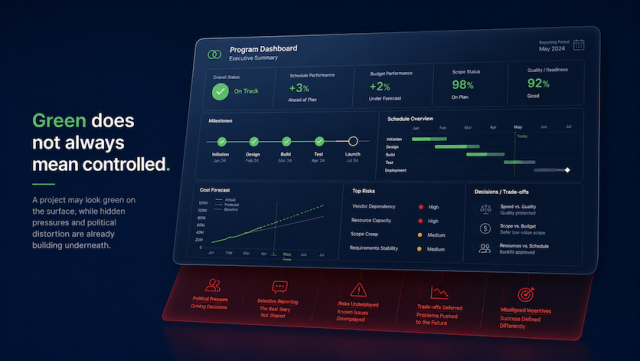
When Truth Decomes Unsafe: Why Project Controls Fails First
LinkedIn
May 12, 2026
Project controls often fails before the dashboard turns red, when technical truth becomes politically unsafe.
This article explores how forecasts, schedules, risks, and governance processes can shift from control mechanisms to reassurance tools when organizations delay uncomfortable decisions.
It introduces a practical framework for mature controls: protecting the path from signal to visibility, escalation, decision, and action.
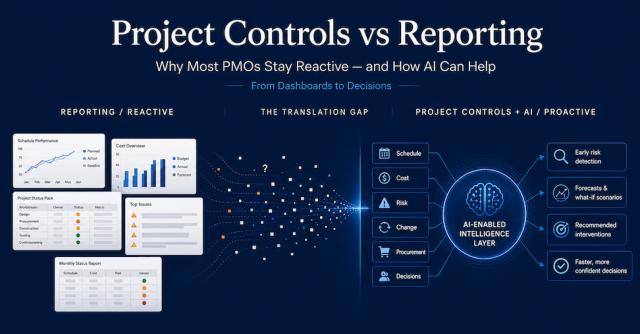
Reporting Is Not Control: From Visibility to Intervention
LinkedIn
May 05, 2026
Reporting Is Not Control: From Visibility to Intervention challenges the common misconception that better dashboards create better control.
The article reframes PMO and project controls maturity around decision intelligence, forecast credibility, decision debt, and earlier intervention, showing how AI can help only when it strengthens governance and accelerates decisions, not just reporting.
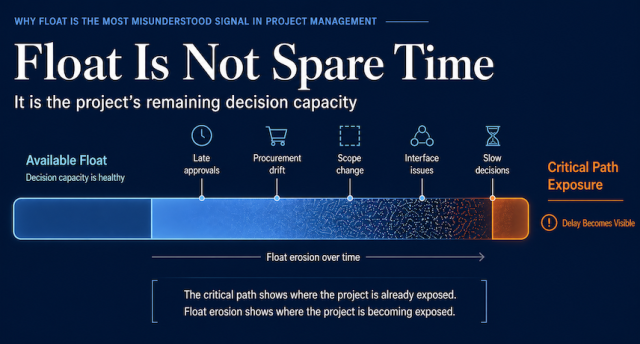
Float is not spare time. It is the project's remaining decision capacity
LinkedIn
April 28, 2026
Most projects do not lose control on the day the critical path turns red.
They lose control earlier.
Quietly.
Through slow decisions.
Late approvals.
Procurement drift.
Unresolved interfaces.
Optimistic assumptions.
Changes discussed commercially but not integrated logically.
The schedule often contains the warning.
But the warning is hidden in a signal many leaders still treat as technical:
Float.
In many projects, float is still seen as spare time.
A planning calculation.
A buffer.
A number buried in the schedule until the critical path finally turns red.
But that is a dangerous simplification.
Float is not a discretionary contingency pool.
It is evidence of remaining schedule resilience.
More importantly, it is the project’s remaining decision capacity.
The critical path shows where the project is already exposed.
Float erosion shows where the project is becoming exposed.
That distinction matters.
Because by the time an activity becomes critical, the project has often been losing control for weeks or months.
I wrote this article to explain why float may be one of the most misunderstood signals in project management, and why project leaders, PMOs, sponsors, and project controls teams should treat float erosion as a governance warning, not just a scheduling metric.
Read the full article
Float is the project’s remaining ability to decide before delay decides for you.
Where do you see float being silently consumed most often?
Procurement, approvals, interfaces, change, or slow decisions?
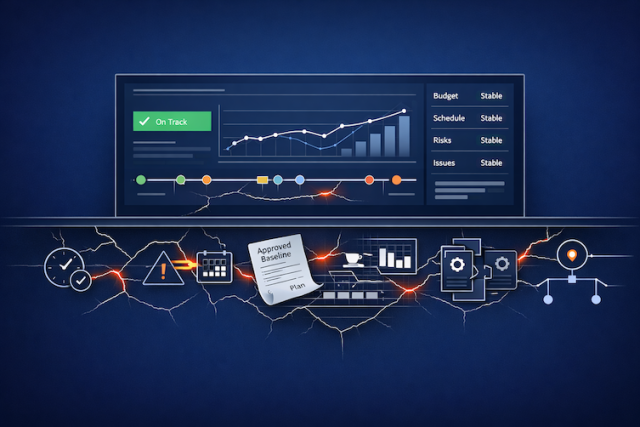
The 7 governance blind spots that make complex projects present as controlled until it is too late
LinkedIn
April 21, 2026
A project can be reviewed regularly, reported professionally, and still be poorly governed.
That is the uncomfortable truth.
In complex projects, governance rarely fails in one visible moment.
It fails earlier.
It fails when signals stop becoming decisions.
When decisions stop becoming interventions.
And when dashboards continue to present control that no longer truly exists.
That is the theme of my latest article:
The 7 governance blind spots that make complex projects present as controlled until it is too late
In it, I explore why governance should be understood not as a reporting ritual, but as a decision system.
Because projects are not saved by visibility alone.
They are saved by the ability to detect drift early, escalate meaningfully, and intervene before recoverability disappears.
The article introduces a lens I believe matters more than most governance frameworks admit:
The Governance Conversion Chain
signal → decision → intervention → outcome
When that chain breaks, governance may still look active.
But it is no longer protecting the outcome.
If you lead projects, PMOs, controls, portfolios, or capital delivery, this article was written for you.
I would value your perspective:
Where do you think governance usually fails first in real life?
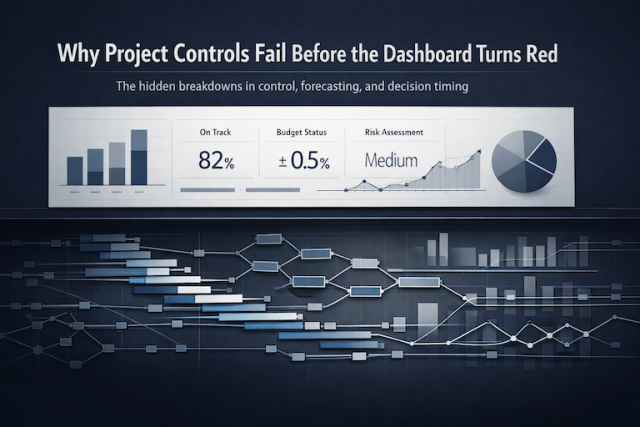
Why project controls fail long before the dashboard turns red
LinkedIn
April 14, 2026
Most projects do not lose control when the dashboard turns red.
They lose it earlier.
When the schedule is still updated, but no longer trusted.
When risks are still documented, but no longer converted into forecast or action.
When cost and schedule still exist, but no longer tell the same delivery story.
When governance keeps reviewing tension, but decisions arrive too late to protect the outcome.
That is the pattern I explored in my latest LinkedIn article:
Why project controls fail long before the dashboard turns red
It is a strategic view on the hidden breakdowns that weaken predictability before visible KPI deterioration appears.
If you work in project controls, PMO, CAPEX delivery, or executive governance, this is the question worth asking:
Is your control system still helping leaders act early, or only helping them explain problems later?
Read the article here. And if this is your world, follow my work for deeper thinking on project controls, governance, and delivery predictability.
Founder | Head of Project Management | Project Planning & Controls
PROPRISM
January 01, 2015
Founded a project planning niche consultancy business and run and manage all day-to-day matters of the business. Spearhead clients’ project management, strategic business planning, and performance against customers’ projects implementing systems and processes. Orchestrate delivery of high-quality lifecycle projects for clients such as Jan De Nul, GlaxoSmithKline, MSD, and Sanofi.
M2 Protection and Management of Innovation in Health
Universite Paris Saclay
January 01, 2020
The Master 2 PIMS provides a unique professional program at the crossroads of science, law, and economics. It prepares graduates to manage health innovation projects by combining expertise in R&D, regulatory affairs, intellectual property, and business strategy. The curriculum integrates lectures, case studies, and internships, fostering strong connections with industry and research
Location: France - Cannes Date : June 01, 2026 - June 03, 2026 Organizer: Datacloud
global event, networking, and thought-leadership platform for the data centre, cloud, AI, and investment space. We host conferences worldwide, connecting senior leadership to develop meaningful connections, resulting in significant ROI for attendees.
Join Thinkers360 for free! Are you a Reader/Writer, Thought Leader/Influencer (looking to increase your earnings), or an Enterprise User (looking to work with experts)?



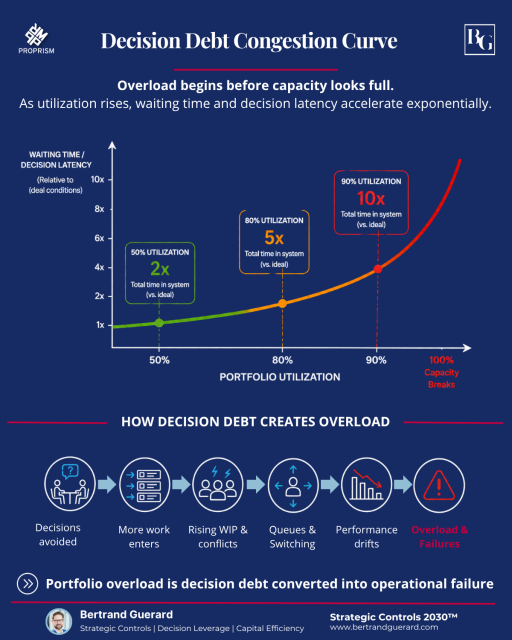 DEcision Debt Congestion Curve
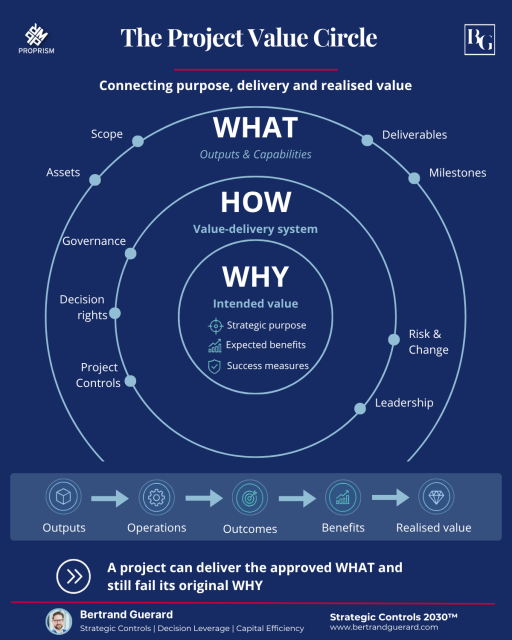 The Project Value Circle
 The same interface slip. 2 different control systems
 More people. Same bottleneck
 What dreates overload fastest?
 Beaucoup de dérives CAPEX sont décidées avant l'exécution
 Complex projects fail at the interfaces before they fail in the dashboard
 When Resource Loading Exceeds Real Capacity
 Là où le délai se perd vraiment
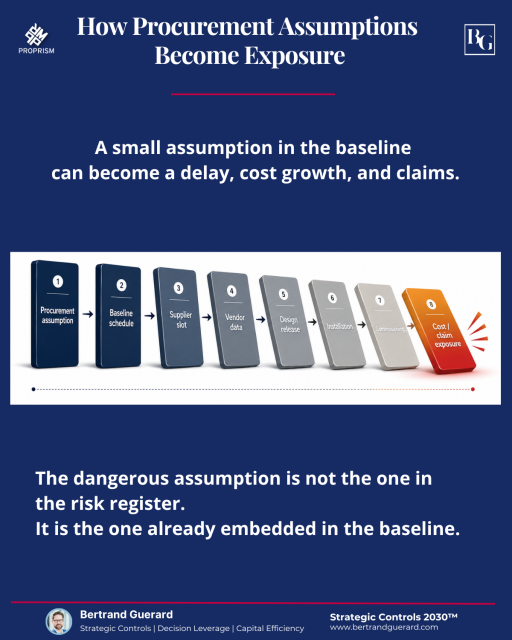 How Procurement Assumptions Become Exposure
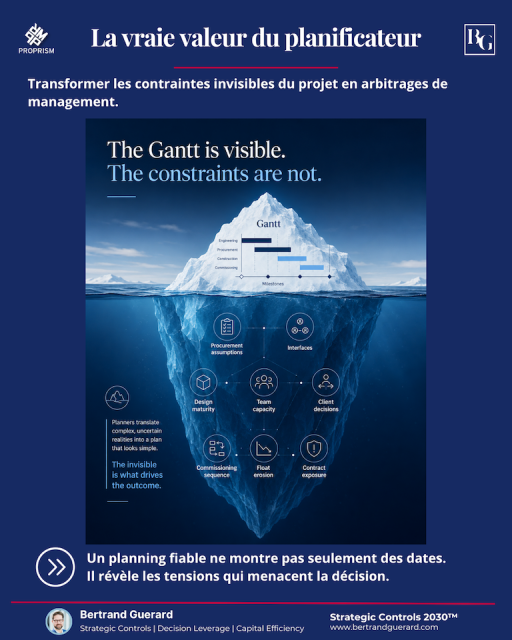 La vraie valeur du planificateur
 The claim is rarely the beginning
 Quand le chef de projet fait aussi le planning...
 Risk Transfer Without Control
 Un planning n'est fiable que si son avancement reflète le terrain
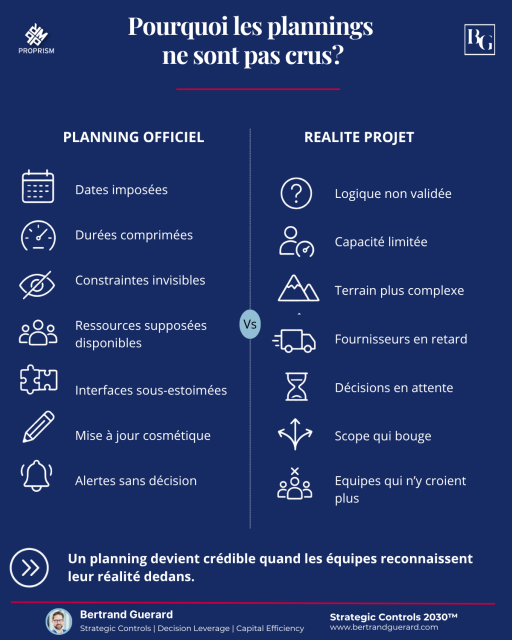 - Pourquoi les plannings ne sont pas crus ?
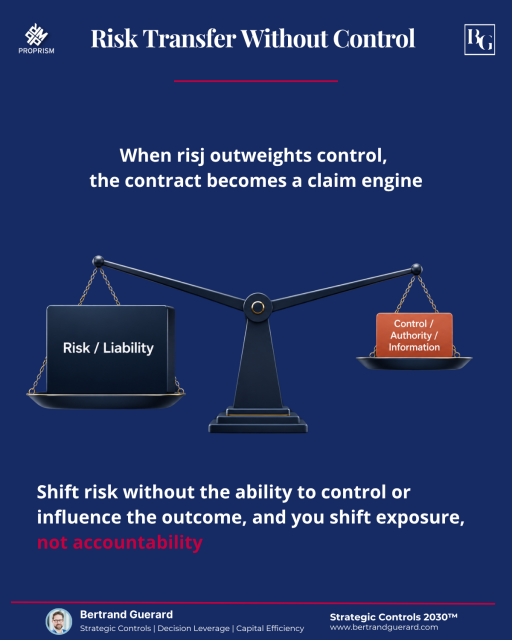 Risk Transfer ≠ Risk Control
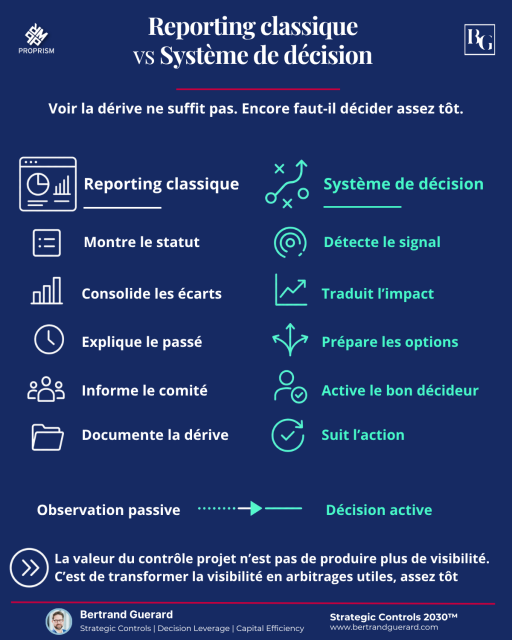 - Reporting classique vs Système de décision
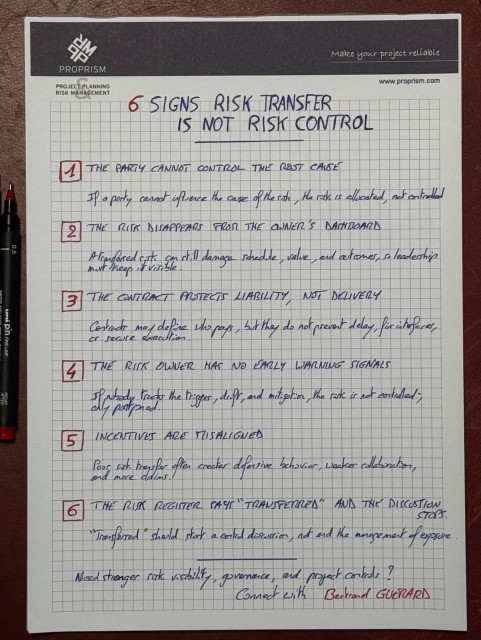 6 signs risk transfer is not risk control
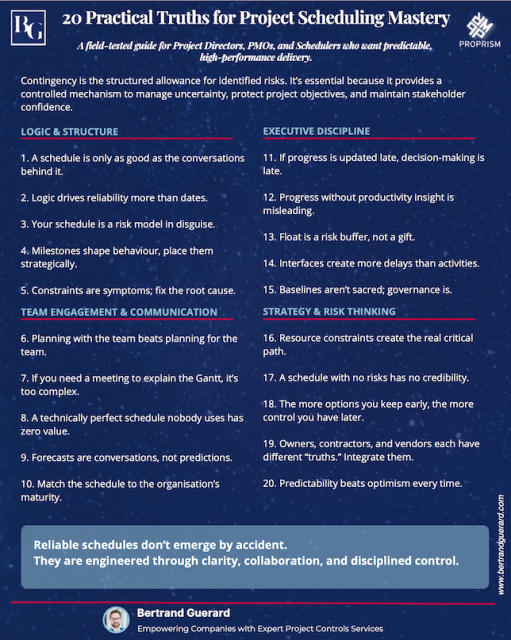 20 Pratical Truths for Project Scheduling Mastery
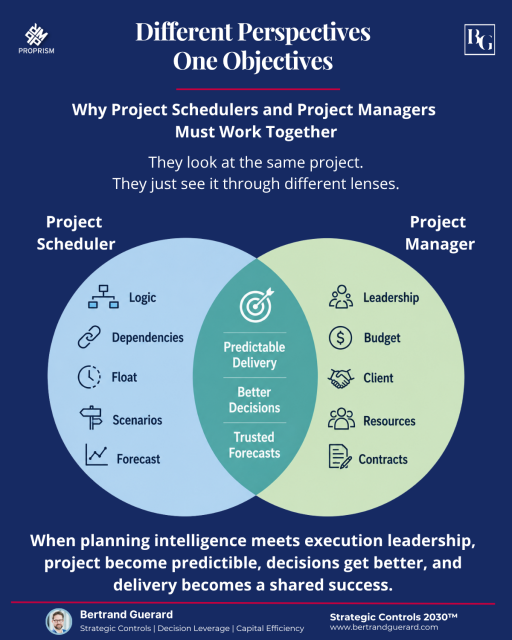 Different Perspectives - One Objectives
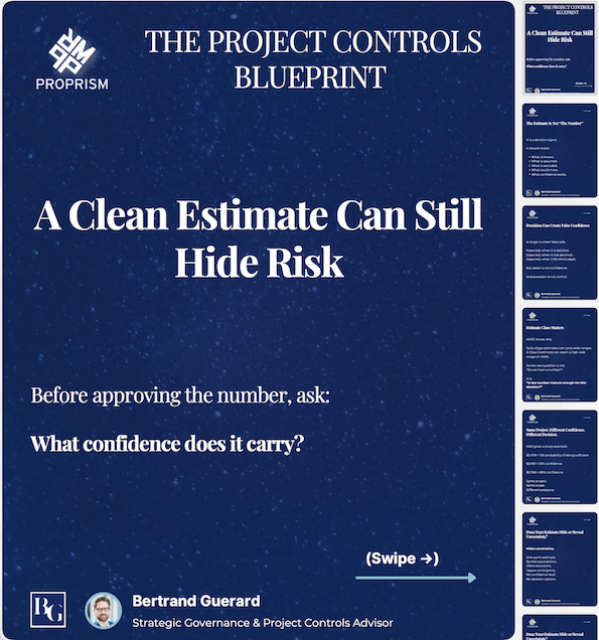 A Clean Estimate Can Still Hire Risk
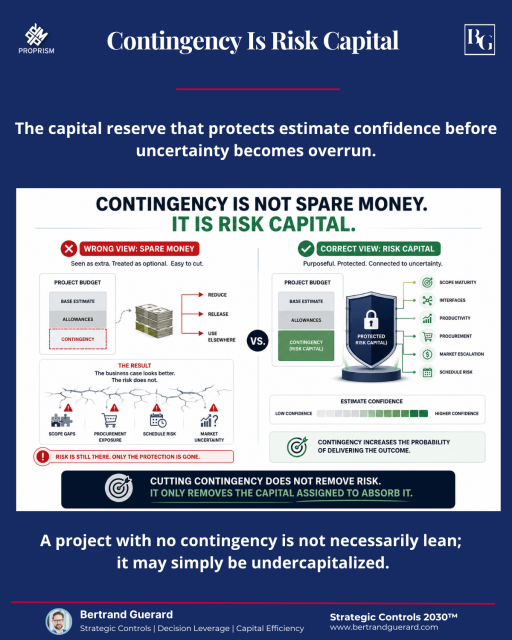 Contingency Is Risk Capital
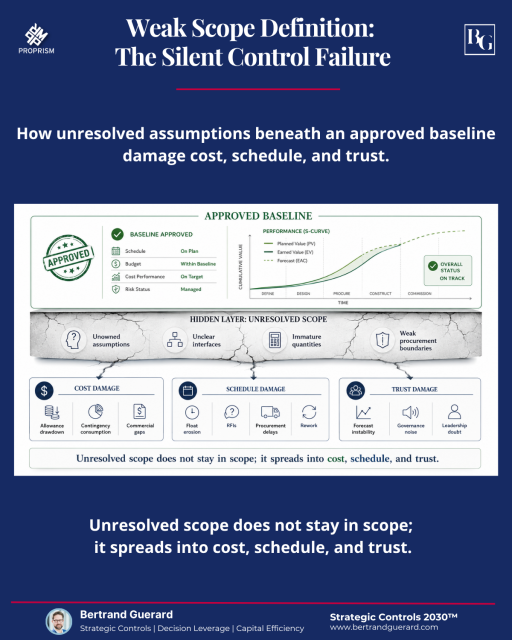 Weak Scope Definition: The Silent Control Failure
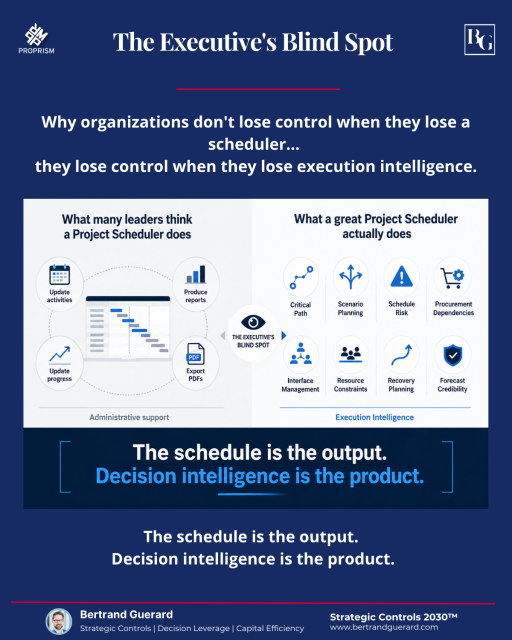 The Executives's Blind Spot
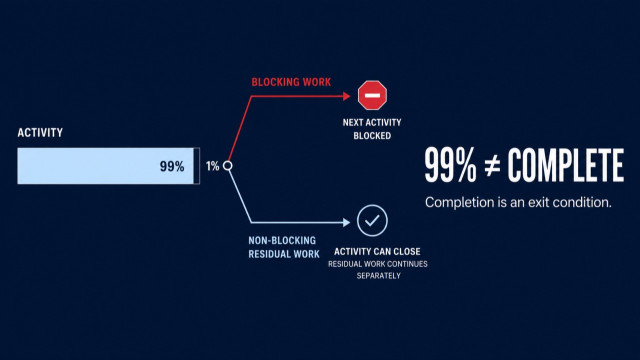 When Is a Schedule Activity Really Complete?
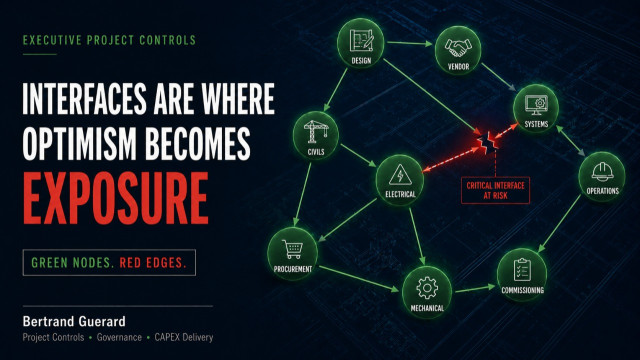 Interfaces Are Where Optimism Becomes Exposure
 Portfolio Overload Is a Governance Failure Disguised as Ambition
 Procurement Strategy Is a Delivery Design Code
 Estimate Class Is Not Confidence: The Cost Governance Gap Behind CAPEX Overruns
 The Estimation Is Not the Decision. The Confidence Level Is.
 Your Forecast is only as strong as the Scope Structure beneath it
 Scope Maturity is a Capital Control, not a Technical Detail
 When the Baseline Becomes Political, the Forecast Becomes Useless
 Decision Architecture: The Missing Layer Between Project Visibility and Control
 Predictability Is Not a Project Metric. It Is a Leadership Advantage.
 The Control Illusion: Why Reporting Does Not Create Project Control
 The 7 Signals Your Forecast is No Longer Trusted
 When Truth Decomes Unsafe: Why Project Controls Fails First
 Reporting Is Not Control: From Visibility to Intervention
 Float is not spare time. It is the project's remaining decision capacity
 The 7 governance blind spots that make complex projects present as controlled until it is too late
 Why project controls fail long before the dashboard turns red
 Founder | Head of Project Management | Project Planning & Controls
 M2 Protection and Management of Innovation in Health


 DataCloud Global Congress