

Thinkers360
Interested in getting your own thought leader profile? Get Started Today.

Prof. Hernan Huwyler, MBA CPA

Director at IE Law Shool

Copenhagen, Denmark

Hernan Huwyler is a globally recognized expert in risk management, artificial intelligence (AI), cybersecurity, and compliance, with over 20 years of experience leading multinational companies to successfully manage global risks and achieve strategic objectives. An MBA and CPA with expertise in accounting, auditing, and compliance, Hernan has a proven track record in sectors such as oil & gas, energy, and engineering, where he has led process improvement projects, financial statement audits under US GAAP and IFRS, and compliance programs for regulations like GDPR, Sarbanes-Oxley (SOX), and FCPA.

Hernan is a pioneer in integrating AI into risk management, conducting AI risk and impact assessments in alignment with ISO 23894. He has developed innovative frameworks for quantifying risks, particularly in cybersecurity and operational risk, enabling organizations to prioritize risks based on their potential impact and likelihood. His work in cybersecurity risk management focuses on integrating cyber risk into broader enterprise risk management (ERM) programs, ensuring robust protection against emerging threats.

A strong advocate for data-driven decision-making, Hernan has created tools and templates for risk assessments, control testing, and risk reporting, which are widely used by professionals in the field. He is also known for designing compliance programs that align with international standards such as ISO 31000, ISO 27001, and ISO 27701, as well as regulations like GDPR and SOX.

In addition to his practical contributions, Hernan is an influential educator and thought leader. He directs master’s and postgraduate programs, sharing his expertise in risk management, compliance, and AI. He has authored several books and articles on topics like risk appetite, risk culture, and third-party risk management, and regularly publishes insights on platforms like LinkedIn. His blog, GRC Daily Executive, serves as a resource for professionals seeking to stay updated on best practices in governance, risk, and compliance.

Hernan’s leadership style is characterized by his ability to thrive in dynamic environments, handle changing priorities with ease, and collaborate across all organizational levels to achieve measurable business efficiency. Fluent in English and Spanish, he is a versatile and optimistic project coordinator who excels in training, analysis, and fostering collaboration.
Key Contributions and Influence

AI and Risk Management: Leading the integration of AI into risk frameworks, ensuring organizations are prepared for AI-related risks and opportunities.

Cybersecurity: Developing frameworks to manage and mitigate cyber risks within ERM programs.

Compliance: Designing programs that align with global standards like GDPR, SOX, and ISO 31000.

Education and Thought Leadership: Directing academic programs, authoring books, and sharing insights through articles and his blog.

Practical Tools: Creating actionable tools for risk quantification, control testing, and reporting.

Hernan Huwyler’s ability to bridge theory and practice, combined with his focus on technology-driven solutions, positions him as a leading figure in the evolution of risk management and compliance in the digital age.

Available For: Authoring, Influencing, Speaking
Travels From: Copenhagen
Speaking Topics: Artificial Intelligence Risks, Governance, Compliance, Quantitative Risk, Audit, Cyber Security, SAP, Fraud, SOX, Transformation

Prof. Hernan Huwyler, MBA CPA Points
Academic 55
Author 150
Influencer 20
Speaker 10
Entrepreneur 13
Total 248

Points based upon Thinkers360 patent-pending algorithm.

Thought Leader Profile

Portfolio Mix

Company Information

Company Type: Company
Business Unit: Education
Minimum Project Size: N/A
Average Hourly Rate: N/A
Number of Employees: 10,001-50,000
Company Founded Date: Undisclosed
Media Experience: I bring over two decades of immersive media experi
Last Media Training: 10/13/2023
Last Media Interview: 10/13/2023

Areas of Expertise

AI 31.41
AI Ethics 46.78
AI Governance 62.99
Analytics 30.13
Business Continuity
Business Strategy 30.16
Change Management
Cybersecurity 30.50
ERP
Finance
Generative AI
IT Operations 31.69
IT Strategy 31.13
Leadership
Legal and IP 30.53
Predictive Analytics 30.04
Privacy
Procurement
Project Management 30.13
Risk Management 38.25
Security 32.78

Industry Experience

Engineering & Construction
Financial Services & Banking
Higher Education & Research
Oil & Gas
Professional Services
Utilities

Publications & Experience

2 Academic Whitepapers
The Risk-Adjusted Intelligence Dividend: A Quantitative Framework for Measuring AI Return on Investment Integrating ISO 42001 and Regulatory Exposure
Cornell University
December 15, 2025
Organizations investing in artificial intelligence face a fundamental challenge: traditional return on investment calculations fail to capture the dual nature of AI implementations, which simultaneously reduce certain operational risks while introducing novel exposures related to algorithmic malfunction, adversarial attacks, and regulatory liability. This research presents a comprehensive financial framework for quantifying AI project returns that explicitly integrates changes in organizational risk profiles. The methodology addresses a critical gap in current practice where investment decisions rely on optimistic benefit projections without accounting for the probabilistic costs of AI-specific threats including model drift, bias-related litigation, and compliance failures under emerging regulations such as the European Union Artificial Intelligence Act and ISO/IEC 42001. Drawing on established risk quantification methods, including annual loss expectancy calculations and Monte Carlo simulation techniques, this framework enables practitioners to compute net benefits that incorporate both productivity gains and the delta between pre-implementation and post-implementation risk exposures. The analysis demonstrates that accurate AI investment evaluation requires explicit modeling of control effectiveness, reserve requirements for algorithmic failures, and the ongoing operational costs of maintaining model performance. Practical implications include specific guidance for establishing governance structures, conducting phased validations, and integrating risk-adjusted metrics into capital allocation decisions, ultimately enabling evidence-based AI portfolio …

See publication

Tags: AI, AI Ethics, Risk Management

Standardized Threat Taxonomy for AI Security, Governance, and Regulatory Compliance
Cornell University arxiv
November 17, 2025
The accelerating deployment of artificial intelligence systems across regulated sectors has exposed critical fragmentation in risk assessment methodologies. A significant "language barrier" currently separates technical security teams, who focus on algorithmic vulnerabilities (e.g., MITRE ATLAS), from legal and compliance professionals, who address regulatory mandates (e.g., EU AI Act, NIST AI RMF). This disciplinary disconnect prevents the accurate translation of technical vulnerabilities into financial liability, leaving practitioners unable to answer fundamental economic questions regarding contingency reserves, control return-on-investment, and insurance exposure. To bridge this gap, this research presents the AI System Threat Vector Taxonomy, a structured ontology designed explicitly for Quantitative Risk Assessment (QRA). The framework categorizes AI-specific risks into nine critical domains: Misuse, Poisoning, Privacy, Adversarial, Biases, Unreliable Outputs, Drift, Supply Chain, and IP Threat, integrating 53 operationally defined sub-threats. Uniquely, each domain maps technical vectors directly to business loss categories (Confidentiality, Integrity, Availability, Legal, Reputation), enabling the translation of abstract threats into measurable financial impact. The taxonomy is empirically validated through an analysis of 133 documented AI incidents from 2025 (achieving 100% classification coverage) and reconciled against the main AI risk frameworks. Furthermore, it is explicitly aligned with ISO/IEC 42001 controls and NIST AI RMF functions to facilitate auditability.

See publication

Tags: AI Governance, IT Strategy, Risk Management

11 Article/Blogs
My Book: AI Management Systems The Operational Playbook That Turns AI Governance from Aspiration into Auditable Defense
Import from wordpress feed
March 12, 2026
AI Management Systems: Operational Playbook for Chief AI Officers and Compliance Risk ManagersBy Hernan Huwyler Artificial intelligence is no longer a side experiment owned by innovation teams. It now sits inside core business processes, decision engines, customer interactions, and regulated operati

See publication

Tags: AI, AI Ethics, AI Governance

Practical Monitoring and Evaluation for AI Projects
Import from wordpress feed
March 12, 2026
How to Measure Real Progress, Catch Problems Early, and Prove ROI Most AI projects do not fail in one dramatic moment. They drift. Expectations rise faster than results. User adoption stalls quietly. Error rates stay hidden behind a single accuracy number. Costs creep up. Support teams start working

See publication

Tags: AI, AI Ethics, AI Governance

Why Separating Your AI Build Team From Your AI Ops Team Guarantees Failure
Import from wordpress feed
March 12, 2026
Practical “You Build It, You Run It” for AI: How to Create End-to-End Ownership Without Burning Out Teams Most AI systems do not break because the first version was badly built. They break because ownership falls apart after release. One team builds the model. Another team deploys it. A third te

See publication

Tags: AI, AI Ethics, AI Governance

How to Build the Right AI Delivery Team
Import from wordpress feed
March 12, 2026
The 7 Roles Every AI Team Needs and the Management Functions Most Teams Forget to Assign Most AI projects do not fail because people worked hard on the wrong tasks. They fail because the team was missing critical roles, responsibilities were fuzzy, or technical and business people were never set up

See publication

Tags: AI, AI Ethics, AI Governance

Resource Estimation for AI Projects
Import from wordpress feed
March 12, 2026
The 15 Cost Categories for AI Budgets (And What They Actually Cost) A Deloitte survey found that 52% of AI projects exceed their original budget. The overage isn’t typically caused by one large unexpected expense. It’s caused by dozens of cost categories that were never included in the o

See publication

Tags: AI, AI Ethics, AI Governance

Practical AI Assessments
Import from wordpress feed
March 12, 2026
The 9-Stage AI Assessment Framework That Answers Three Questions Every Project Must Face Every AI project, regardless of industry, budget, or technology, must answer three questions at the right time. Can we build this? Are we ready to deploy it? Did it actually succeed? Most organizations answer th

See publication

Tags: AI, AI Ethics, AI Governance

Goal Setting for AI Projects
Import from wordpress feed
March 12, 2026
How to Define Objectives, Scope, and Success Without Creating False Expectations Most AI projects do not fail because the team lacked ambition. They fail because the goals were vague, the scope was loose, and the expected outcomes were never translated into measurable business terms. One group thoug

See publication

Tags: AI, AI Ethics, AI Governance

Building vs Buying Decisions for AI Systems
Import from wordpress feed
March 12, 2026
How to Choose the Right Path Without Regretting It Later Most AI teams ask the building vs buying question too late. They already have a preferred answer. Engineering wants to build because it feels more flexible. Business wants to buy because it feels faster. Procurement wants a vendor comparison.

See publication

Tags: AI, AI Ethics, AI Governance

Feasibility Assessment for AI Projects
Import from wordpress feed
March 12, 2026
How to Assess Data, Model Choice, and Integration Before You Build Most AI projects do not fail because the idea was bad. They fail because the feasibility work was weak. The team liked the use case, rushed into a proof of concept, then discovered the data was inconsistent, the model choice was poor

See publication

Tags: AI, AI Ethics, AI Governance

Practical Problem Definition for AI Projects and Use Cases
Import from wordpress feed
March 12, 2026
How to Choose the Right Use Case Before You Waste Time and Budget Most AI projects go wrong before anyone builds a model. They go wrong in the problem statement. The team says they want “an AI solution” when what they really have is a workflow delay, a reporting bottleneck, a quality issue, or a

See publication

Tags: AI, AI Ethics, AI Governance

GRC Intro
Import from wordpress feed
October 13, 2023
GRC Intro

See publication

Tags: Risk Management, Security, GRC

2 Books
AI Management Systems
Hernan Huwyler
February 09, 2026

About this book
As a practitioner who has sat in the same seats you occupy, leading risk, control, and compliance functions for global organizations, I wrote this book to strip away the AI hyperbole. My objective is to provide you with strong corporate defense for the age of intelligence.
The core value of this book lies in its ability to transform probabilistic technical uncertainty into measurable business decisions. We are moving beyond the era of experimental pilots and entering a period of strict regulatory and financial accountability. For senior leaders, managing AI is no longer just about choosing the right model; it is about protecting the firm's license to operate. This book provides an end-to-end framework that spans the entire technological lifecycle, from the initial lexicon used in the boardroom to the complexities of secure model decommissioning.
I have structured this playbook to serve as a bridge between the data science lab and the executive suite. Rather than offering a technical manual, I present an operational system that translates the binding requirements of the EU AI act and global ISO standards into specific, measurable engineering tasks. By institutionalizing an AI management system, you enable your organization to treat governance as a heartbeat rather than a standalone policy, shielding your company from claims of negligence and significant regulatory penalties.
The hallmark of my approach is what I call the moneyball methodology for assessing risks and impacts on AI projects. We move away from subjective heat maps and qualitative checklists toward a rigorous quantification of risk through concrete financial exposure. This book shows you how to price algorithmic bias, quantify the impact of model drift, and calculate the true return on investment for AI projects by modeling the risk delta introduced by automation.
Beyond the numbers, we address the human architecture of change. Implementing AI software requires a sophisticated understanding of workforce psychology and the management of automation anxiety. This text provides the best practices for fostering a culture of governed experimentation where innovation is encouraged but never at the expense of established guardrails. We cover the necessary multidisciplinary team compositions, fusing domain expertise with technical rigor to ensure your AI portfolio is an asset, not a liability.
This work is grounded in the reality of defending risk programs inside Fortune 500 firms. It introduces a unique control-to-compliance architecture that acts as a Rosetta stone, linking real-time system telemetry directly to your contractual obligations and international mandates. By the final chapter, you will possess a structured, audit-ready regime that ensures your organization’s posture is based on internationally accepted standards such as iso 42001 and the NIST risk management framework.
This book is your operational guide to navigating the transition from manual processes to an AI-augmented future. It equips you to lead with technical fluency and strategic empathy, ensuring that your organization remains resilient, compliant, and profitable in an increasingly automated world.

See publication

Tags: AI Ethics, AI Governance, Risk Management
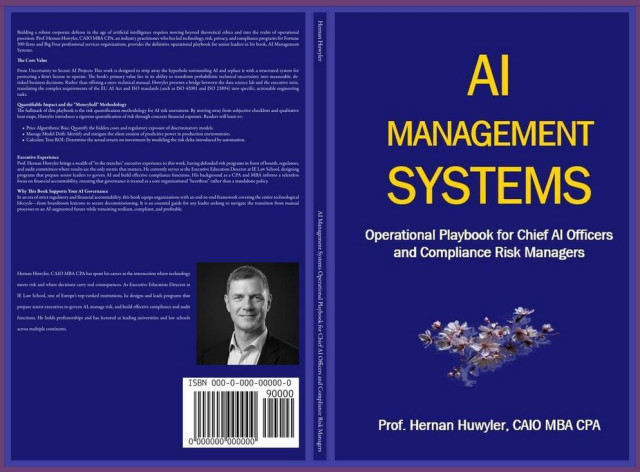
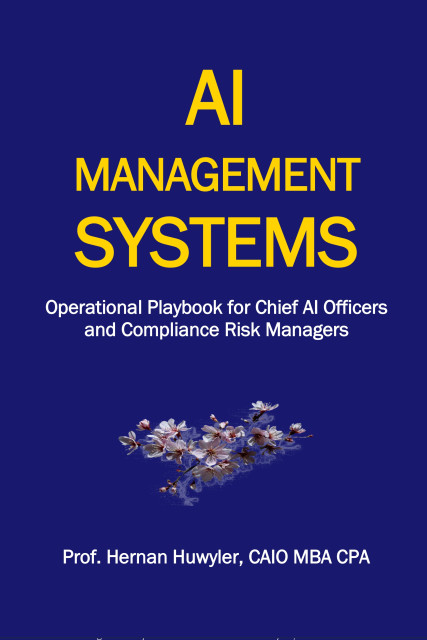
AI Management Systems Operational Playbook for Chief AI Officers and Compliance Risk Managers
Hernan Huwyler
February 08, 2026
Overview

Building a robust corporate defense in the age of artificial intelligence requires moving beyond theoretical ethics and into the realm of operational precision. Prof. Hernan Huwyler, CAIO MBA CPA, an industry practitioner who has led technology, risk, privacy, and compliance programs for Fortune 500 firms and Big Four professional services organizations, provides the definitive operational playbook for senior leaders in his book, AI Management Systems.

The Core Value

From Uncertainty to Secure AI Projects This work is designed to strip away the hyperbole surrounding AI and replace it with a structured system for protecting a firm's license to operate. The book's primary value lies in its ability to transform probabilistic technical uncertainty into measurable, de-risked business decisions. Rather than offering a mere technical manual, Huwyler presents a bridge between the data science lab and the executive suite, translating the complex requirements of the EU AI Act and ISO standards (such as ISO 42001 and ISO 23894) into specific, actionable engineering tasks.

Quantifiable Impact and the "Moneyball" Methodology
The hallmark of this playbook is the risk quantification methodology for AI risk assessment. By moving away from subjective checklists and qualitative heat maps, Huwyler introduces a rigorous quantification of risk through concrete financial exposure. Readers will learn to:
- Quantify the hidden costs and regulatory exposure of discriminatory models.
- Identify and mitigate the silent erosion of predictive power in production environments.
- Determine the actual return on investment by modeling the risk delta introduced by automation.


Executive Experience
Prof. Hernan Huwyler brings a wealth of "in the trenches" executive experience to this work, having defended risk programs in front of boards, regulators, and audit committees where results are the only metric that matters. He currently serves as the Executive Education Director at IE Law School, designing programs that prepare senior leaders to govern AI and build effective compliance functions. His background as a CPA and MBA informs a relentless focus on financial accountability, ensuring that governance is treated as a core organizational "heartbeat" rather than a standalone policy.

Why This Book Supports Your AI Governance
In an era of strict regulatory and financial accountability, this book equips organizations with an end-to-end framework covering the entire technological lifecycle, from boardroom lexicons to secure decommissioning. It is an essential guide for any leader seeking to navigate the transition from manual processes to an AI-augmented future while remaining resilient, compliant, and profitable.

See publication

Tags: AI, AI Governance, Risk Management

1 Book Award
WINNER: "Corporate Defense in the Age of Intelligence"
Hernan Huwyler
February 09, 2026
Best Operational Playbook for AI Risk Management & Compliance

This groundbreaking book transforms AI governance from abstract principles into a battle-tested framework for Fortune 500 leaders. Unlike theoretical texts, it delivers:

Moneyball Risk Quantification: Converts AI uncertainties (bias, drift, decommissioning) into financial exposures, replacing heat maps with ROI-calibrated decisions

Control-to-Compliance Architecture: Links real-time telemetry to EU AI Act/ISO 42001 requirements via audit-ready engineering tasks

Boardroom-to-Lab Translation: Bridges executives and data scientists with lifecycle management spanning lexicon definition to secure model sunset

Workforce Psychology Integration: Addresses automation anxiety through governed experimentation frameworks

Judges' Citation:
"In an era of regulatory transition from pilots to accountability, this book provides the definitive operational system. It institutionalizes governance as organizational heartbeat rather than checklist compliance, shielding firms from negligence claims while enabling profitable AI scaling."

Established by: Global GRC Global Leadership Council
Retail Partners: Amazon, Apple Books, Barnes & Noble (Top Retailer Selection)
Date: February 2026

This award positions the book as the authoritative practitioner guide, directly addressing the C-suite pain points of regulatory transition, financial accountability, and operationalizing standards like NIST AI RMF and ISO 42001 discussed throughout our conversation.

See publication

Tags: AI Governance

2 Coursewares
Director of AI Governance Certified Program
Copenhagen Compliance
April 06, 2025

How to Gain Practical Insights from the Frontline as
The Director of AI Governance Lead Corporate AI Governance
with Confidence, Clarity & Credibility

Course Overview

As AI rapidly reshapes industries and public institutions, those in governance roles must navigate this evolving, high-stakes environment with wisdom and foresight.

This two-day certification seminar provides practical insights and proven strategies to help you manage the complexities of AI governance effectively — equipping you to build resilient frameworks, champion ethical AI, and influence decision-makers in your organisation.

Key Objectives

Understand the frontline challenges and opportunities of AI governance
Develop a pragmatic, risk-based playbook for AI oversight
Master stakeholder management and AI-related change leadership
Build the foundations for a comprehensive AI governance framework tailored to your organisation
Earn an internationally recognised certification to position yourself as an AI governance leader
Register Now
What You’ll Learn

Prioritise with Purpose
AI governance isn’t about controlling everything — it’s about identifying the highest-risk use cases and allocating your resources wisely. Learn to focus your efforts where it matters most.

Lead with Change Management
Effective AI governance is driven by people. Discover techniques to engage diverse stakeholders, win hearts and minds, and create a governance culture that scales wiqth your organisation.

Communicate with Empathy & Credibility
While you don't need to become a data scientist, you do need to speak their language. Learn to balance technical fluency with practical oversight to ensure your AI governance practices are relevant and respected.

The Director of AI Governance Certification Exam

Conclude the 2 day seminar with a practical exam designed to assess your application of key principles — certifying you as an Director of AI governance leader ready to take immediate action.


Gain practical, frontline insights from AI governance experts
Build a customised AI governance playbook for your organisation
Receive an immediately applicable toolkit of policies, templates, and frameworks
Earn a globally recognised certification
Network with an international community of AI governance leaders

Prioritise with Purpose
AI governance isn’t about controlling everything — it’s about identifying the highest-risk use cases and allocating your resources wisely. Learn to focus your efforts where it matters most.

Lead with Change Management
Effective AI governance is driven by people. Discover techniques to engage diverse stakeholders, win hearts and minds, and create a governance culture that scales wiqth your organisation.

Communicate with Empathy & Credibility
While you don't need to become a data scientist, you do need to speak their language. Learn to balance technical fluency with practical oversight to ensure your AI governance practices are relevant and respected.
Two-Day AI Governance Curriculum and Program
DAY 1
Foundations of AI Governance

Introduction to AI systems and governance frameworks
Exploring the societal and regulatory impact of AI
Core principles: fairness, transparency, and accountability
Practical evaluation techniques with real-world AI case studies


DAY 2
Protecting AI Integrity & Ethical Considerations

AI risk management strategies and mitigation frameworks
Legal, ethical, and societal implications of AI deployment
Designing safeguards, protocols, and ethical AI guidelines
Advocacy techniques for responsible AI leadership
Final exam and peer feedback


Be a Catalyst for Responsible AI Governance

This programme isn’t about theory — it’s about action. Join us and position yourself at the forefront of AI governance leadership, shaping how organisations manage AI ethically, safely, and strategically.

See publication

Tags: AI, AI Ethics, AI Governance

CAIO Certification Courseware
Copenhagen Compliance
September 08, 2024
The CAIO Certification is a 3-day course that utilizes a modular approach for flexibility and depth. Offered
both online and in-room, the program is accessible globally, making it ideal for busy professionals across
multiple regions. Participants include a diverse mix of AI specialists, IT managers, compliance officers, risk
managers, auditors, data protection officers, and business consultants. This program goes beyond theory,
focusing on real-world applications and equipping you with frameworks, templates, and methodologies
that can be implemented immediately within your organization.

See publication

Tags: AI, AI Ethics, AI Governance

1 Executive
AI GRC Leader Consultancy Managememt
IE Law Publisher
January 06, 2025

See publication

Tags: AI, Cybersecurity, Risk Management

1 Influencer Award
Legal 500 Award GC Powerlist Denmark Teams
legal500
February 02, 2025
Recognition in the Legal 500 GC Powerlist Denmark 2023 marks 13-member team as a top-tier in-house function. It validates their evolution into strategic business partners, integrating legal, risk, and compliance. The award honors their innovative model, blending specialized expertise with AI adoption, to drive commercial growth and scalable global solutions.

See publication

Tags: Risk Management

1 Journal Publication
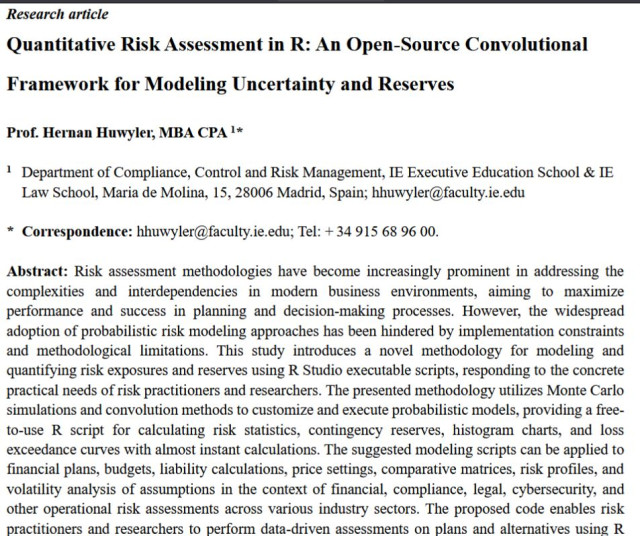
Quantitative Risk Assessment in R: An Open-Source Convolutional Framework for Modeling Uncertainty and Reserves
Senodo
November 24, 2025
Risk assessment methodologies have become increasingly prominent in addressing the complexities and interdependencies in modern business environments, aiming to maximize performance and success in planning and decision-making processes. However, the widespread adoption of probabilistic risk modeling approaches has been hindered by implementation constraints and methodological limitations. This study introduces a novel methodology for modeling and quantifying risk exposures and reserves using R Studio executable scripts, responding to the concrete practical needs of risk practitioners and researchers. The presented methodology utilizes Monte Carlo simulations and convolution methods to customize and execute probabilistic models, providing a freeto-use R script for calculating risk statistics, contingency reserves, histogram charts, and loss exceedance curves with almost instant calculations. The suggested modeling scripts can be applied to financial plans, budgets, liability calculations, price settings, comparative matrices, risk profiles, and volatility analysis of assumptions in the context of financial, compliance, legal, cybersecurity, and other operational risk assessments across various industry sectors. The proposed code enables risk practitioners and researchers to perform data-driven assessments on plans and alternatives using R Studio's open-source platform, providing fast and robust processing capabilities for near-real-time insights. This study bridges the gap between theoretical advancements in probabilistic risk modeling and practical application, offering both a methodological contribution to the field of risk …

See publication

Tags: AI Governance, Business Strategy, Risk Management
1 Keynote
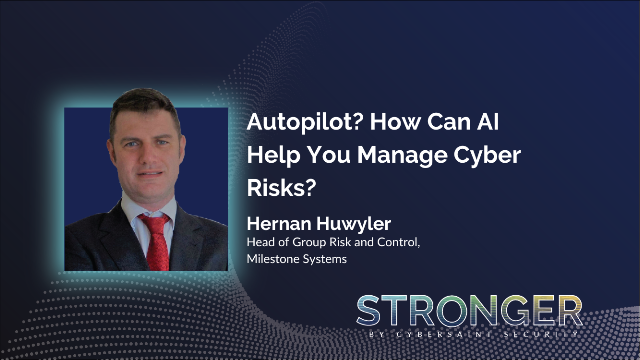
Stronger 2023 -Autopilot AI Risks
Stronger
October 01, 2023
In an era marked by rapid advancements in artificial intelligence, the voices of concern, risks and caution have grown louder. Researchers, industry leaders, and thought leaders have inundated us with warnings about the potential perils of AI. Beneath this collective concern lies a disconcerting truth: the AI risk discourse is far from unified.

Within this maelstrom of AI risk assessments, factions emerge, each with its own distinct priorities and anxieties. Some fixate on the distant, seemingly far-fetched risks reminiscent of science fiction. Others are genuinely alarmed by the tangible problems posed by AI, such as chatbots and deepfake video generators, in our present reality. Some are driven by the allure of business profits, while others are motivated by national security interests.

Autopilot? How Can AI Help You Manage Cyber Risks?
Abstract:
You will gain tools and Python scripts for modeling quantified risks, a list of AI controls, and a program to audit biases in AI models
Session Details:
During this session, Prof. Hernan Huwyler will showcase real-world practical applications of AI in cyber risk management. He will demo how algorithms in Python and AI solutions can act as your trusted co-pilot to simplify the identification, quantification and management of cybersecurity risks. Participants will receive tools and templates to: - Model threats, estimate prevalences, set distributions and maximum and minimal data and downtime losses using Python scripts - Model second-tier impacts from data losses resulting in compliance breaches and profit losses - List of controls to manage software using AI models - Testing program for bias audits to address discrimination and malfunction risks within AI models

See publication

Tags: Risk Management, Security, GRC

6 Media Interviews
RIsk Awareness Week 2021 2022 2023 2024 2025 2026 COmpliance Risk Quantification
Risk Academy
March 19, 2025
Assessing compliance and legal risks with qualitative and biased opinions is just malpractice. Change insurance and control provisions by using an estimator tool to calculate loss expectancy curves on contractual, regulatory, criminal and privacy risks. Learn how to use simple MS Excel formulas to model risks based on common distributions and how to collect and validate risk data on legal assessments.

See publication

Tags: AI, Legal and IP, Risk Management

Interview with Hernan Huwyler by Joe Fields
Onalytica
March 03, 2025
Hernan Huwyler is known for bridging the gap between theory and practice in risk management. His work is highly practical and actionable, making it valuable for professionals in the field. He is a strong advocate for using data and technology to enhance risk management processes, which aligns with the growing trend of digital transformation in the industry. Hernan Huwyler, a risk and compliance expert with 22+ years of experience, focuses on data-driven risk management, compliance programs, and internal audit transformation. He highlights challenges like data quality and tool simplification, predicting a future dominated by AI and automation. Passionate about quantitative risk assessment, he’s open to collaborations through speaking engagements, consulting, and content creation.

See publication

Tags: AI, Risk Management, Security

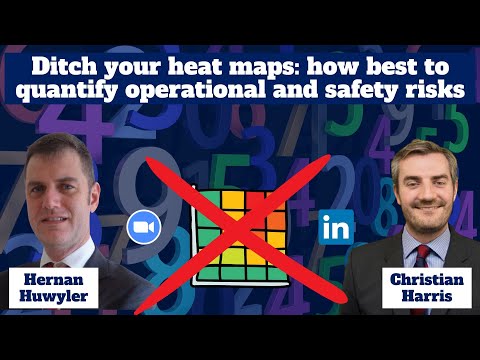
Ditch your heat maps, with Hernan Huwyler
Christian Harris
January 27, 2025
Christian Harris hosts Professor Hernan Huwyler, Head of Risk at Milestone Systems (part of Canon), to discuss risk management and the limitations of qualitative risk management techniques, such as heat maps. This was a recording of a Safety Roundtable (www.safetyroundtable.co.uk) session, attended by 100+ safety and risk professionals.


Highlights:

Hernan highlights the popularity of heat maps due to their simplicity, but also points out their pitfalls and limitations.
What are the benefits of data-driven risk assessment include speaking the language of business, understanding different scenarios, minimizing biases, and adhering to ISO standards.
Hernan discusses the issues with heat maps, such as the inability to aggregate risks, discretional values, and lack of clarity on scenarios being assessed.
He proposes an alternative method, which involves using available data, generating and normalizing data, and creating a model to predict future risks and their costs.
This data-driven approach enables better decision-making and planning, as well as providing a clear picture of causes and consequences.
Hernan emphasizes the importance of being a data-driven professional in the risk management field.
He shares a methodology and an Excel model to try out yourself
We take views from attendees of the Safety Roundtable about the topic of ditching heat maps and quantifying operational and safety risks instead


See publication

Tags: AI, Project Management, Risk Management

Interview with Hernan Huwyler
Kuppinger & Cole
January 20, 2025
How to quantify cyber security risks

See publication

Tags: AI, Risk Management, Security

RIsk Quantification at Risk Awareness Week
Risk Academy
January 13, 2025
o many legal and compliance professionals, risk assessments are bureaucratic paperwork for regulatory reporting and corporate defence.

Clearly, it is not adding any value for deciding the allocation of resources and controls in the ethics and compliance programs. The consequences of siloed and biased assessments can be fatal for the organization, and also, for the careers of the legal advisors and compliance officers. By identifying sources of internal and external data and using these sources for decision-making, better strategies can be developed to prevent litigation and breaches or offering new services.

This presentation will allow improving your techniques to better use data to assess compliance and legal risks for regulatory and contractual requirements. You will learn how to perform smart quantitative analyses for managing penalty risks in a business case based on a concession contract.

See publication

Tags: Analytics, Predictive Analytics, Risk Management
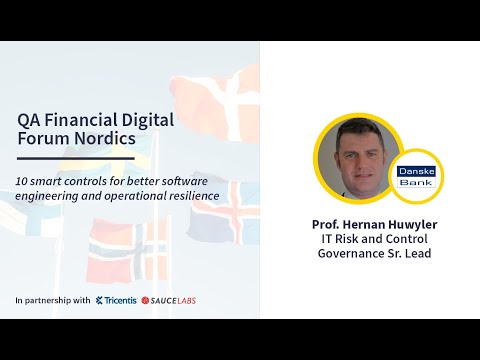
Keynote presentation Hernan Huwyelre: 10 smart controls for better software engineering and operational resilience
QR Financial Nordics
January 12, 2025
Hernan Huwyler delivered a keynote highlighting 10 smart controls to enhance software engineering and operational resilience, emphasizing proactive risk management and robust system design. He shared practical strategies for integrating security, compliance, and efficiency into software development processes. The session underscored the importance of continuous monitoring and adaptive controls to mitigate vulnerabilities and ensure long-term operational stability.

See publication

Tags: Cybersecurity, IT Operations, Risk Management

1 Membership
Copenhagen Compliance Content Lead Instructor
Copenhagen Compliance
March 02, 2025
Researching and promoting practices to protect data and other IT assets based on the ISO 27001 and 27002. Developing audit procedures and programs for certifications and assurance. Researching and promoting practices to protect data and other IT assets based on the ISO 27001 and 27002. Developing audit procedures and programs for certifications and assurance.

See publication

Tags: AI, Cybersecurity, Risk Management

1 Presentation
IE Law Prof Huwyler - AI Performance
IE Law
February 10, 2025
AI system management
depends on continuous
performance
assessment
Conducting algorithm audits is
essential to ensuring that
predictive risk, control, and
compliance models remain fair,
unbiased, and aligned with their
intended objectives

See publication

Tags: AI, Cybersecurity, Risk Management

1 Professor
Academic Director for Compliance, Control, Risk and Corporate Governance Executive Education
IE
October 13, 2023

See publication

Tags: Risk Management, Security, Education
Thinkers360 Credentials

10 Badges

Blog

Opportunities

Events

1 Online Event
Risk Awareness Week 2023

Location: Online    Date : October 08, 2023 - October 14, 2023     Organizer: Risk Academy

RISK AWARENESS WEEK 2023 is shaping up to be another ground-breaking risk management and decision making event. This year our theme is “Take More Risk”

See Event

Contact Prof. Hernan Huwyler, MBA CPA

Book Prof. Hernan Huwyler, MBA CPA for Speaking

Book a Video Meeting

Media Kit

Share Profile

Contact Info

  Profile

Prof. Hernan Huwyler, MBA CPA


Latest Activity

Search
How do I climb the Thinkers360 thought leadership leaderboards?
What enterprise services are offered by Thinkers360?
How can I run a B2B Influencer Marketing campaign on Thinkers360?