
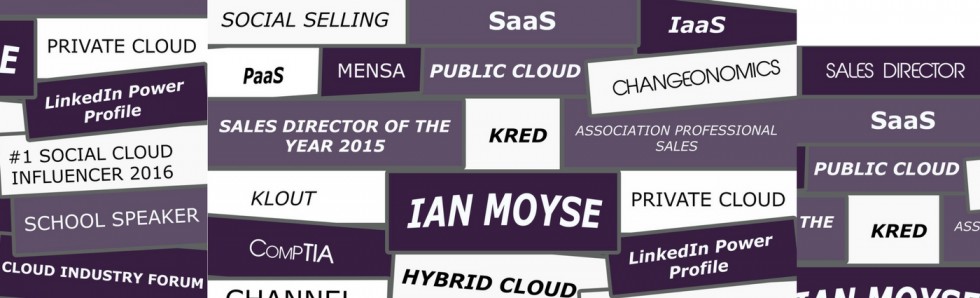

Ian Moyse , Technology Sales Leader, has sat on the Boards of industry bodies such as Eurocloud, FAST, Cloud Industry Forum & TechUK cloud Committee. Also have been a non exec for multiple technology firms and a judge for the UK Cloud Awards, Women in Sales Awards, Top Sales World Awards and BESMA awards. Have been rated #1 social influencer on cloud by Klout and 2 years running #1 cloud influencer by Onalytica. Widely published and has appeared on numerous lists as a top Cloud Blogger. Socially influenced and blogged for Oracle, SAP, Sage, IBM, Mitel, Intel, Qlik, HP, Huawei, Commvault, Equinix and many more.
Available For: Advising, Authoring, Consulting, Influencing, Speaking
Travels From: Reading, UK
Speaking Topics: Cloud, Social Selling, Sales, Personal Branding
| Ian Moyse | Points |
|---|---|
| Academic | 0 |
| Author | 33 |
| Influencer | 755 |
| Speaker | 0 |
| Entrepreneur | 10 |
| Total | 798 |
Points based upon Thinkers360 patented algorithm.

 “When the Storm Hits - Why A Cloud Rewind is Your Digital Lifeboat"
Tags: Cloud, Digital Transformation, Emerging Technology
 Where do you want to take your small business in 2025 ?
Tags: Cloud, Digital Transformation, Emerging Technology
 Who is Promising 100x Faster Data Insights?
Tags: Cloud, Digital Transformation, Emerging Technology
 Removing Technology Roadblocks For The Decade Ahead
Tags: Cloud, Digital Transformation, Emerging Technology
 Cloud Migration for Small Business: What, Why and How
Tags: Cloud, Business Strategy
 Cloud’s Gift to Small Businesses
Tags: Cloud
 Four Ways Cloud-based Solutions Benefit Small Businesses
Tags: Cloud, Business Strategy
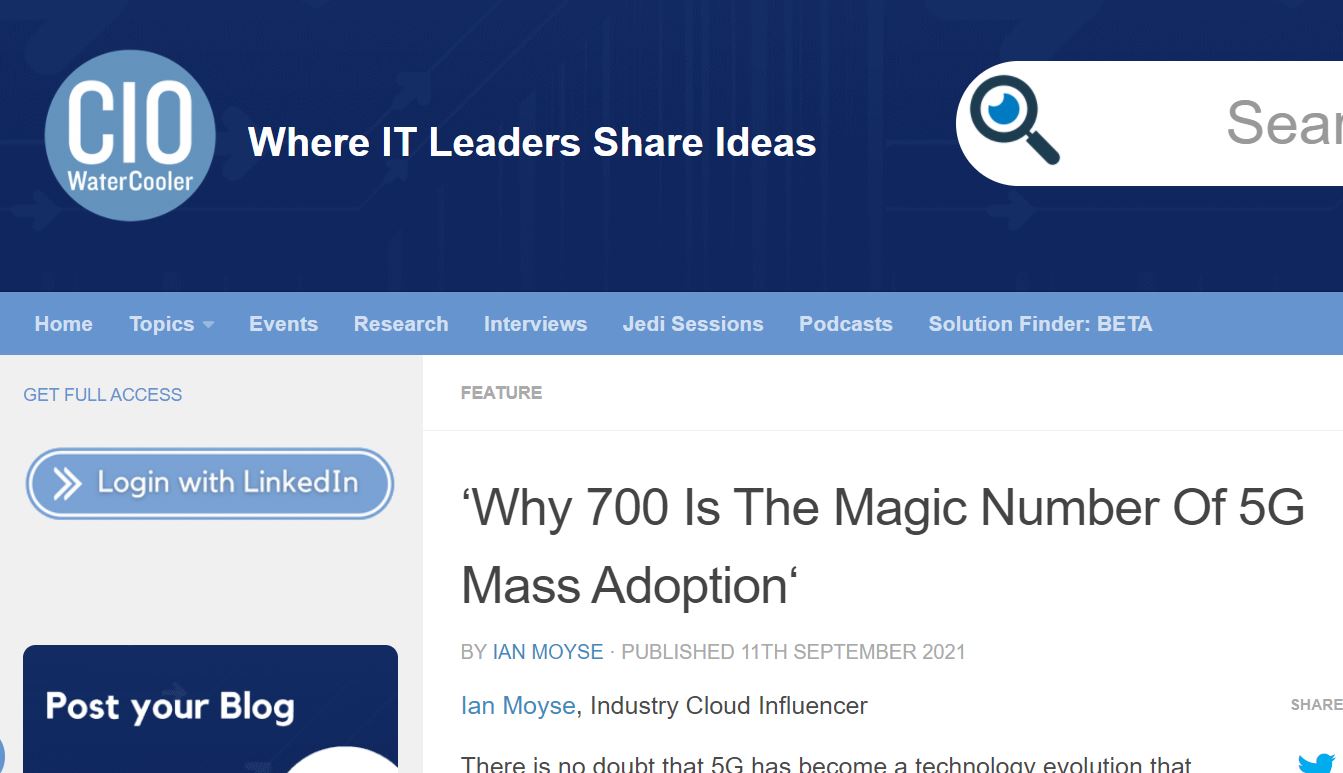 ‘Why 700 Is The Magic Number Of 5G Mass Adoption‘
Tags: 5G, Digital Transformation, Emerging Technology
 SaaS is the way – and the way is SaaS: Exploring new market moves
Tags: Cloud, Digital Transformation, Emerging Technology
Tags: Cloud, Customer Experience, Digital Transformation
Tags: Cloud, Digital Transformation, Emerging Technology
 Cloud Challenges SkillsSkills Gulf Is Cloud’s Biggest Peril
Tags: Cloud, Digital Transformation, Emerging Technology
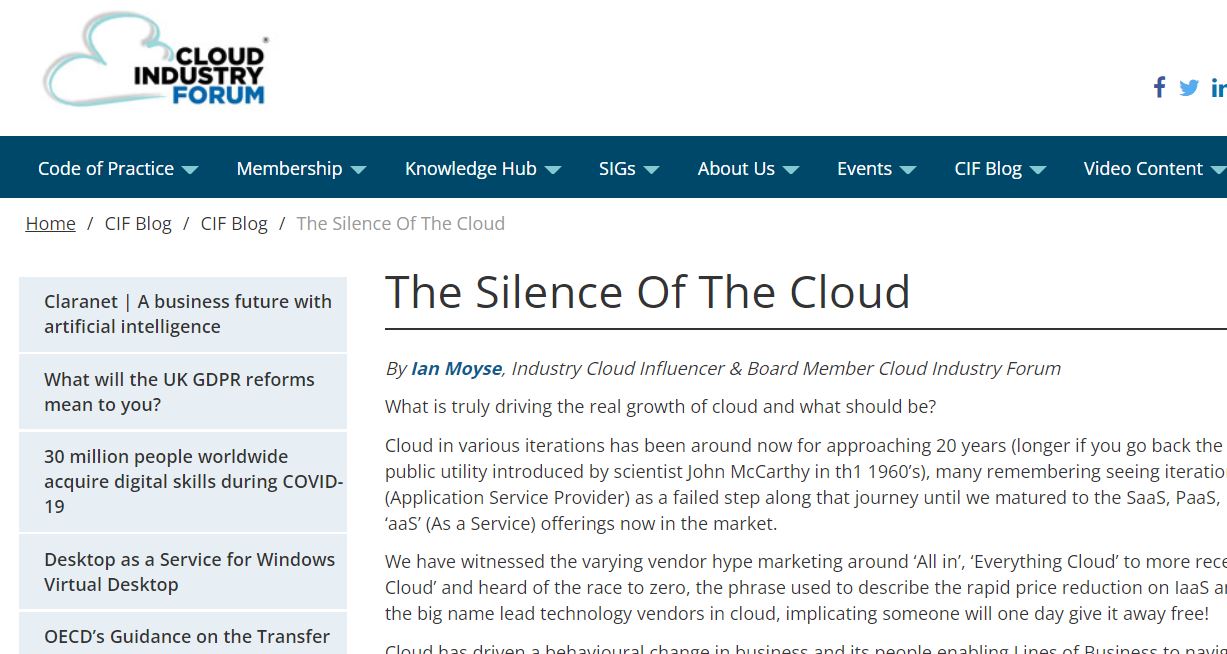 https://www.cloudindustryforum.org/content/silence-cloud
Tags: Cloud, Digital Transformation, Emerging Technology
 Q&A on Cloud Ubiquity with Ian Moyse
Tags: Cloud, Digital Transformation, Emerging Technology
Tags: Cloud, Digital Disruption, Digital Transformation
 Q&A on Cloud Ubiquity with Ian Moyse
Tags: Cloud, Digital Disruption, Digital Transformation
 The past, present and future of cloud from an industry veteran
Tags: Cloud, Digital Transformation, Emerging Technology
 Blogs for Oracle DYN
Tags: Cloud, Digital Transformation, Social
 5 Reasons for a Multi-Cloud Infrastructure
Tags: Cloud
 Influencer: Skills Gulf Is Cloud’s Biggest Peril
Tags: Cloud, Big Data, IoT
 Sales Director
Tags: Cloud, Digital Transformation, Emerging Technology
 Interview with Social Influencer Ian Moyse
Tags: Cloud, Marketing, Social
 Cloud Insight Jam - Ian Moyse talking Cloud
Tags: Cloud, Digital Transformation, Emerging Technology

Tags: Cloud, Digital Transformation, Emerging Technology
 What role does cloud play in digital transfomation ?
Tags: Cloud, Digital Transformation, Emerging Technology

Tags: Cloud, Digital Transformation
 Is AI really that Cloudy?
We live in a time where rapid technological advancements are all around us from cloud computing, smart devices (phones, TV’s), Internet of Things (IOT), through to the seemingly rapid high profile that artificial intelligence (AI) has gained in being reported as a transformative force with the potential to reshape industries, change jobs and affect our everyday lives. With this has come big news coverage; concerns of data privacy, job removals and machines able to replace humans – look at the current Hollywood Actors strike (as this is written) for how far reaching these concerns go.
We have seen fear at the face of the introduction of new technologies throughout the ages, from the Motor car through to Cloud Computing. AI perhaps is more frightening to many as it is more complex, has the ability to have more far-reaching impact and has been played out as the evil baddie in so many movies. AI, as cloud computing has already done so quickly, will become commonplace and taken for granted in our everyday lives, mostly hidden away behind the web and applications, obscured from users realising they are interacting or benefitting from AI at all.
As shown in the plethora of stats available, AI is already being adopted fast in a rush to leverage the competitive and commercial advantages it promises to businesses.
Cloud computing has itself played a pivotal role in enabling the growth of AI and democratized access, enabling businesses of all sizes to leverage AI capabilities without significant upfront investment in infrastructure. Much as we saw early cloud adopters gaining competitive advantage, followed by cloud-first strategies driving growth and innovation in businesses, we are now at a stage where AI first companies utilising AI as a core component of their business strategy are gaining unfair competitive advantage and changing the delivery of core business processes and customer interactions.
AI led strategies are driving business advantage across many disciplines and reimagining processes and experiences in a way previously not possible. For example, faster product and services innovation, where AI is being utilised to enhance user experience and create unique features. A distinct positive impact is being seen in customer support and service with AI powering Chatbots and virtual assistants that can serve 24*7 and reduce support costs whilst improving customer satisfaction and scores. Repetitive tasks and processes are being automated to reduce errors, improve efficiency, and bring reduction to labour costs.
From my experience AI has been a mixed bag until recently and whilst I am seeing a great breadth of successful tools and use cases, I have seen solutions bannered under the hype of ‘AI’ and ’ML’ machine learning that promise a lot, but under the covers the results are not as perfect as the hyped marketing alludes. So, as I professed with Cloud Computing in its earlier days, all are not borne equal, and it remains important to look past the technology hype to the application and true results that any product or solution will bring to your business and customers. A great way to do this is to partner with someone who has a broader experience in AI and its application, able to map your needs and outcomes against the realities of what is available today. Look as I did for example at Infosys and how they ease AI adoption alongside existing technology stacks. Infosys Applied AI is an integrative flexible offering that allows businesses to access, deploy, and contextualize cloud services and harnesses the power of convergence across cloud, AI, and analytics to enable new business solutions, manage risk and efficiently scale any AI investment enterprise wide.
I asked Balakrishna (Bali) D.R., Executive VP, Head of AI and Automation Services, Infosys for his insight into the current state of AI adoption “In the last few decades, each wave of technological revolution, be it the internet revolution or the mobile and cloud revolution has acted like a filter that has screened out enterprises which have been unable to adapt to the shifting landscape. The AI revolution riding on the previous cloud era, is going to transform those who amalgamate the power of both into “AI first” enterprises. Accelerated by the power of the cloud, the early adopters will rapidly democratize different types of AI assets across the value chain to various stakeholders via the creation of an applied AI cloud. This will also provide a shared platform for rapid experimentation, like an AI store with a catalogue of latest pre-trained models, golden data sets, responsible AI pipelines promoting re-usability, and helping scale AI projects faster.”
In today’s economy whilst revenue and growth are critical, other factors are also high on the agenda for many corporations, with Environmental, Social, and Governance (ESG) matters becoming crucial yardsticks for measuring a company's impact on the world beyond just financial performance. AI can benefit ESG in a variety of ways. AI can assist in reducing the biases in hiring processes and ensuring diversity and inclusion. Through analysing job descriptions and submitted CV’s (Resumes), AI algorithms can highlight any potential bias and recommend changes to ensure fairness. AI can also support companies in building diverse teams by identifying candidates from a wider range of social, economic and career backgrounds.
In governance realms, AI can play a crucial role in compliance monitoring. It’s innate advanced ability to analyse massive datasets quickly and to detect anomalies or patterns that may indicate fraudulent activities, can help companies uphold ethical standards and prevent financial misconduct and fraud.
One of the most impactful applications of AI within the environmental arena is likely to be resource management. Algorithms powered by AI can analyse vast amounts of data to optimise resource consumption and reduce waste. For example, AI can predict energy use patterns and adjust operations, accordingly, minimizing carbon emissions. AI Smart grids help balance energy supply and demand, improving energy efficiency, apt in our times of increased energy usage and costs.
As our world continues to grapple with complex challenges such as climate change, social inequality, and ethical governance, the integration of Artificial Intelligence (AI) into such ESG strategies provides a powerful force for driving positive change. This is just one of a plethora of valuable use cases and areas where AI will impact business effectiveness and market advantage. Large gains are already being made across Healthcare, Retail, Finance, Manufacturing, Energy, Education, Agriculture and Transport and logistics.
Decisions of whether to embrace AI or avoid, whether partially or completely, are complex and depend on a variety of factors for each individual and business as they make their considerations. The potential of AI is undeniable, offering unparalleled efficiency, innovation, and insights. In my opinion the adoption of AI is not a matter of if, but when, where and how. The transformative power of AI across industries, combined with its potential to make us smarter and enhance our business and private lives, ensures it will be integrated into every facet of our lives, often as we are already witnessing in ways that are seamless and invisible to the human interacting with it.
For many if not most adopting AI they will already be a progression of their already established cloud and digital transformation journeys and they will already have in place the important foundations of infrastructure, capabilities and digital acceptance required to embrace and infuse AI into their+ business processes effectively.
Embracing AI is not a simple switch it on or one size fits all project. It requires a programmatic approach of discovery, business process alignment and deployment that supports both scale and future proofing. This to achieve a secure and predictable outcome from what can be a complex area of technology. Working with an experienced business partner in AI and cloud here makes immense sense as there are many steps in the transformation journey to get right ; from understanding what AI is and what is it not, aligning its use cases to your own business issues, ensuring a strong data driven program and culture (importantly supported by leadership), selecting the AI tools, ensuring the right skills are available and that security is not compromised from the outset.
Here again is where I was interested to see the value that Infosys is bringing to the market through innovations such as Infosys Topaz, launched earlier this year. An AI first set of data services with over 12,000+ AI use cases, 150+ pre-trained AI models and 10+ AI platforms delivering industry ready to use solutions enabling AI to be bought to more business functions faster and importantly more
Like Cloud Computing not so long ago, AI has its nay sayers and sceptics and there are unknowns and complexities that must be addressed as any business approaches its own AI path. However as with Cloud and other new technologies there is immense advantage to be gained by taking an ‘Explore and Embrace’ strategy early and there are enablers like Infosys at hand with expertise and tools to de-risk and appropriate the right AI strategy for your business. AI is already in use in a volume of proven use cases where it is driving greater revenues, customer satisfaction and efficiencies. Understanding where this fits for your organisation in comparison is a now, not tomorrow agenda action. AI is going to become an embedded part of our daily lives both in business and as a consumer; It is time to understand and realise it is going to be Human + AI and not Human vs AI and now is the time to lead your organisation and customers into its next transformative phase.
Tags: AI, AI Infrastructure, Cloud
 Sales DirectorIs AI really that Cloudy?
