
Nov04
Organisations have become increasingly sophisticated at identifying, measuring and reporting risk. But sophistication does not necessarily translate into an ability to anticipate change, adapt under pressure or sustain performance.
The challenge facing business leaders is no longer simply how to manage risks or recover from disruption. It is how to build organisations capable of navigating uncertainty without losing their strategic direction.
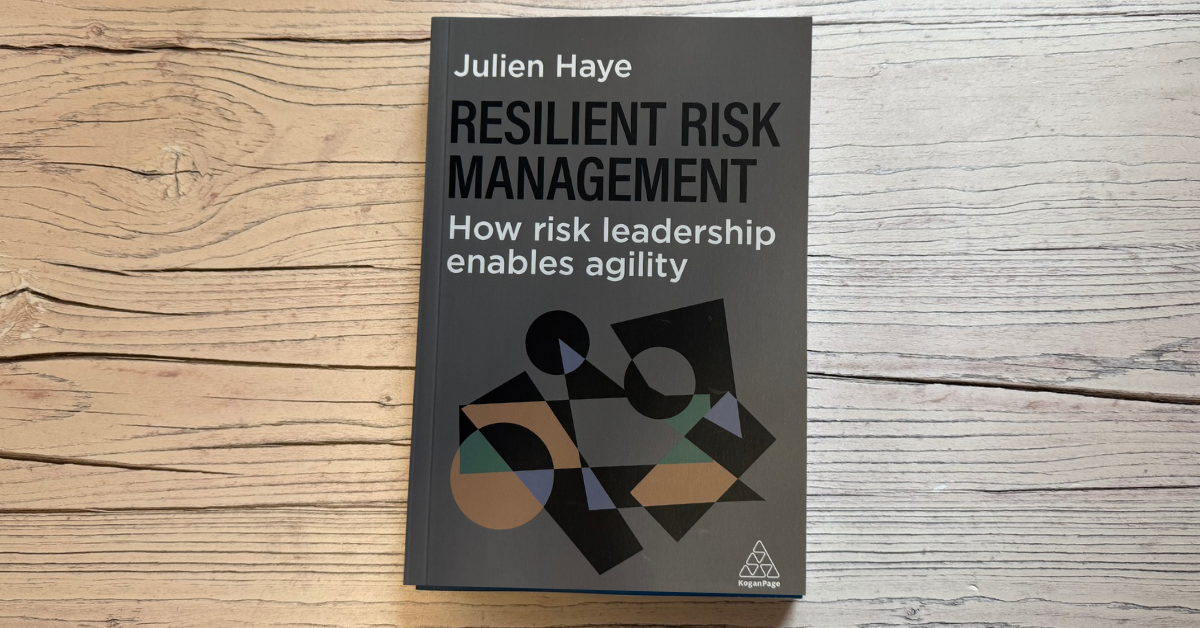
This is the central argument explored by risk and resilience expert Julien Haye in his new book, Resilient Risk Management: Strategies for Organizational Agility and Adaptability, published today by Kogan Page.
Drawing on more than 26 years of experience in financial services and risk leadership, Haye examines why resilience must move beyond traditional risk management and crisis preparedness to become an enterprise-wide capability embedded in strategy, governance, culture and decision-making.
“Organisations do not become resilient simply by managing more risks. They become resilient when they can recognise change, make difficult decisions and adapt without losing sight of what they are trying to achieve,” says Haye.
As geopolitical uncertainty, technological transformation and interconnected risks reshape the business environment, organisations face growing pressure to anticipate disruption while continuing to deliver their strategic objectives.
Yet resilience is often approached through separate disciplines, frameworks and organisational structures. Risk management, business strategy, governance, crisis preparedness and culture may each receive significant attention without necessarily functioning as a coherent whole.
Resilient Risk Management explores how these capabilities can be brought together, enabling organisations to strengthen strategic foresight, align risk appetite with decision-making, develop organisational agility and build the leadership behaviours needed to navigate uncertainty.
A central argument is that resilience cannot be delivered through frameworks and controls alone. It also depends on how leaders exercise judgement, how accountability is established, how effectively concerns are escalated and whether organisations can challenge assumptions before vulnerabilities become crises.
“Too often, organisations invest in the visible architecture of risk management while overlooking the human and cultural conditions that determine whether it works. A framework cannot compensate for a culture where people are afraid to challenge, where accountability is unclear or where warning signals fail to reach decision-makers,” Haye explains.
The new book builds on themes explored in Haye's earlier work, The Risk Within, which examined the human and organisational dimensions of risk management.
Where that work explored the behaviours, assumptions and organisational conditions that can undermine risk management effectiveness, Resilient Risk Management broadens the discussion to the strategic capabilities organisations need to anticipate change, adapt and sustain performance.
Structured across 17 chapters, the book combines strategic models, practical frameworks, global organisational examples and insights from experienced Chief Risk Officers.
It examines how leaders can:
Drawing on examples involving Microsoft, Toyota, HSBC, Sony and Marks & Spencer, the book explores how organisations confront uncertainty, address vulnerabilities and adapt to changing circumstances. It also examines the implications of emerging technologies, including artificial intelligence, for future organisational resilience.
For boards, Chief Risk Officers and senior executives, the book raises a fundamental question: Are organisations developing the capabilities to navigate uncertainty, or simply becoming more sophisticated at managing the risks they already understand?
Resilience is not measured solely by the quality of an organisation's frameworks, the completeness of its risk assessments or its ability to recover from individual disruptions.
It also depends on whether strategy, governance, leadership and culture work together to support timely decisions, effective adaptation and long-term value creation.
Resilient Risk Management provides a practical guide for leaders seeking to make that transition, positioning resilience not as an additional layer of risk management, but as an enduring organisational capability.
Title: Resilient Risk Management: Strategies for Organizational Agility and Adaptability
Author: Julien Haye
Publisher: Kogan Page
Publication date: 3 November 2026
Formats: Paperback, hardback and ebook
Publisher: https://www.koganpage.com
Julien Haye is Managing Director of Aevitium, a risk management advisory and training firm, and an experienced risk leader with more than 26 years in financial services.
Recognised among Thinkers360's Top Voices in EMEA in 2026 and as a Top Voice in 2026, he is also the author of The Risk Within and host of the RiskMasters podcast.
Through his advisory work, writing and thought leadership, Haye focuses on connecting risk management, strategy, leadership, governance and organisational culture to strengthen organisational resilience and decision-making under uncertainty.
Email: julienhacontact@gmail.com
Julien Haye is available for interviews and expert commentary on enterprise resilience, strategic risk leadership, organisational agility, governance and the future of risk management.