Oct20
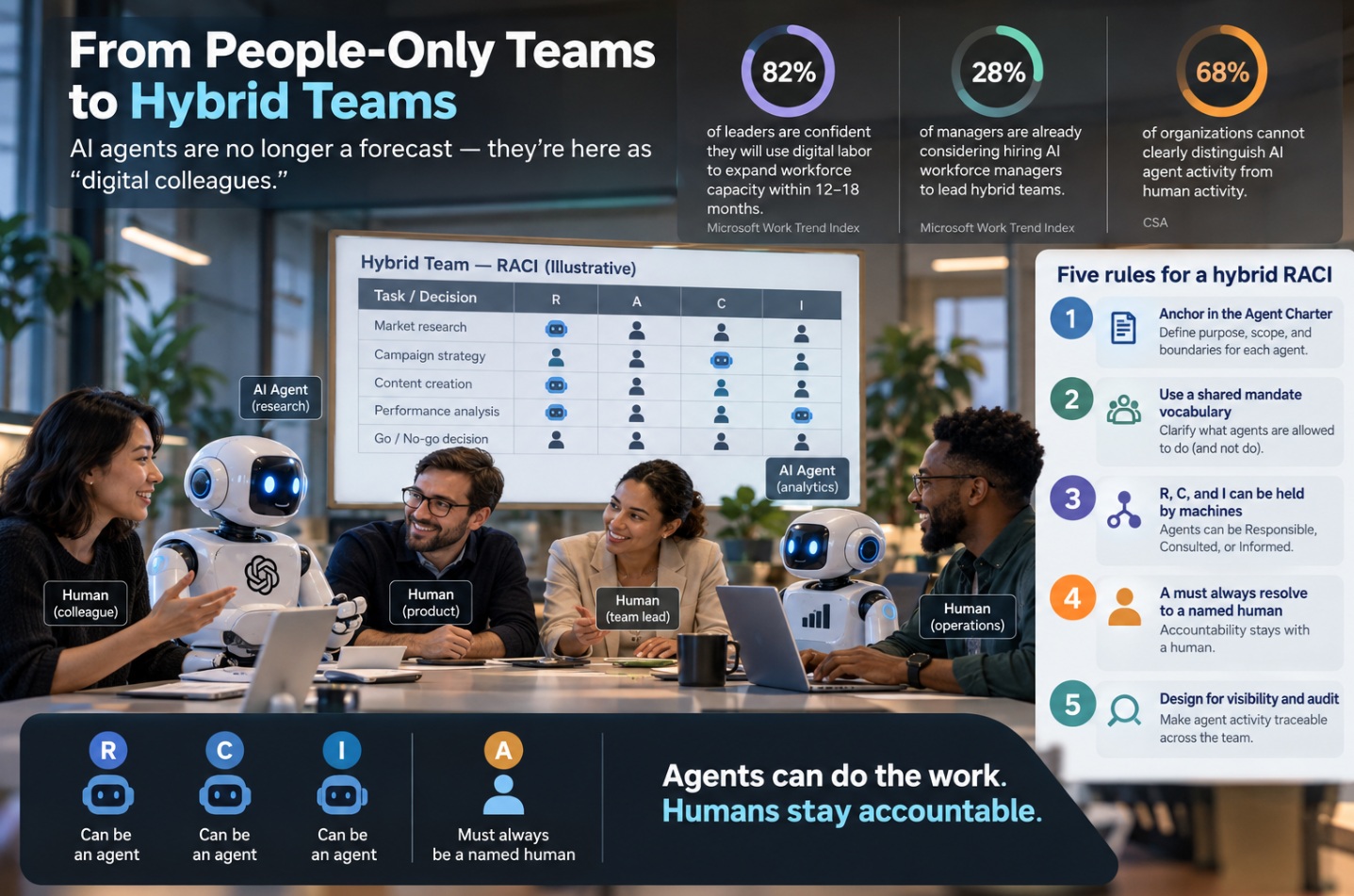
Somewhere in your organization, a project team already has members that never attended the kickoff. Microsoft's Work Trend Index now describes agents joining teams as "digital colleagues" — in its words, "not just tools" but "teammates, capable of initiating action, managing projects, and adapting in real time." In the same research, 82% of leaders say they are confident they will use digital labor to expand workforce capacity within 12 to 18 months, and 28% of managers are already considering hiring AI workforce managers to lead hybrid teams of people and agents.
Meanwhile, the instrument we use to make team accountability legible has not moved. The RACI chart — Responsible, Accountable, Consulted, Informed — still assumes that every letter lands on a person. And the cost of that assumption is now measurable: in a Cloud Security Alliance study of 228 IT and security professionals, 68% of organizations said they cannot clearly distinguish AI agent activity from human activity — even as 85% report agents running in production.
In the first article of this series, I argued that deploying an agent is an act of delegated authority, governed best by the PMO through an Agent Charter. In the second, I showed how to write the Charter's hardest component, the mandate. This article takes the next step: once a chartered agent sits inside a delivery team, how does the team's accountability model have to change? My answer: three of RACI's four letters can be held by a machine. The fourth never can — and keeping it human takes more design than it sounds.
RACI works because of assumptions so obvious nobody wrote them down. Agents break every one.
It assumes the Responsible party can explain itself. The accountability conversation — "walk me through why you did this" — is RACI's enforcement mechanism. An agent can produce logs, but logs are not reasons; this is why I argued in Article 1 that the audit standard for agents must be reconstructability, not testimony.
It assumes responsibility is scarce. A human R does one thing at a time, so RACI rations work. An agent R replicates instantly. When the R column scales without limit, the constraint moves to the humans in the A, C, and I columns — and most teams never redesign for that.
It assumes consultation costs something. Good RACI discipline minimizes C and I because human attention is expensive. Agents invert this: consulting is now free, so hybrid teams drown in machine-generated updates. An I column that once protected attention now floods it — and automation bias, the quiet rubber-stamping I warned about in Article 1, is what unbounded I looks like in practice.
It assumes overstepping is visible. A human who exceeds their role gets noticed in the standup. An agent that exceeds its role is, for 68% of organizations, indistinguishable from a colleague doing their job. Social visibility was RACI's silent control, and it is gone.
The fix is not a new acronym. It is the old one, re-engineered against the broken assumptions.
Rule 1: A always resolves to one named human. Never an agent, never "the team," never a committee. In practice this is the Agent Charter's sponsor: the person who signed the mandate answers for everything inside it. The moment a RACI cell proposes a machine as Accountable, the team has stopped assigning accountability and started diffusing it. You can automate responsibility; you cannot automate accountability.
Rule 2: An agent may hold R only where a mandate exists. A hybrid RACI cell is not a name — it is a reference. "R: triage-agent, per mandate M-07" is a governed assignment; "R: the AI" is mandate by omission, the failure pattern I described in [link to Article 2]. If the mandate cannot be cited, the R belongs to a human until it can.
Rule 3: When the agent takes R, the human A changes jobs. With a human R, the Accountable role mostly reviews outcomes. With an agent R, there is no one to coach and no one to blame — so the A's work becomes administering the mandate: setting materiality ceilings, responding to escalations, and asking "why did we authorize this?" instead of "why did you do this?" Microsoft calls this emerging role the "agent boss"; 36% of leaders already expect to manage agents within five years. I would put it more precisely: the agent boss is an administrator of delegated authority, and that is a project management job.
Rule 4: Treat C and I as budgets, not courtesies. Because agent-generated consultation is free, the design question flips from "who must we inform?" to "what may claim a human's attention?" Tie the I column to the Charter's monitoring component: define which signals humans must see, route the consequential ones to the A at a rate that preserves genuine attention, and let the rest flow to logs. An I column designed for scarcity will otherwise manufacture the very rubber-stamping it was meant to prevent.
Rule 5: Add a named escalation receiver to every agent row. When a human R hits trouble, they walk to someone's desk. An agent needs that path designed in advance: for every row where an agent holds R, name the human who receives its escalations and the expected response time. This is the Charter's escalation component expressed at team level — and in my experience it is the single most revealing exercise, because teams often discover the answer is "nobody in particular."
The standup stops being a status meeting — agents compile status better than people do — and becomes a judgment meeting: materiality calls made, escalations handled, boundaries tested. The retrospective gains a standing question: did the mandates hold? Every near-overstep is a finding, feeding the renewal gate rather than an incident report. Performance conversations change for humans, not machines: on a hybrid team, people are evaluated less on throughput — agents absorb that — and more on the quality of their mandate administration: the ceilings they set, the escalations they caught, the ambiguity they refused to delegate.
None of this diminishes the human role. It concentrates it. The CSA data shows 74% of organizations admit agents often receive more access than necessary; teams that practice these rules are precisely the ones that will notice.
I ended Article 1 with the observation that the fundamental unit of organizational design is becoming the mandate — a bounded grant of decision authority that may be held by a person, a team, or a machine. RACI is where that abstraction meets a Tuesday afternoon. Three letters can move to machines, and increasingly they will. The fourth letter is the line: accountability is a human property, because it is backed by things a machine cannot stake — judgment owned in public, consequences accepted in person.
So here is the exercise for your next team meeting. Print your current RACI. Highlight every cell where software already acts — not assists, acts. For each highlighted cell, ask two questions: where is the mandate, and which human's name does the A resolve to? Every cell that fails both tests is not a gap in a chart. It is an incident report waiting for its date.
Keywords: Agentic AI, Future of Work, Project Management
The Hybrid Team: Rethinking RACI When Some of Your Team Members Are Machines Two Clocks, One Truck: The Army's Need for Speed Meets New Defense Sourcing Rules
 Sustainable Transformation: The Elephant and The Mouse In The Room
 The Price of Standing Alone: Strategic Autonomy in a World Where Nobody Can Do It Alone
 The Potter’s Hands: Why Great Leaders Shape Environments, Not People